6 Minute English
Intermediate level
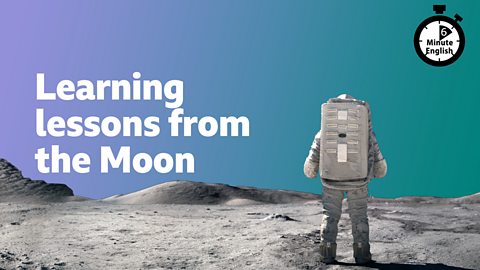
Learning lessons from the Moon
Episode 231221 / 21 Dec 2023

Introduction
Summer 2023 saw two missions to the Moon. Why are scientists so keen to get there? Find out with Georgie and Neil.
This week's question
Who was the third astronaut on the Apollo 11 mission, after Neil Armstrong and Buzz Aldrin?
a) Yuri Gargarin
b) Michael Collins? or,
c) Alan Shepard?
Listen to the programme to hear the answer.
Vocabulary
inert
not moving; unable to move
crater
very large hole in the ground, which has been caused by something hitting it or by an explosion; the round hole at the top of a volcano
pockmarked
marked by small holes and scars
a big deal
important or significant
trace (something back)
discover the causes of something by investigating how it developed
a smoking gun
indisputable incriminating evidence; conclusive proof of something
TRANSCRIPT
Note: This is not a word-for-word transcript.
Neil
Hello. This is 6 Minute English from BBC Learning English. I’m Neil.
Georgie
And I’m Georgie. “That's one small step for man, one giant leap for mankind” – famous words, but do you know who said them?
Neil
Of course - that was Neil Armstrong, the first person to land on the Moon.
Georgie
Right, the Apollo 11 spacecraft landed Neil Armstrong on the Moon on the 20th of July 1969. But in decades after that famous event, interest in returning to the Moon faded away... until now.
Neil
Summer 2023 saw the start of a new race for the Moon between Russia’s Luna-25 spacecraft and India’s Chandrayaan-3. Russia’s rocket crashed on landing, but Chandrayaan-3 successfully touched down on the 23rd of August, making India only the fourth country to successfully land on the Moon.
Georgie
But why this sudden interest in going back to the Moon? That’s what we’ll be discussing in this programme and, as usual, we'll be learning some useful new vocabulary too.
Neil
But before we blast off, I have a question for you, Georgie. Everyone knows that Neil Armstrong was the first man on the Moon, and was followed by a second astronaut, Buzz Aldrin. But who was the third Apollo astronaut who flew the command module while his crewmates walked on the Moon? Was it:
a) Yuri Gagarin?
b) Michael Collins? or,
c) Alan Shepard?
Georgie
Hmm, I think it was Michael Collins.
Neil
Okay, Georgie, we’ll find out the answer at the end of the programme. In some ways, the current interest in the Moon is really more about the origins of Earth. One theory is that during the early days of the solar system, around 4 billion years ago, another planet crashed into Earth breaking off a part which then formed the Moon. Unlike the Earth’s surface, which is constantly moving, the Moon is completely still, frozen in time to create a perfectly preserved record of what happened at the birth of the solar system. Here’s astronomer, Dr Becky Smethurst, explaining more to BBC Radio 4 programme, Inside Science:
Dr Becky Smethurst
…Whereas on the Moon, it’s just this inert rock, there's no atmosphere so every single thing that's happened to the Moon in its four-and-a-half billion years’ worth history is still recorded there on it. And so, if anyone's ever seen an image of the far side of the Moon, the side of the Moon that we cannot see from Earth is incredibly pockmarked. There are craters all over that thing, and so this is a really big deal when we're thinking about what happened to the early Earth as well, because we think all of the Earth's water came from impacts with comets and asteroids in the very early days of the solar system.
Georgie
The rock which makes up the Moon is inert – it doesn’t move. It’s also full of craters - large holes in the ground caused by something hitting it. The Moon has so many of these craters, it’s described as pockmarked – having a surface that’s covered in small marks and scars.
Neil
These craters play an important part in the story. Because the Moon’s surface does not change, finding water there would explain a lot about how water, and therefore life, started on Earth. That’s why Dr Smethurst calls the Moon mission a big deal, meaning important or significant.
Georgie
That’s right. Astronomers know that comets are full of ice, and think comets brought water to Earth when they crashed into it. Evidence of those crashes has been erased by the constantly moving surfaces on Earth, but not on the Moon. So, comparing water from the Moon with water on Earth could provide scientists with vital information, as Dr Smethurst explained to BBC Radio 4’s, Inside Science:
Dr Becky Smethurst
So they'll be looking essentially to see if it has the same characteristics as water here on Earth, and then we can sort of trace that back from sort of the crater history as well to working out what actually happened. How long has it been there for as well. Also, various other minerals that might be there, these very heavy minerals that we know come from comets and asteroids. Again, that would be this sort of smoking gun to be like, yes this that's where this water came from and it's likely that Earth’s water came from there as well.
Neil
Scientists can trace the existence of water on the Moon back to find out what happened on Earth. If you trace something back, you discover the causes of something by investigating how it developed.
Georgie
For this reason, Dr Smethurst says finding water on the Moon would be finding a smoking gun, a modern idiom meaning indisputable evidence or proof. We’ve learned a lot about the Moon, but we still don’t know the answer to your question, Neil - who was the third Apollo astronaut on that famous first landing in 1969? I said it was Michael Collins…
Neil
Which was… the correct answer! Michael Collins never set foot on the Moon himself, but afterwards said the experience of looking back at Earth from the Apollo spacecraft changed his life forever. OK, let’s recap the vocabulary we’ve learned from our trip to the Moon, starting with inert, not moving or unable to move.
Georgie
A crater is a very large hole in the ground.
Neil
Pockmarked means marked by small holes and scars.
Georgie
If you say something is a big deal,it’s important or significant in some way.
Neil
To trace something back means to discover its causes by examining how it developed.
Georgie
And finally, the idiom a smoking gun refers to indisputable evidence or conclusive proof of something. Once again, our six minutes are up. Join us next time for more scintillating science and useful vocabulary here at 6 Minute English. Goodbye for now!
Neil
Goodbye!
Latest 6 Minute English

Sexism: Female farmers fighting back
Episode 231228 / 28 Dec 2023
How can female farmers beat rural sexism?

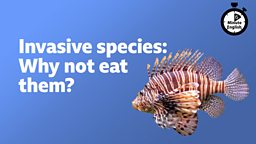
Invasive species: Why don't we eat them?
Episode 231207 / 07 Dec 2023
Could we eat invasive species?

What and where is Little Italy?
Episode 231130 / 30 Nov 2023
Mozzarella, ricotta, cannolis and focaccia... Where are we? Little Italy of course!

Social media and teenage health
Episode 231123 / 23 Nov 2023
What are the health risks of social media for teenagers?





Sounds that make you want to scream
Episode 230928 / 28 Sep 2023
Are there any sounds you find upsetting?




The stories behind our names
Episode 230831 / 31 Aug 2023
What do our names reveal about our culture and family history?


Are you unhappy at work?
Episode 230817 / 17 Aug 2023
Does work leave you feeling bored and exhausted?




Is it wrong to eat plants?
Episode 230629 / 29 Jun 2023
Should we treat plants with the same consideration we treat animals with?


The art of subtitling
Episode 230608 / 08 Jun 2023
Hear how subtitles can help bring TV and movies to life
Ecotourism: good or bad?
Episode 230601 / 01 Jun 2023
We discuss the growing popularity of ecotourism.
Can climate change cause more disease?
Episode 230525 / 25 May 2023
With warming temperatures, mosquitos are now spreading to new areas, including Europe.

Ice and the origins of life on Earth
Episode 230504 / 04 May 2023
We talk about an essential element for life to thrive.

Women in politics
Episode 230427 / 12 Apr 2023
We discuss some of the reasons why women make up only 26% of the world's politicians.
What's the point of museums?
Episode 230420 / 20 Apr 2023
We discuss the role of museums in the 21st century and the items taken from different countries.

How culture affects sadness
Episode 230413 / 11 Apr 2023
What ways do you think culture can influence sadness?

Would you eat a Kalette?
Episode 230406 / 06 Apr 2023
Hear about a new kind of vegetable making an entrance in British kitchens

Do you get jealous easily?
Episode 230330 / 06 Mar 2023
Let's talk about the ugly green-eyed monster


Food and mood
Episode 230316 / 16 Mar 2023
We look at the link between what you eat and how you feel.
How to talk to a climate denier
Episode 230309 / 09 Mar 2023
The dos and don'ts of trying to discuss science with someone who doesn't believe in it
Losing your mother tongue
Episode 230302 / 02 Mar 2023
Hear the story of a woman who replaced her native Czech for English.

The health benefits of apples
Episode 230223 / 23 Feb 2023
Could 'an apple a day keep the doctor away'?

Doomscrolling: Why do we do it?
Episode 230209 / 27 Jan 2023
What is doomscrolling and why are we attracted to bad news? Listen to find out!

Exercise for the lazy
Episode 230202 / 22 Jan 2023
What's the least amount of exercise you should do to stay healthy?

Can AI have a mind of its own?
Episode 230126 / 26 Jan 2023
Hear about the software engineer who became 'friends' with his computer

Climate change: Are there too many people?
Episode 230119 / 13 Jan 2023
Does the size of your carbon footprint depend on where in the world you were born? Listen to find out!

The hidden life of buffets
Episode 230112 / 12 Jan 2023
Neil and Sam discuss buffet meals and the history behind them.

Songwriting
Episode 230105 / 05 Jan 2023
Writing a memorable song isn't easy. So is there an art to good songwriting?