'Why I was always driving home for Christmas'

- Published
For me, Christmas as a manager usually meant one thing - I'd be on a motorway, somewhere!
During my 30 years in management, we always kept our family home on the south coast. If I wanted to get back to see my kids open any of their presents, then travelling back after training on Christmas Eve - or even Christmas Day itself - was not unusual for me.
Wherever I laid my hat, from Middlesbrough to Plymouth, or Bristol to Stoke, one thing I never missed out on was Christmas dinner with my family.
Sometimes, I would leave after training on Christmas Day to get home in time, then drive back later to be at the hotel the team was staying at, or wherever my lodgings were.
Even if I gave my players Christmas Day off, I would still travel back on Christmas night.
I had to - because for all the time I spent travelling, going up and down the motorway, and even when I was tucking into my turkey dinner, the game on Boxing Day was never far from my mind.
It was the same whether I was up against Manchester United - who we narrowly lost to in my first Premier League Boxing Day game with Stoke in 2008 - or facing a long trip to Bradford or Barnsley when I worked further down the league ladder.
My best Boxing Day results were probably both with Stoke, winning 2-0 at Blackburn in 2010 - the club's first Premier League Boxing Day win - or coming from behind to beat Liverpool 3-1 at the Britannia Stadium in 2012.
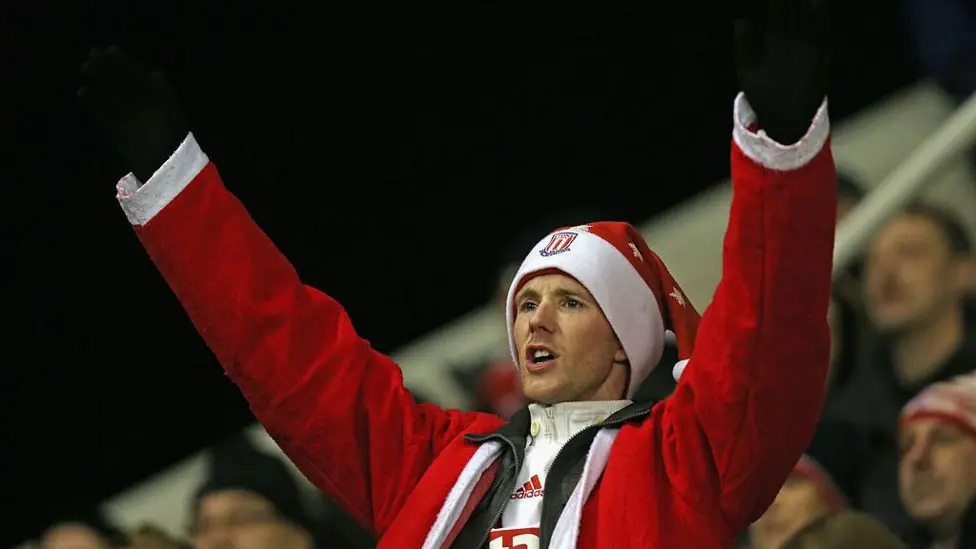
A Stoke City fan is appropriately dressed for Christmas as he enjoys his side's win over Liverpool on Boxing Day 2012. Liverpool took an early lead through a Steven Gerrard penalty but the Potters responded with two goals from Jonathan Walters and another from Kenwyne Jones
My worst? Any defeat, even if it was near home.
But at least there was always a chance to get over it quickly - usually with another game a couple of days later.
Football management is full throttle most of the year anyway, but Christmas - and Easter too - was always a special time when the games would come at you thick and fast.
You can still be hired and fired at that time of year - both have happened to me over the festive period - but as a player and a manager, I loved it. That's why I look at the Premier League Christmas schedule this year and feel desperately disappointed.
It's part of Boxing Day tradition to go to games as a family day out, and historically they have always attracted bumper attendances at every level, but this season I see only one Premier League fixture on Friday, and it's in the evening. The rest are spread over the weekend.
Our top-flight clubs no longer really need the extra revenue that these bigger crowds bring, but has it really got to the stage where the people who decide on Premier League fixtures do not seem to understand or care about what the real supporters want, the ones who turn up week in, week out?
I am so pleased the Football League has stuck to tradition by having a full programme of games. Well done to them, and bah humbug to the Premier League!
As a player 'nights out were encouraged'

Pulis (left) as a young player with Bristol Rovers in 1977 and (right) as a senior professional with Bournemouth a decade later in 1987
A lot has changed about the game since my first Christmas as a footballer, 50 years ago.
As a young apprentice at Bristol Rovers in the 1970s, it was a time of giving - to me, if I was lucky!
Each apprentice had the job of looking after the boots of at least three senior professionals throughout the season and these duties could not be taken lightly.
Cleaning dressing rooms and even treading in divots to repair a worn-out pitch was also in my remit, but the match boots were crucial and would have to be in spit spot condition for every game.
Over Christmas and Easter, the two busiest times of the season, you'd be non-stop. We would spend hours cleaning, drying and polishing them.
There was some reward, though. Christmas was one of the two extra pay days we would hope would come our way. The other was at the end of the season, when the players you'd been looking after would show their gratitude with a tip of a few pounds.
I had left home at 16 to join Rovers who, at that time, were in what is now the Championship. At that age, I was allowed back to south Wales after training on Christmas Eve.
If the senior players were in on Christmas Day, the apprentices based in Bristol would be obliged to cover for us. But even at that age it was made pretty clear our jobs entailed working during these holiday periods, and on Boxing Day we were always watching the first team or playing in the Football Combination league.
Turning professional myself took away all of the above duties - although I always took care of my own boots and studs anyway - but Christmas was still a special time.
Every club I was at, we had someone who would organise Christmas days - and nights - out.
I went to all sorts of different venues, with many different themed evenings.
Times were different then and our wages were very close to the majority of workers away from the game, so footballers were much closer to the communities they played in. Mixing with the public just wasn't an issue and those nights out at local pubs and nightclubs to let your hair down were never alcohol-free.
In fact, many managers at times would encourage nights out together to build team bonding and spirit, and encourage a closeness within the group.
Obviously we know now that drinking to excess is not a good idea, but in the 1970s and 80s the English game and culture accepted it and embraced it.
Just take a look back at how many European Cup finals our teams not only competed in, but won during that era - Liverpool, Nottingham Forest and Aston Villa are testament to that.
Drinking was never frowned upon. You even took a drop of whiskey or brandy in your pre-match cup of tea if the weather was really cold. I actually played with some very good drinkers, but compare them to the rugby lads of the day and they were just puppies really!
Having to 'influence' nights out as a manager

Tony Pulis watches Middlesbrough beat Bolton on Boxing Day 2017 alongside the club's owner and chairman Steve Gibson. Pulis had been appointed manager earlier that day
When I first went from being a player to a manager, I took the same approach from my playing days.
Over the years we have all become much more aware of how alcohol and smoking can affect your physical conditioning. In previous columns I have explained how, with the majority of players I signed, I really checked out their characters.
When it came to Christmas, I would always allow the players to arrange their night out after a home game early in December, and never too close to the festive programme.
I put the responsibility on one or two senior players to take care of the younger lads and make sure the whole group behaved themselves.
In my early years of management, with the lads being in the lower leagues, they were generally safe enjoying themselves locally like I did as a player.
My mandate was that the following Monday would be a hard session, so they had Sunday to recover for what would inevitably be a punishing workout.
It always amazed me that some players could party hard and still be on top form the next day, yet others would struggle to get up a full head of steam.
When I moved up the levels, I became more and more aware of how I had to try to influence their Christmas nights out, including where they took place.
Mondays would always bring the inevitable banter of what had happened on the night out and I have to confess that some of the stories I have heard are better off left in my head rather than making it into this column.
Times have changed, however. Players have become like film stars and a lot of clubs now allow their players the freedom to jet off to a different country for their party.
With players' wages rocketing they have become more detached from normal life. The advent of camera phones and social media also makes things different when they go out, too.
I would always get the players to organise a dinner and a night out with their wives and girlfriends locally, and there would be club-run evenings to celebrate Christmas, but my main concern was always the lads' night out.
I would encourage the players to arrange their own players' party outside the town or city they represented.
I have laid on buses and hotels to make it happen, with the lads brought in by bus one night, and then out the next morning. That covered the risk of drink-driving the next day, and also worked by keeping the group together.

Pulis is 'the ghost of Christmas past' on this fan's festive turkey hat in 2017, when two of his old teams, Stoke and West Brom, met on 23 December. The Potters beat the Baggies 3-1
Bonding and breaking down barriers
To go from meeting in local pubs to watching private jets take players to far away cities is a huge change for a manager, but the same principle of team bonding remains.
The most important thing is the lads have a great time together, get to enjoy each other's company and hopefully pull them away - even if only temporarily - from their present-day addiction to mobile phones.
Being a team, a proper team, means sacrificing yourself at times for your mates. Team spirit and togetherness is a vital ingredient for success in any team sport and I have witnessed people's perceptions of others change after spending a few hours relaxed together, and seen characters change because of this too.
Yes, we have seen some really disappointing incidents at different clubs down the years but I still think Christmas parties done in the right way are a good idea, because they break down barriers and bond team members together in a tightly knit environment.
I am always asked about one incident, at Stoke in 2009, but one of the golden rules I have always stuck to as a manager was to adhere to the mantra of 'what happens in the dressing room, stays in the dressing room'.
Suffice to say the players' Christmas party that year went ahead as arranged.
Tony Pulis was speaking to BBC Sport's Chris Bevan.