Bus journey times being 'killed by congestion' in cities

 Getty Images
The Number 38 bus service threads a north-south path through Edinburgh, far from the picture postcard version of Scotland's capital.
It serves a college, retail park and two hospitals, but the amount of time it takes to travel this route is getting longer.
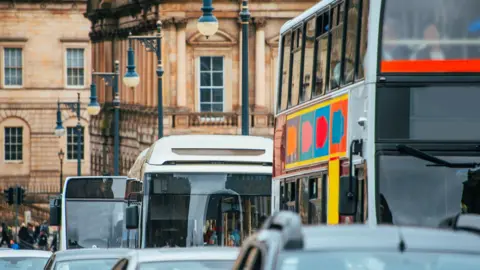
Scotland's bus industry has warned that the growing number of vehicles on the road, congestion at peak times and not enough priority measures for buses is making its services less attractive.
The average speed for a bus in Scotland is now 11.3mph, down from 14.9mph two years ago, according to industry data.
Lothian Buses' 38 crosses eight of Edinburgh's major roads and is one of the services worst affected by congestion in a city known for its reliable bus service.
It is the waiting at these traffic pinch points which can cause stress for shop worker - and number 38 regular - Nico Reverie.
"You can obviously see what the hold ups are, but there's not a lot you can do about it," he said.
"It is frustrating when there are delays as I need to make a connecting bus so you're sometimes not sure if it is going to happen.
"I need to allow more time to get to work so I'm not late.
"It is just the traffic really, otherwise it is a decent service."
Research commissioned by trade body CPT Scotland shows there has been a significant increase in running times of the Number 38 service over the last 20 years - with rising traffic volumes, a reduction in speed limits and cycle lanes all contributing to this.
The frequency of the 38 has been reduced to allow the same number of vehicles to operate the service, which is a point not lost on passenger Francis Boyle, 65, a stores worker at the Royal Infirmary of Edinburgh.
"It is quite a good service overall, but it doesn't run for long enough in the day, especially when you consider it covers two big hospitals," he said.
"There can be congestion, though I'm lucky I'm using it at times when it is not always the busiest, but they always seem to be up against the vagaries of roadworks no matter where you are in the city.
"It is not their fault but it does have an impact."

The CPT study points out that operators across Scotland are having to add buses and tweak timetables to try and beat congestion and maintain consistent levels of services.
This comes at a time when the long term trend shows that fewer people are using buses.
Paul White, director of CPT Scotland, said: "When a bus or coach is stuck in traffic it lengthens the passenger journey time, increases the costs of operation, and ultimately makes bus less attractive, potentially resulting in reduced bus use, cuts to services, or higher fares.
"This can be addressed by local authorities and operators working together on priority measures which could include bus lanes, bus gates and traffic light priority."
Mr White points to the success of controversial bus gates in Aberdeen, where journey times improved by up to 18.8% and passenger numbers increased.
The CPT study claims that if bus speeds in congested urban areas, currently limited to 7.8mph on average, could be increased to 13.2mph this would add 11.3m extra journeys every year.
It would also cut operators costs by 38% as they would need fewer drivers and buses on a route.
Longer term, the use of Artificial Intelligence to analyse real-time and historical data to prioritise buses and reduce delays - as is being tested at more than twenty junctions in Glasgow - will also make a difference.
Every second counts

Publicly-owned Lothian Buses is widely regarded as of the UK's best operators, a point demonstrated by the bulging awards trophy cabinet at its Edinburgh headquarters.
But that does not make it immune to the challenges of congestion.
Willie Hamilton, the firm's operations director, said a significant increase in roadworks was his biggest headache.
He said: "It is easy to look as a bus as just a vehicle, but on that bus there could be up to 129 people.
"If you impact that vehicle it is different to one person's journey in a car and that is the message we are trying to get across.
"As car usage grows and the city expands, it magnifies a lot of the challenges we face and increases the number of times we have to invest just to stand still."
Mr Hamilton said shaving seconds off journey times at busy junctions on a route with more priority measures can make a real difference to passengers.