The communities seeking to cash in on wind turbine ownership

 BBC
BBCIn the Fintry Museum, tucked inside the village sports club, Isla Kinnear is talking through a plan that sounds simple on paper, but huge in practice.
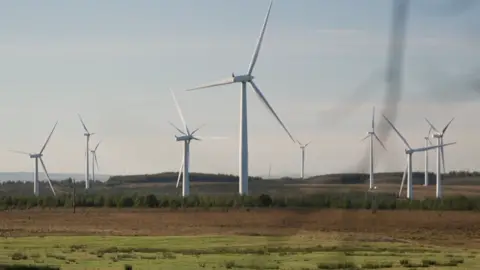
Fintry already owns one of the 15 turbines on a wind farm near the village in Stirlingshire.
The question now is whether communities could get a proper chance to own and run more of these sites.
Isla is director of Fintry Development Trust. She hopes a new Scottish government approach will give local groups a head start when renewable energy projects on public land come up for new leases or "repowering" deals.
The government's proposal would create a 15-month window for community organisations to bid first for ownership, before commercial operators.
The 10 pilot sites in areas managed by Forestry and Land Scotland range from North and South Lanarkshire, Aberdeenshire, and Argyll & Bute among others.
The Black Law site in South Lanarkshire is the first to become available, with a proposed "repowering" year of 2032.

Fintry has seen what even limited ownership can deliver. Isla Kinnear points back to the early days of the local wind farm.
"When the opportunity came for the wind farm back in 2003, there were some people in our village that thought there was a real opportunity here for Fintry," she says.
The trust secured a loan to buy one extra turbine from the developers. Over the years, she says that decision has brought in around £2m for local projects.
"We managed to get a loan to buy an extra turbine from the developers, and that money has then been able to finance different energy projects in the village throughout the past 20 years."
She believes wider ownership could change what's possible and how much revenue could be raised for the village.
"Oh, millions. Certainly millions," she says. "And for a village like Fintry, where it's only 700 people, it's life-changing."
What's changing, and why now?
Community groups have been arguing for a bigger stake in renewables for years, saying too much value leaves local areas when projects are owned and run elsewhere.
Cowal Community Energy, based in Dunoon, has been among those pressing for reform.
Director Alan Stewart says they tried to take on a lease for a wind farm on land owned by Forestry and Land Scotland, but were unsuccessful.
He says the process highlighted a basic problem: Communities were not always told about opportunities early enough, or treated as serious bidders.
"But what we have succeeded in doing is having the legislation changed so that Forestry and Land Scotland now have to tell communities in their area where there's a wind farm coming up for lease.
"So the community can now get a chance at leasing that."
Alan Stewart says the change could help keep more money in local areas.
"It could be phenomenal. They now have the opportunity to take ownership of a farm and have the money invested in their area and not sent abroad or wherever the payment company is."
Depending on the site and the deal, he estimates "£2m a year could come into the community".
The upside: Bigger revenue, local control
Dr Josh Doble, policy director at Community Land Scotland, says community ownership can translate into practical improvements.
He points to examples where renewables income has funded housing, transport and local services.
"Housing, local transport need. We've even got examples of renewable energy money going into our mountain rescue service."
He says income has also supported local organisations and helped address everyday pressures.
"Funding for local charities or local community groups. Funding for young people in the area to take driving lessons or address fuel poverty," he adds.
Community Land Scotland says its analysis suggests community-owned projects can return far more to local areas than standard community benefit schemes linked to private developments.
"If you have a community-owned energy project, you get 34 times more revenue going back into the local area compared to a community benefit scheme from a private development."
The catch: Communities also take on the risk
There's a trade-off. Community ownership is not a charity model. It brings industrial-scale responsibilities, including borrowing, technical expertise, maintenance and long-term operations.
Stewart says groups may need commercial lenders to raise large sums, and that lenders will only back projects they believe can reliably pay back.
"We go to commercial lenders. They are happy to lend because it's a guaranteed income for them."
He says lenders could ultimately take ownership if a community pulled out.
"So if anything was to happen to the community for some reason and they pull out, they will take ownership of it."
Limits and unanswered questions
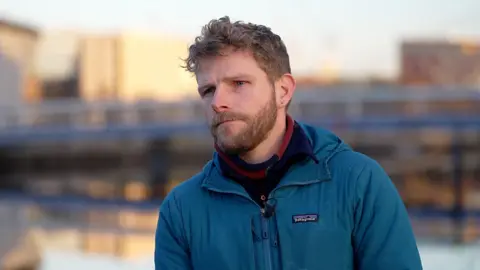
Josh Doble from Community Land Scotland says the government's current proposals on community ownership will not mean a free-for-all.
It is initially aimed at Forestry and Land Scotland sites, applies only to developments under 50 megawatts, and is not expected to begin until after 2030.
But those working in the sector want it sooner and want the principle extended.
"We want it to happen before 2030," says Josh. "We want communities to be able to bid on repowering leases over 50 megawatts, and we want to see it on all publicly owned land."
The Scottish government said the new approach would keep fairness at the heart of their net-zero ambitions.
It said the pilot would be kept under review and further opportunities to make better use of public land for community energy may be explored.
For communities like Fintry, the promise is clear.
For others, the question is whether they can build the capacity to take on projects closer in scale to running a company than a local charity.
Alan Stewart says it's a "partial victory".
His advice to other communities is straightforward.
"Keep going. Talk to the right people. Get the right advice. But don't give up."