6 Minute English
ระดับกลาง
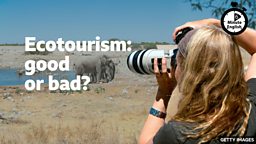
Ecotourism: good or bad?
Episode 230601 / 01 Jun 2023

____________________________________________________________________________
Learn more about travel and transport
____________________________________________________________________________
Introduction
In recent years, nature and wildlife tourism has grown massively. Whether it’s meeting mountain gorillas or swimming with dolphins, every year tourists pay thousands of dollars for a once-in-a-lifetime opportunity. But ecotourism doesn't always work well. Beth and Neil discuss the topic and teach you related vocabulary.
This week's question
Most tourists on safari are looking for ‘the big five’, the name given to Africa's most iconic large animals. But which animals are ‘the big five’?
a) the lion, leopard, giraffe, baboon and buffalo
b) the lion, leopard, tiger, elephant and buffalo or
c) the lion, leopard, rhinoceros, elephant and buffalo?
Listen to the programme to find out the answer.
Vocabulary
ecotourism
travel to places of natural beauty in which the tourists’ main motivation is to appreciate the natural world and support the traditional culture of local people
sustainable
designed to continue at a steady level which does not damage the environment
tiger selfie
having your photo taken with a captive wild tiger
at the other end of the scale
by contrast
grassroots NGOs
non-governmental organisation (NGO) which tries to achieve its aims through the actions of local ordinary people rather than leaders
go a long way (towards)
be an important factor in achieving a certain goal
TRANSCRIPT
Note: This is not a word-for-word transcript.
Neil
Hello. This is 6 Minute English from BBC Learning English. I’m Neil.
Beth
And I’m Beth. Nowadays, the word ‘safari’ is often used negatively. For many people, the idea of killing animals for sport is unacceptable.
Neil
As the popularity of hunting declines, safaris are swapping their guns for cameras, offering tourists the chance to photograph wild animals in their natural habitat. In recent years, nature and wildlife tourism, also called ecotourism, has grown massively.
Beth
But the story is complex. While money from ecotourism is supposed to support threatened wildlife and traditional local cultures, the reality is sometimes different. In this programme, we’ll be asking: is ecotourism good or bad? And, as usual, we’ll be learning some useful new vocabulary as well.
Neil
But first I have a question for you, Beth. Most tourists on safari are looking for ‘the big five’, the name given to Africa's most iconic large animals. But which animals are ‘the big five’? Is it:
a) the lion, leopard, giraffe, baboon and buffalo
b) the lion, leopard, tiger, elephant and buffalo or
c) the lion, leopard, rhinoceros, elephant and buffalo?
Beth
I guess it’s a) the lion, leopard, giraffe, baboon and buffalo.
Neil
I’ll reveal the answer at the end of the programme. The balance between the good and bad things ecotourism can bring is well understood by Vicky Smith, whose website, Earth Changes, matches ecotourists with environmentally-friendly travel companies. Here is Vicky talking with BBC Radio 4 programme, Costing the Earth.
Vicky Smith
Just because tourism is nature-based, it doesn't mean to say it's necessarily responsible or sustainable. So, there's a lot of animal activities in tourism that we know which are, you know, highly irresponsible and unsustainable, like a performing whale and dolphin shows, or swimming with dolphins, elephant-riding, tiger selfies where the tigers are drugged.
Beth
Genuine ecotourism is sustainable – designed to continue at a steady level which does not damage the environment. Not every travel company which calls themselves eco-friendly acts sustainably, and may still advertise irresponsible tourist activities, including tiger selfies – having your photo taken with a captive wild tiger.
Neil
There are two requirements travel companies should meet to qualify as genuine ecotourism. First, tourists’ main motivation should be to appreciate and observe the natural world without interfering, and second, the money they spend should support traditional communities. Clearly, having your photograph taken with a chained and drugged tiger does not meet these requirements.
Beth
But not all companies claiming to be ecotourism behave so irresponsibly. According to Antonia Bolingbroke-Kent, who runs small scale wildlife expeditions to some of the most remote places on Earth, it’s possible to put travel companies on a sliding scale from good to bad. On BBC Radio 4’s programme, Costing the Earth, Antonia discussed her work in Tajikistan, a country where ecotourism is making a positive impact on both animal and human communities.
Antonia Bolingbroke Kent
At the other end of the scale is Tajikistan, where I work a lot, which gets less than two dozen wildlife tourists a year, and the money these visitors bring is essential to the conservation work that grassroots NGOs are doing. So those few tourists… their money goes a very long way and the animals people are looking at… snow leopards, rare mountain ungulates like Bukharan markhor, they are being observed from a distance, their behaviour is not being affected in any way, and the local communities are genuinely benefiting.
Beth
Antonia uses the phrase at the other end of the scale as a way of contrasting irresponsible tourist companies with what’s happening in Tajikistan. There, animals including snow leopards and mountain ungulates, are being protected by ecotourist projects run by non-governmental organisations, or NGOs - organizations trying to achieve environmental or social aims outside of government control. These NGOs are grassroots organisations meaning that they are run from the bottom up, by ordinary people rather than leaders.
Neil
Despite getting very few ecotourists a year, the money they spend in Tajikistan goes a long way, in other words, the money is an important factor in achieving their goals, which in Tajikistan at least, means protecting rare wild animals. OK, it’s time to reveal the answer to my question.
Beth
You asked me about ‘the big five’, the name for Africa’s iconic safari animals. I guessed they were: the lion, leopard, giraffe, baboon and buffalo.
Neil
You guessed right about the lion, leopard, and buffalo, but the others were the rhinoceros and the elephant. OK, let’s recap the vocabulary we’ve learned from this programme about ecotourism – travel to places of natural beauty where the tourists’ motivation is to appreciate nature and support the local culture.
Beth
The adjective sustainable describes actions designed to continue at a steady level so as not to damage the environment.
Neil
A tiger selfie means having your photo taken with a captive wild tiger, not something to be advised!
Beth
The phrase at the other end of the scale is similar in meaning to the phrase, ‘by contrast’.
Neil
A grassroots NGO is a non-governmental organisation which tries to achieve its aims through the actions of local ordinary people rather than leaders.
Beth
And finally, if something goes a long way towards a certain goal, it’s an important factor in achieving that goal. Once again, our six minutes are up. Goodbye for now!
Neil
Bye!
6 Minute English ล่าสุด
Sexism: Female farmers fighting back
Episode 231228 / 28 Dec 2023
How can female farmers beat rural sexism?

Invasive species: Why don't we eat them?
Episode 231207 / 07 Dec 2023
Could we eat invasive species?

What and where is Little Italy?
Episode 231130 / 30 Nov 2023
Mozzarella, ricotta, cannolis and focaccia... Where are we? Little Italy of course!

Social media and teenage health
Episode 231123 / 23 Nov 2023
What are the health risks of social media for teenagers?






Sounds that make you want to scream
Episode 230928 / 28 Sep 2023
Are there any sounds you find upsetting?




The stories behind our names
Episode 230831 / 31 Aug 2023
What do our names reveal about our culture and family history?


Are you unhappy at work?
Episode 230817 / 17 Aug 2023
Does work leave you feeling bored and exhausted?





Is it wrong to eat plants?
Episode 230629 / 29 Jun 2023
Should we treat plants with the same consideration we treat animals with?



The art of subtitling
Episode 230608 / 08 Jun 2023
Hear how subtitles can help bring TV and movies to life
Ecotourism: good or bad?
Episode 230601 / 01 Jun 2023
We discuss the growing popularity of ecotourism.
Can climate change cause more disease?
Episode 230525 / 25 May 2023
With warming temperatures, mosquitos are now spreading to new areas, including Europe.

Ice and the origins of life on Earth
Episode 230504 / 04 May 2023
We talk about an essential element for life to thrive.

Women in politics
Episode 230427 / 12 Apr 2023
We discuss some of the reasons why women make up only 26% of the world's politicians.
What's the point of museums?
Episode 230420 / 20 Apr 2023
We discuss the role of museums in the 21st century and the items taken from different countries.

How culture affects sadness
Episode 230413 / 11 Apr 2023
What ways do you think culture can influence sadness?

Would you eat a Kalette?
Episode 230406 / 06 Apr 2023
Hear about a new kind of vegetable making an entrance in British kitchens

Do you get jealous easily?
Episode 230330 / 06 Mar 2023
Let's talk about the ugly green-eyed monster


Food and mood
Episode 230316 / 16 Mar 2023
We look at the link between what you eat and how you feel.
How to talk to a climate denier
Episode 230309 / 09 Mar 2023
The dos and don'ts of trying to discuss science with someone who doesn't believe in it

Losing your mother tongue
Episode 230302 / 02 Mar 2023
Hear the story of a woman who replaced her native Czech for English.

The health benefits of apples
Episode 230223 / 23 Feb 2023
Could 'an apple a day keep the doctor away'?

Doomscrolling: Why do we do it?
Episode 230209 / 27 Jan 2023
What is doomscrolling and why are we attracted to bad news? Listen to find out!

Exercise for the lazy
Episode 230202 / 22 Jan 2023
What's the least amount of exercise you should do to stay healthy?

Can AI have a mind of its own?
Episode 230126 / 26 Jan 2023
Hear about the software engineer who became 'friends' with his computer
Climate change: Are there too many people?
Episode 230119 / 13 Jan 2023
Does the size of your carbon footprint depend on where in the world you were born? Listen to find out!
The hidden life of buffets
Episode 230112 / 12 Jan 2023
Neil and Sam discuss buffet meals and the history behind them.

Songwriting
Episode 230105 / 05 Jan 2023
Writing a memorable song isn't easy. So is there an art to good songwriting?