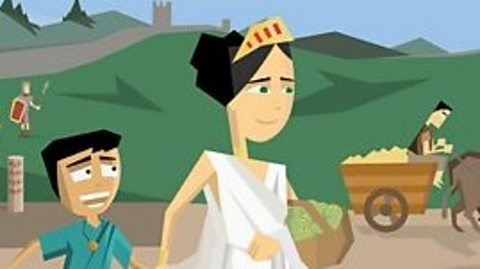
What was special about the Roman army?
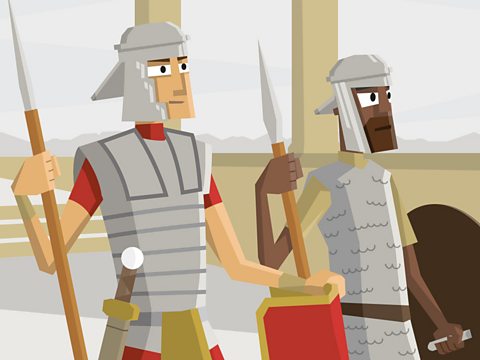
The soldiers were the best trained, they had the best weapons and the best armour.
The Roman army conquered a huge empire.
A Roman soldier could march 20 miles a day, wearing all his armour and equipment.
Who was in the Roman army?
Only men could be in the Roman Army, no women were allowed.
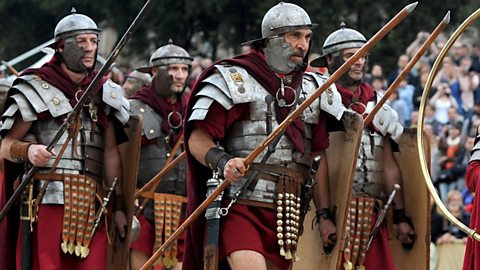
There were two main types of Roman soldiers: legionaries and auxiliaries.
- The legionaries were the very best soldiers.
- A legionary had to be over 17 years old and a Roman citizen.
- Legionaries signed up for at least 25 years' service.
- But if they lived, they were rewarded with a gift of land they could farm.
- An auxiliary was a soldier who was not a Roman citizen. He was only paid a third of a legionary’s wage.
How did the Roman army fight?
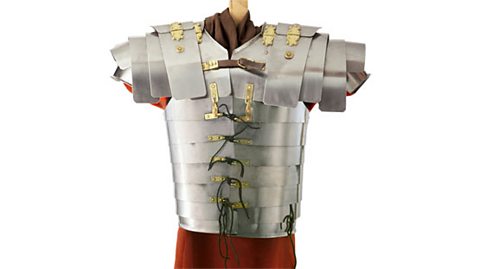
The Roman army was huge.
It was divided up into groups called ‘legions’. Each legion had between 4,000 and 6,000 soldiers.
A legion was divided into groups of 80 men called ‘centuries’.
The man in charge of a century was known as a ‘centurion’.
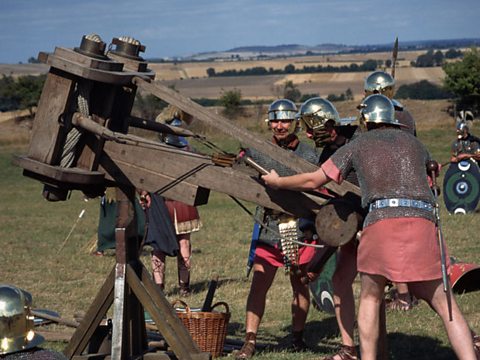
- Some soldiers shot bows and arrows, flung stones from slingshots, or could swim rivers to surprise an enemy.
- They hurled javelins and drew their swords, before charging into the enemy.
- The cavalry (soldiers riding horses) chased anyone who tried to run away.
Watch: What was a Roman fort like?
Take a trip around the famous Roman fort at Vindolanda on Hadrian's Wall.
Find out about Vindolanda.
Presenter: The fort here at Vindolanda was the home to 800 soldiers and their job was to guard the wall against people they described as barbarians.
Now, for the Romans, barbarians were local tribes who lived on the other side of the wall in what’s now, northern England and Scotland.
But it wasn’t the legionaries that guarded the wall. This was the job of auxiliary soldiers who came from right across the Roman empire… places like Belgium, Spain, Greece, and even as far away as Africa.
After 25 years working as an auxiliary, you could become a Roman citizen. And when the soldiers weren’t on duty guarding the wall, they lived here with their families. These are their barracks. And we can still see their remains today.
Barracks are soldiers’ homes. These ones at Vindalanda used to have two floors and an attic on top.
This was the main road in the middle and it would have been humming with activity with the soldiers coming out and washing themselves in the morning and at the end of the day.
That big building that you can see at the end there, that was basically the posh bit, that was where the centurions slept so they were the bosses keeping their eyes on all the soldiers down here.
This is one of the three public loos that’s been left here at Vindalanda. You’d have had twelve wooden seats along here. You’d sit down, do your business straight into the drain below and probably have a chat with some of your friends as you did so.
And I know it looks a bit odd but that’s because in Roman times people always used to go to the loo at the same time, together so it wasn’t very private.
For the last forty years, archaeologists who are really like detectives, have been digging carefully through layers of soil, finding extraordinary evidence of the lives of the soldiers who once lived here.
Justin Blake, Archaeologist: What we’re looking for is the little things that they’ve dropped and left behind: shoes, writing tablets, little bits of weapons and armour and like a detective, those are the clues that we use to find out what the Roman people were doing here all that time ago.
Presenter: And what’s particularly special about what’s been found here?
Justin Blake: The undoubted highlight from Vindolanda are the amazing writing tablets that we find and these are tiny little postcard sized scraps of birch and alderwood that the Roman soldier have written to each other and further afield with an old fashioned iron pen that they dip into the ink and write straight on top of the bits of wood.
And from those letters we just have an enormous amount of information about the Roman soldiers but others as well and exactly what they thought about living right at the edge of the empire on Hadrian’s Wall.
Presenter: The letters reveal the most fantastic details about the soldiers’ lives, how they miss their friends and their families and the good wine back at home. But the main thing that they seem to moan about is the freezing cold up here in the north of England.Luckily some of their mates could send them supplies.
“I have sent you some pairs of socks from Satura, two pairs of sandals and two pairs of underpants. I pray that you live in the greatest of good fortune.”
Well it’s good to know that even the Romans had to wear pants.
Activities
Activity 1: Roman legionary's equipment
Click on this Roman legionary below to find out about his equipment.
Activity 2: Quiz – Roman army
Race Across the Continents game - new update! game
Help this team of adventurers race their way to victory. Explore the globe in this exciting game update to discover new audio voiced by Ade Adepitan and fun animations. Challenge yourself with brand-new achievements and become a high-flyer!

More on Roman Empire
Find out more by working through a topic
- count1 of 4

- count2 of 4
- count3 of 4