What is the purpose of poetry?

Sometimes poems are short and rhythmic like a song. Sometimes they are long narratives with characters and plot lines like a story. So why do we read and write poems?
For the writer, a poem is a way of expressing themselves. Often, people choose to write about subjects that they are passionate about or experiences they have had.
For a reader, poetry can be a way of connecting with a particular topic that you feel strongly about.
Sometimes though, poetry can simply put a smile on your face or make you laugh which is another great reason to read it.
What is poetry about?
The fun thing about poetry is that it can be about anything.
Poets are inspired by all sorts of different things and you can be too.
Have a look at the different images below. Think about how the images make you feel and what words come to mind when you look at them. This could be the start of your next poem!
Inspiration
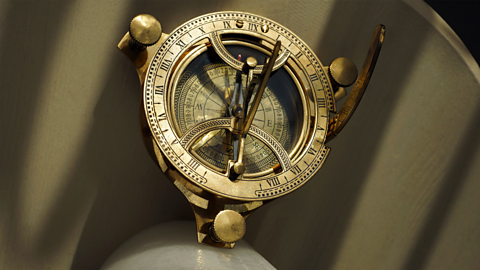
Image caption, An astrolabe, an ancient scientific invention used to track the position of the Moon and stars.


1 of 3
Activity: Brain storm
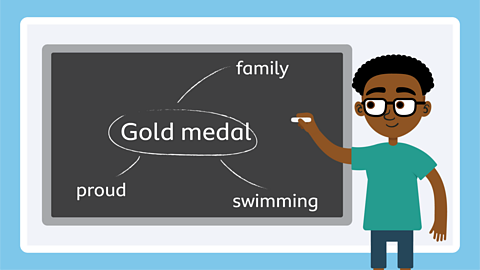
Coming up with ideas for a poem can be hard. Here is an activity to help you get started. Think of a time when you have had strong emotions. It can be any emotion; sad, angry, excited, joyful. Here are some ideas to help:
- Watching a football match with a family member
- Being blamed for something you didn’t do
- Saying goodbye to a loved one
- Winning an award or prize when you have worked really hard
Write down your event in the middle of a piece of paper. Now, write down all the words that come to mind around your event in a spider diagram. These words can be the start of your next poem!
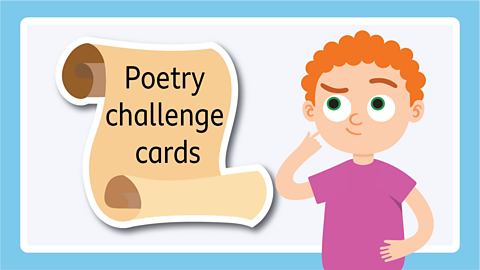
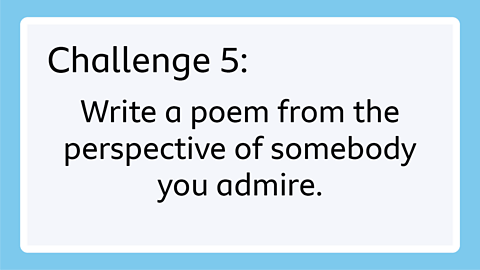
Activity: Poetry challenge cards
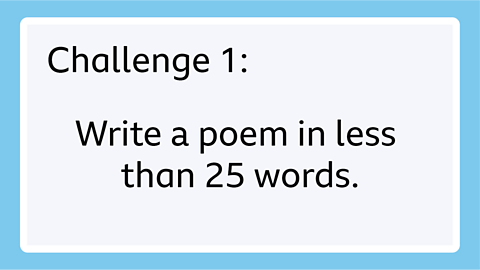
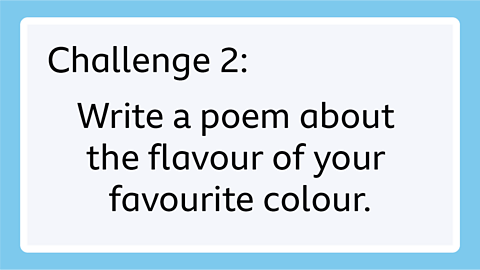
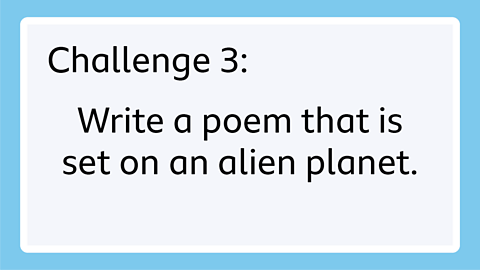
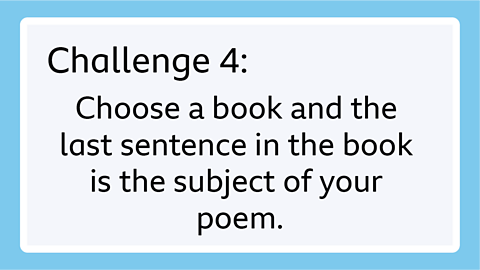
Have a go at one of the poetry challenge cards.
How many challenges can you complete?
1 of 6
Nonsense poetry
Not all poetry is serious. Sometimes poems are silly or funny or even use made up words.
Watch poet Joseph Coelho create a nonsense poem!
When I was growing up, I thought poetry was very serious.
It took me a long time to realise that it can be fun and that anyone can do it. At its heart, poetry is about having fun with words and the sounds that they make.
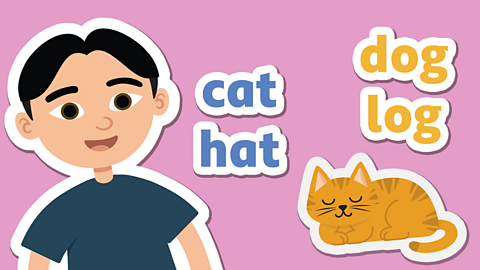
One of my favourite poetic devices is onomatopoeia. It's a long word, but simply means words that are also sounds. Words like moo, quack, roar, drip, drop, splash! By stringing sound words together it is possible to create a poem.
The cow goes moo and the duck goes quack
Roar goes the lion and drip goes the tap.
Drop goes the penny as it splashes into the well.
Plop goes the elephant dung and bad is the smell.
Onomatopoeia (sound words) are fun to play with because with sounds you get rhythms.
A splish splash splosh.
And a drip drop plop.
A rustle bustle tussle
And a slip slap slop.
Listening to the sounds around us can inspire poems. Poems that are just fun to say.
They don't have to have a deep meaning in fact poems don't have to have any meaning at all they can be utter nonsense!
One way to create great nonsense poems is to first write some sentences about doing something very ordinary like brushing your teeth.
I pick up my toothbrush
Run my toothbrush under the tap
Squirt some toothpaste onto it
I put the toothbrush in my mouth
Then run the toothbrush over each tooth and my tongue
Going back and forth until it froths up.
Then just swap some of the words with random words. I'm going to swap toothbrush with hippopotamus and run with skedaddle and mouth with tuna fish and tongue with peanut butter.
Now, the poem sounds like this.
I pick up my hippopotamus
Skedaddle my hippopotamus under the tap
Squirt some hippo paste onto it.
I put the hippopotamus into my tuna fish
Then run the hippopotamus over each hippo and my peanut butter
Going back and forth until it froths up.
There are nonsense poems waiting to be created from everyday descriptions of a journey on a bus or a trip to the shops, a visit to the bathroom or a trip to the zoo.
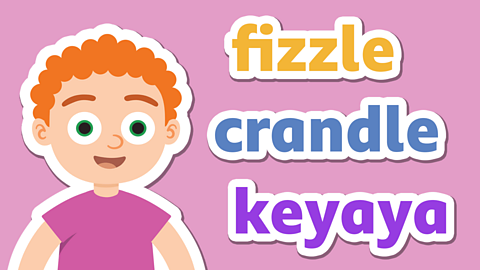
It's just a matter of playing with words, swapping everyday words for words you find funny or words you like the sound of. It doesn't matter what they mean. You could even make up words like bloomlurgy, tangleflority, keyayaya, laykal wangdoolahlah!
When I realised you could make up words when writing poems, it didn't take long to realise that I could make up characters and situations. Maybe a zoo keeper without a zoo or a lion that quacks like a duck or a shrimp with a limp.
Poetry is fun! It's a playground for the imagination.
I might write about some funny situations. Perhaps a carp who plays a harp or a pike that rides a bike or shark that's afraid of the dark!
Your turn to think of your own made up words. Have a go at fitting them into the poem below or make up your own poem.
The … sank my …
So I … their …
Then they … my …
We all … to the moon!
Activity: Performing your poem
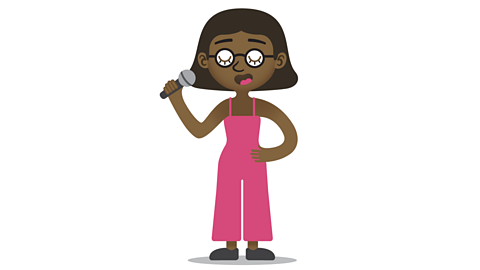
Whatever type of poem you have written, it is time to perform it! You can perform to a friend, family member or even to yourself in the mirror.
You can read it from your paper or try to memorise it.
Top tips!
Stand up straight and face forward.
Speak clearly and say each word carefully.
Don’t rush!
Change your speed and volume as you are performing. Changing from slow to quick and loud to quiet can make your performance more dramatic!
Where next?

Play Bitesize Primary games. game
Fun and educational primary games in science, maths, English, history, geography, art and design, computing and modern languages.
More on Poems
Find out more by working through a topic
- count1 of 8
- count2 of 8
- count3 of 8
- count4 of 8