First Past the Post - electing MPs
Quick version
The voting system used to elect Members of Parliament (MPs) to the UK Parliament is called First Past the Post (FPTP):
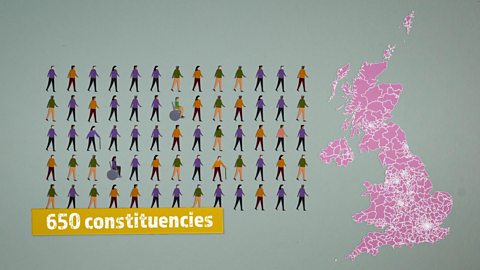
- the UK is divided into 650 constituencies (seats)
- at an election each constituent (voter) has one vote for one candidate
- the candidate with the most votes becomes the MP
- the party with the most MPs becomes the government (generally)
Advantages of FPTP
- Clear MP-constituency relationship
- Usually returns one party creating strong government
- simple and easy to understand
Disadvantages of FPTP
Majority of voters often do not get their choice of MP
Parties do not always gain fair representation
Tactical voting
FPTP shares some similarities with the Additional Member System which is used to elect MSPs to the Scottish Parliament.
Video - First Past the Post
Watch this video explaining how the First Past the Post voting system works.
What is the First Past the Post voting system?
The UK is a representative democracy.
The country is divided into 650 constituencies and each constituency votes for aMember of Parliament, or MP, to represent it at the UK Parliament inWestminster.
The voting system used to elect MPs is called First Past the Post or FPTP.
On election day, voters receive a ballot paper with a list of candidates.
As only one MP will represent each constituency, each political party putsforward one candidate.
There can also be independent candidates.
Voters put across next to their favourite candidate.
All the votes are counted and the candidate with the most votes wins.
This is a simple majority voting system.
A candidate only needs one more vote than any of the others to be elected.
Learn in more depth
- What is the First Past the Post voting system?
- Advantages of the First Past the Post voting system?
- Disadvantages of the First Past the Post voting system?
- How is First Past the Post similar to the Additional Member System?
Keep going to learn more.
What is the First Past the Post voting system?
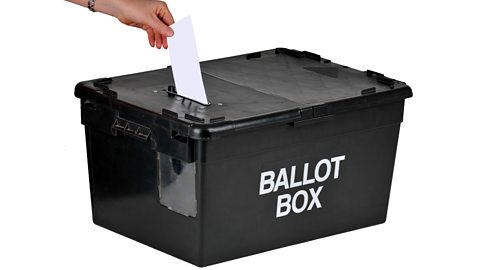 Image source, Finnbarr Webster / Alamy
The FPTP electoral system is used to elect MPs to the House of Commons.
- For the purpose of the election, the UK is divided into 650 areas called constituencies (seats)
- Each constituency is represented by one MP
- At an election, each constituent has one vote for one candidate from a list.
- The votes for each candidate are counted
- The candidate with the most votes wins by a simple majority and becomes the MP.
In addition to voting for a local MP, voters are also taking part in choosing a government. The party with the most MPs becomes the government.
In 2024, Labour had more MPs than all the other parties put together (a majority of MPs) so they became the government.
In 2010, unusually, no party won a majority of the MPs (had more MPs than all the other parties put together) so the Conservative Party (the largest party after the election) invited the Liberal Democrat Party to share power in a coalition government.
Image source, Finnbarr Webster / AlamyAdvantages and disadvantages of First Past the Post voting
What are the advantages of FPTP?
Close MP-constituency relationship
- One representative is elected for each constituency. This usually means there will be a strong constituency-MP relationship.
- It is clear who your MP is and you can see what they do.
- If voters do not like their MP they can vote to get rid of an individual person.
One party strong government
- Usually one party wins the election. This means the winning party gets five years to put its plans (given in its manifesto) into action.
- A clear majority of MPs makes it easier to push manifesto policies through parliament.
- In 2024, the Labour Party who won the General Election with 411 MPs. This gave them a majority of 172, meaning that Labour would only lose a vote in the House of Commons if more than 172 Labour MPs voted against their party.
Simplicity
- The FPTP system is straightforward and needs little explanation.
- Voters are unlikely to make a mistake
- Results are easy to count and to understand.
What are the disadvantages of FPTP?
Minority of votes count
In most constituencies more people (in total) vote against the winning candidate than for them.
Sometimes an MP can be elected with a minority of votes.
- In 2017, the Fife North East seat was won by the SNP's Stephen Gethins with 13,743 votes (32.9% of votes).
- Elizabeth Riches of the Scottish Liberal Democrats polled just two votes less, with 13,741.
The winning party is also usually elected by less than 50% of the voters.
- In the 2024 general election, Labour's share of all votes was 33.7%.
Parties do not always gain fair representation
- The proportion of votes for each party is often very different to the proportion of MPs returned.
- A party can win many votes across a number of constituencies but if they do not have the majority in any constituency, none of these voters are represented.
- In 2024, Labour polled 33.7% of votes and returned 63.2% of MPs (411 MPs).
- Reform UK polled 14.3 % of votes and returned 0.8% of MPs (5 MPs)
Tactical voting
- It is argued that FPTP encourages tactical voting (or people not bothering to vote) as they think their vote will have little chance of helping elect their chosen candidate.
- Voters may choose to vote tactically when they are more interested in preventing a candidate or party from winning a seat, than in a specific candidate or party winning.
- This may happen in a safe seat where one party usually receives many more votes than any other party.
- Tactical voters many choose not to vote for their preferred candidate, in the hope of giving another candidate a better chance of winning.
According to a YouGov survey from June 2024, one in five voters (22%) said they planned to vote tactically at the general election on 4th July.
Comparing FPTP election of MPs and AMS election of MSPs?
MSPs are chosen for the Scottish Parliament using an electoral system called the Additional Member System or AMS.
AMS is a form of proportional representation. This means it aims to give political parties a share of representatives (MSPs in Scotland) in proportion to their share of the vote.
There are two types of MSP:
Constituency MSPs - Scotland is divided into 73 areas called constituencies. Each constituency is represented by one MSP.
Regional MSPs - Scotland is divided into eight regions. Each region is represented by seven MSPs.
For the Additional Member System voters are given a ballot paper which asks them to record two (‘X’) votes:
- the first vote is for the constituency MSP
- the second vote is for a regional MSP
How is AMS similar to FPTP?
The election of constituency MPs in the AMS system is the same as the FPTP system.
This part of AMS has the same advantages and disadvantages as FPTP.
How is AMS different from FPTP?
The second AMS vote is for regional MSPs and is what makes AMS a form of proportional representation.
In this vote, voters vote for their preferred party:
- the second ballot paper has a list of political parties
- voters put one X next to their choice of political party
- votes are counted to see what proportion of votes each party received
- the number of constituency MSPs elected for each party is counted and compared to the proportion of votes each party received in each region.
- additional regional MSPs are elected to reflect the proportion of votes each party received in the second ballot.
AMS is a more proportional system than FPTP. It better reflects the overall proportion of votes for each party, and gives more opportunity for voters to feel that their vote has counted.
AMS is more complicated than FPTP. Each voter has more than one representative and this may make it less clear who to turn to. Each party controls its own regional list which means voters have less say over who all their representatives are than with the FPTP system.
Check out Voting systems in Scotland for more information on AMS.
Quiz
Recap what you have learned
MPs are elected using an electoral system called First Past The Post (FPTP):
FPTP is a form of plurality voting:
- the UK is divided into 650 constituencies (seats)
- each constituency is represented by one MP
- at an election, each constituent has one vote for one candidate from a list.
- the candidate with the most votes wins by a simple majority and becomes the MP.
| Advantages of FPTP | Disadvantages of FPTP |
|---|---|
| close MP-constituency relationship | minority of votes count |
| one party strong government | parties may not gain fair representation |
| simplicity | tactical voting more likely |
Compared to FPTP, the Additional Member System (AMS) used to elect MSPs to the Scottish Parliament has advantages and disadvantages:
| Advantages of AMS | Disadvantages of AMS |
|---|---|
| more choice | complex/confusing |
| fairer to all parties | multiple representatives |
| more choice of representatives | parties control regional lists |
| more views represented | not the most proportional system |
More on Democracy in the UK
Find out more by working through a topic
- count18 of 18
- count1 of 18
- count3 of 18