What is the House of Lords?
Quick version
The House of Lords is part of the UK Parliament.
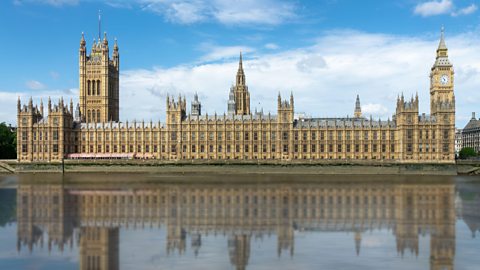
UK Parliament meets in Westminster, in London and has three parts:
- The House of Commons
- The House of Lords
- The Crown
Although the UK's political system can be described as a constitutional monarchy, it it the House Lords and the House of Commons which make the laws and not the Crown/monarch.
The House of Lords is the second chamber of the UK Parliament.
It's role is to scrutinise legislation and hold the government to account.
Bills pass back and forward between the House of Commons and the House of Lords.
The wording of a bill must be agreed by both houses before it is sent for royal assent and becomes law.
Most members of the House of Lords have been appointed by the monarch on the advice of a prime minister in recognition of their expertise.
Some peers represent political parties. Others are crossbench peers who represent different area of UK business, culture and society.
Some members are Church of England bishops and some are hereditary peers who have inherited their title.
Video – Passing legislation
Watch this video to find out more how laws are created.
Passing legislation
The first reading is when the bill is announced.
At the second reading the bill is explained and members of the House debate andvote on it.
If a majority votes in favour of the bill, it moves to the committee stage, where acommittee examines its content and hears from experts, organisations andmembers of the public.
The committee can suggest changes to the bill, which is then returned to theHouse for the report stage.
Members discuss any amendments before the bill's third reading, where there is afinal debate and vote.
If the majority vote in favour of the bill, it goes over to the other House forconsideration.
Any new amendments are sent back to the other House to discuss.
This can happen several times before the bill is agreed upon.
If the bill is passed, it is sent for Royal Assent and becomes law and an Act ofParliament.
What is the purpose of the House of Lords?
The House of Lords is the second chamber of the UK Parliament. It works with the House of Commons to create and shape legislation but is independent of the Commons.
It has three main functions:
- making laws
- holding government to account
- investigating public policy and issues
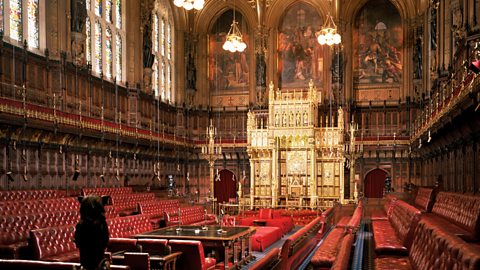
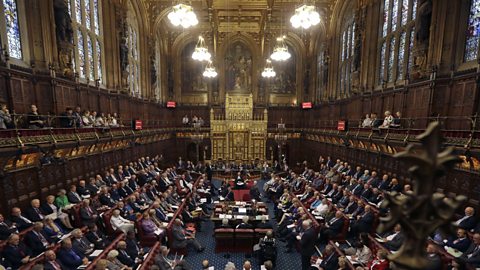
Image caption, The House of Lords chamber (robertharding / Alamy Stock Photo)
1 of 2
How does the House of Lords make laws?
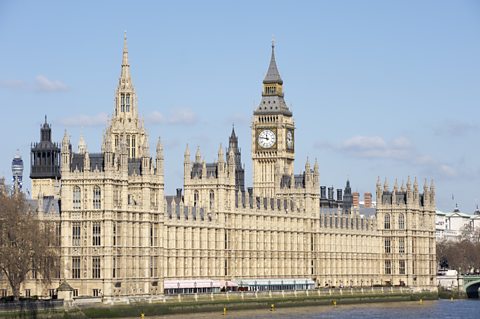 Image source, JohnnyGreig / Getty Images
All new laws or changes to UK laws start as bills in either the House of Commons or the House of Lords.
Bills pass through set stages in both houses, where they are debated, examined in detail, and changes are suggested.
What stages does a bill pass through in the House of Lords?
All bills pass through several stages in the Lords:
- First reading - A formal stage in which the name of the bill is read out in the chamber
- Second reading - The purpose and main content of the bill is debated. Lords can raise any concerns or make suggestions of changes.
- Committee stage - The bill is examined line by line and amendments suggested. Changes may be voted on. The process has no time limit and all members can take part in this
- Report stage - More examination of the bill takes place with debate and voting on amendments.
- Third reading - Final small changes are made to the detail of the Bill, which can then be voted on.
- Consideration of amendments - Changes are sent back and forth between the Commons and Lords with the aim of both houses agreeing on the final wording of the draft law. This back and forth process is often referred to as ping pong.
- Royal Assent - the agreed law is approved by the monarch and becomes an Act of Parliament.
In general, the final text of a bill must be agreed by both houses before is it given Royal Assent and becomes law. However, this is not always the case:
Money Bills which deal with tax or public spending must receive Royal Assent within a month of being introduced in the Lords, even if not passed by the Lords.
Although the Lords can delay a Bill it does not agree with, the Bill can be reintroduced in the following session of parliament and passed in the Commons without consent from the House of Lords.
This means there are some limits on how much the House of Lords can shape laws and hold government to account.
Image source, JohnnyGreig / Getty ImagesHow does the House of Lords hold government to account?
The House of Lords can hold government to account through asking questions and holding debates.
Asking questions of government
From Monday to Thursday, sessions of the House begin with Lords Questions. During this 30 minute slot, peers can ask four questions which a minister or other government spokesperson responds to.
Depending on the answer given, other members can follow up with additional questions.
Members of the House of Lords can also write questions to the government. Up to six questions can be asked each day and the government has to respond within two weeks.
At short notice, peers can ask the Lord Speaker's permission to ask a topical private notice question which a government spokesperson answers in the chamber.
Holding debate
Three types of debate are held throughout a parliamentary session:
General debates
- Usually held on Thursdays.
- One or two topics are debated in a five hour session.
- The subject of debates are mostly suggested by political parties sitting in the Lords.
- Backbench and crossbench peers can propose debates which are then selected through a ballot.
Short debates
- Held during a weekly one hour slot on Thursdays, or at the end of a day's business.
- Backbench and crossbench peers can propose short debates on topical issues which are then selected through a ballot.
Debates on committee reports
- When a committee published a report it is debated with no set timetable.
How does the House of Lords investigate public policy and issues?
Members of the House of Lords can investigate public policy and issues affecting the UK through committees.
Sessional committees
- In practice these are permanent committees that look into broad areas.
- These committees work without a time limit so can carry out very long term investigations, as well as short, focused inquiries.
- Examples include the Justice and Home Affairs Committee or the Science and Technology Committee.
Special inquiry committees
- In each parliamentary session, members submit proposals for committees that will look into a specific area.
- Each of these special inquiry committees carry out an inquiry and report during a fixed term.
- Recent examples include the Food, Diet and Obesity Committee, and AI in Weapon Systems Committee.
House of Lords Committees
Committees are made up of between 10 and 18 members, representing each of the main political parties and includes Crossbench peers who are non-party political.
Typically a committee of 12 members would be made up of four Conservative, four Labour, two Liberal Democrat and two Crossbench members.
Committees normally meet weekly, between Monday and Thursday. Meetings are usually open to the public. They are held in parliament but can travel to relevant locations. The committee can call on witnesses, including experts, to give evidence.
The committee will then write a report based on this evidence. The published report will give recommendations to the government, and the contents of the report are debated in the chamber. The government will respond to a report within two months.
How are members of the House of Lords appointed?
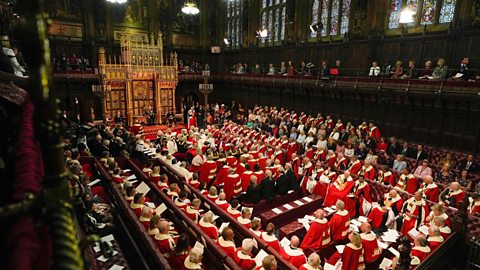 Image source, ALASTAIR GRANT / Getty Images
Members of the House of Lords are sometimes called peers.
As of October 2025, there are 828 peers:
- life peers - Most peers have been appointed by the monarch on the advice of a Prime Minister.
- Lords Spiritual - 26 Church of England archbishops and bishops. When they retire as bishops their membership of the House ceases and is passed on to the next most senior bishop.
- hereditary peers - As of October 2025, there are 85 lords with titles (such as Barons or Viscounts) who have inherited the right to sit in the Lords.
Image source, ALASTAIR GRANT / Getty ImagesWhat is the House of Lords Appointments Commission?
The House of Lords Appointments Commission is involved in the appointment of new life peers.
Anyone who wants to be considered as a crossbench life peer needs to submit a nomination form. The Commission looks over nominations and recommends people for appointment. How many crossbench peers could be added and when they could be appointed are decided by the Prime Minister.
The Commission also examines nominations put forward by political parties to ensure they are suitable candidates.
All appointments must be approved by the Prime Minister before they are formally appointed by the monarch.
Peers linked to a political party or government can be nominated or appointed in a number of ways:
- When a parliament ends at a general election, some MPs who leave the House of Commons may be appointed as life peers.
- Political parties may put forward nominations to top up the number of peers representing their party
- Former speakers of the House of Commons have traditionally been appointed life peers at the request of the Commons
- When a Prime Minister resigns, he or she may recommend ‘resignation honours'.
What is the composition of the House of Lords?
As of March 2025, the political breakdown of members of the House of Lords is as follows:
| Party | Number of life peers | Number of hereditary peers | Total |
|---|---|---|---|
| Conservative | 234 | 45 | 279 |
| Labour | 209 | 4 | 213 |
| Liberal Democrat | 75 | 4 | 79 |
| Democratic Unionist Party | 6 | 6 | 6 |
| Ulster Unionist Party | 3 | 3 | 3 |
| Green | 2 | 2 | 2 |
| Plaid Cymru | 2 | 2 | 2 |
There is a much higher number of hereditary peers who form part of the Conservative group than for other parties.
There is no SNP group of peers as the party has a policy of not accepting seats in the House of Lords.
As of March 2025:
- 575 peers are men and 259 and women.
- This means approximately 31% of peers were women.
- This is lower than the proportion of women in the UK (51%).
There is no official data on ethnic diversity in the House of Lords. According to estimates from 2018:
- Around 6% of peers were from ethnic minority backgrounds.
- This was double the 3% from ethnic minorities in 2000.
- This is significantly lower than the 14.4% of the UK population who currently identify as belonging to an ethnic minority.
There is no official data on how many peers have disabilities.
In 2022, Lord Kevin Shinkwin stated that he believed that there were just a 12 peers with experience of non-age-related disability.If correct, this represents less than 1.5% of peers.
In contrast, including mental health conditions, 20% of people in the UK identify as having some form of disability.
Reform of the House of Lords
Many people oppose the House of Lords because the peers are appointed and not elected.
Others criticise the appointments system as leading to ‘cronyism’ where the Prime Minister gives peerages to his or her friends and supporters.
Supporters of the House of Lords claim the fact members are unelected is a good thing. They believe peers look at Bills on their merits, rather than whether or not they will win them an election. They also point out that many peers are appointed because they have skills and expertise from outside politics. In contrast, a growing number of MPs have only ever worked in politics.
Some MPs have been seeking to reform the House of Lords for a long time. So far all attempts to reform the Lords so members have to be elected have failed.
Quiz
Recap what you have learned
- The UK Parliament is made up of the House of Commons, the House of Lords, and the Crown (Monarch).
- The House of Lords works independently from the House of Commons and acts as the second chamber of Parliament to make laws, scrutinise the government and investigate public policy.
- As of October 2025, there are 828 peers in the House of Lords.
- Life peers are appointed, Lords Spiritual are Bishops and Archbishops of the Church of England and hereditary peers inherit their title.
- Many people oppose the House of Lords because the peers are appointed and not elected.
- Supporters argue that being unelected allows peers to judge laws on merit, not political gain and that they bring expertise from outside politics.
More on Democracy in the UK
Find out more by working through a topic
- count17 of 18
- count18 of 18
- count1 of 18