Influence
Quick version
In the UK the media’s role is to inform the public on important issues that affect them whether these issues are local, national or international.
The media includes;
- Newspapers
- Television and radio
- Online
Pressure groups aim to influence decision-makers without seeking political power.
- Insider groups have strong government connections
- Outsider groups rely on public campaigns to gain attention
- Methods include: demonstrations, petitions, media engagement and campaigns
Trade unions focus on improving working conditions in areas such as pay, pensions and benefits for their members.
- Members pay a subscription fee to join, gaining benefits like legal support, financial perks, and exclusive discounts.
Learn in more depth
- What is the role of the media?
- What are pressure groups?
- What are trade unions?
Keep going to learn more
What is the role of the media in UK politics?
The UK has a strong, independent media history with many different newspaper titles, television and radio channels. The media’s role is to inform the public on important issues that affect them whether these issues are local, national or international.
How influential is the media in the UK
The media is influential in Scotland because it holds the government and other politicians to account.
Politicians know that their policies and actions can be reported by the media so they must consider how these will be presented and how this will affect public opinion.
When the media is critical of political failures or difficulties, politicians must be ready to answer for their actions.
In covering wider social and political issues, the media can stimulate public interest and debate on issues. Politicians may have to respond to how this affects public opinion.
The media is an important tool for politicians to communicate with voters, for example a social media presence allows politicians and parties to speak more directly with members of the public.
By covering politics and elections, the media can play an important role in educating the public and encouraging their participation in decision making.
Newspapers
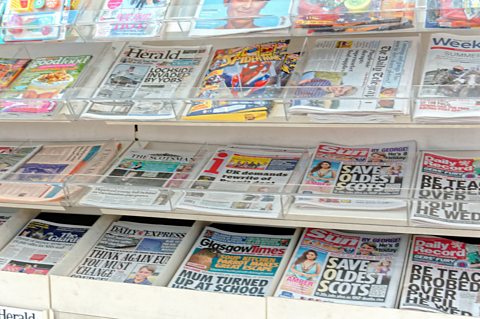 Image source, Gerard Ferry / Alamy
Many people used to get their political news from newspapers but in recent years the internet has become more popular as a source. However, thousands of newspapers are still sold every day and many people read newspaper articles online. In the U, the most popular newspapers are The Sun and The Daily Mail. The most widely read broadsheet papers are The Telegraph and The Times.
Newspapers don’t have to be balanced. As long as the information is accurate, the newspaper can print what they like. This means that different newspapers can report the same story in different ways. They can do this by choosing different stories, pictures and headlines.
Image source, Gerard Ferry / AlamyDuring elections, newspapers are often very clear about which political party they are supporting and urge their readers to vote for. This does not mean that all voters are persuaded by the newspaper they read. People may buy the newspaper for different reasons!
TV and radio
Television and radio political news reporting is different from newspapers as the law requires television news to be fair and balanced. Television companies are expected to report the facts and to be balanced in their analysis. Different representatives from different political parties are each expected to be allowed to give their views on important issues.
In recent years, TV debates have been broadcast involving the leaders of different parties. Each of these debates were watched by millions of voters. Post-debate analysis has suggested that most people who watched the debates had already made up their minds and were not influenced by what they heard. This meant that although one party leader or another may have appeared to have ‘won’ the debate, overall the debates had little impact on the election result.
Online and social media
Increasingly people in the UK are switching to the internet as a source of information, especially social media. As the internet allows almost anyone to post almost anything they choose, some information is not accurate. However, the internet does allow people almost unlimited access to information which means people are better informed than ever before.
For political parties in the UK, being online offers the chance to interact with voters. They can share information about what they would do if elected and then keep voters up to date with what they are doing between elections. This also allows voters to interact with MPs. They can ask questions and raise issues easily.
What are pressure groups?
At elections the people decide which representatives they want to make decisions on their behalf. However, elections can be as much as four or five years apart so people must have other ways of influencing their representatives.
One way is through pressure groups. Pressure groups are organisations of people with similar opinions. Pressure groups do not want power for themselves instead they want to influence those in power. They also encourage responsible participation in the democratic process.
There are many pressure groups in the UK that aim to influence political decision-making. Many UK-wide pressure organisations will have a separate Scottish section that aims to influence Scottish Parliament on some of their devolved powers.
How do pressure groups work?
- Posting leaflets through doors or knocking on doors and talking to people.
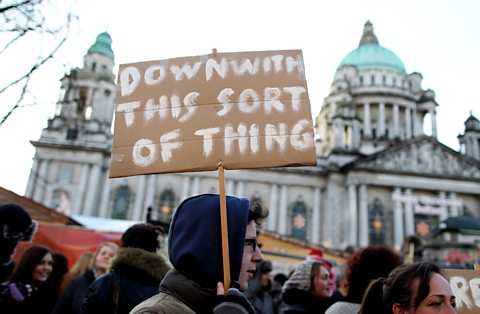
- Taking part in demonstrations, marches or attending rallies.
- Organising petitions.
- Lobbying (speaking directly to) MSPs or councillors.
- Writing letters to politicians or to newspapers.
- Giving interviews which are reported in the media (radio, TV and newspapers) or taking part in publicity stunts to gain media attention.
Developments such as Freedom of Information laws, the internet, social networking and a 24/7 media, mean pressure groups are aware of their power and are becoming increasingly professional in the way they work.
Outsider and insider groups

Outsider pressure groups are those who do not have influence in the government. This means that they tend to use media-based, high profile campaigns to capture public attention. Outsider pressure groups include Greenpeace, CND (Campaign for Nuclear Disarmament) and Surfers Against Sewage.
For example, in 2020 Marcus Rashford worked with Fare Share on the #MakeTheUTurn campaign to convince the government to provide families in England with vouchers for free school meals during summer holidays for pupils in need.
On the other hand, insider pressure groups are those that have the support and the attention of the government. They will often approach them for advice and have regular discussions about laws.
For example, the British Medical Association is a pressure group. They will rarely organise demonstrations or marches. Instead, they usually rely on meetings with the Government. They tend to be behind the scenes and away from the cameras to influence decision making.
How influential are pressure groups?
Generally, the larger a pressure group, the more influence it can hold:
- larger groups can argue the issues they campaign on affect a significant part of the population
- a pressure group that can demonstrate it represents a large number of people can have a larger influence on voting and elections
- more members means more people can become active in pressure group campaigns and activity
- more members means more funding - the pressure group can use this for larger events, campaigns, advertising or even to fund legal action
However a pressure group's influence also depends on the views of the wider public:
- do they care enough about the issues the pressure group campaigns on?
- do they agree with the pressure group's position?
- do they approve of the pressure group's methods and actions?
What are trade unions?
Trade unions are organisations of workers which attempt to improve the pay and working conditions for their members. In return for paying a subscription, members receive a wide range of benefits. These can be legal, such as financial help with access to a lawyer. Many trade unions offer a range of financial benefits to members such as cheaper deals with mortgages, discounts on holidays and car purchase. Trade unions exist in a wide range of occupations and professions.
A trade union may negotiate with the company over money matters, such as pay and pensions. Often within a workplace, a trade union representative, known as a shop steward will act as a ‘go-between’ between worker and management. He/she will try to resolve problems which may arise.
How can people participate in a trade union?
Members can participate in trade union activities by:
- attending union meetings in the workplace and discussing issues like pay and conditions
- voting in ballots held by the union, sometimes they will decide whether or not the union should take action
- voting in ballots to elect a new representative, such as a shop steward
- taking part in a form of industrial action such as a work-to-rule or a strike
Some employers do not recognise trade unions as they feel they are bad for business and may therefore discourage staff from joining. Other employers understand that good worker/management relations are important.
Trade unions work with employees and management on a daily basis, resolving workplace issues. Trade unions have rights but they also have responsibilities which they must adhere to.
What are trade union rights?
- To take industrial action to protect the rights of workers.
- To hold a secret ballot to establish if the majority of members are in favour of taking action.
- To try to attract new trade union members.
What are trade union responsibilities?
- Not to pressure anyone into joining a trade union.
- Trade unions can ask their members about changes in the workplace.
- To ensure that all forms of trade union activity and industrial action are peaceful and within the law.
How influential are trade unions?
Trade unions with large memberships can be more influential.
- they can argue that they represent a significant part of the population
- a large trade union can demonstrate it represents a large number of people can have a larger influence on voting and elections
- more members means more people can become active in trade union organisation, campaigns and activity
- more members means more funding - the trade union can use this for larger campaigns or even to fund legal action
However a trade union's influence also depends on the views of the wider public:
- do they care enough about the issues the pressure group campaigns on?
- do they support the union's position?
- do they approve of the union's methods and actions?
- how are they affected by the union's activity - for example people might react in different ways to a strike that causes disruption
Quiz
Recap what you have learned
- The role of media in the UK is to inform the public on important local, national or international issues.
- Newspapers don’t have to be balanced but the information has to be accurate.
- The law requires television news to be fair and balanced.
- Online almost anyone can post almost anything they choose, some information is not accurate.
Pressure groups, encourage public participation and aim to influence decision-makers without seeking political power.
Types of pressure groups in the UK:
- Insider groups
- Outsider groups
Methods used by pressure groups include:
- Demonstrations
- Petitions
- Media engagement
- Campaigns
Many UK-wide pressure organisations will have a separate Scottish section that aims to influence Scottish Parliament on some of their devolved powers.
Trade unions are worker organisations focused on working conditions. Members pay a subscription fee and in return can receive assistance in areas including:
pay disputes
legal assistance
financial perks
salaries
pensions and benefits
Trade union shop stewards act as as a go-between for communication between employees and management.
Trade unions have the right to:
- Organise industrial actions
- Hold secret ballots
- Collect membership subscriptions
More on Democracy in the UK
Find out more by working through a topic
- count11 of 18
- count12 of 18

- count13 of 18
- count14 of 18