Watch: How to use commas
In order to make your writing clear, you need to use commas.
As well as using them to separate out key information, or divide up different clauses, commas can also completely change the meaning of a sentence if they're not used correctly.
Watch this video to explore how commas are used.
Exploring the different ways to use commas
Commas can be handy to make things clearer.
Let's eat Albert… that's a good example.
No, Albert! Don’t worry, we'll show you.
A comma can be used to change the meaning of a sentence.
So instead of actually eating Albert, we're going to eat WITH Albert.
Commas can also be used to separate out any key information in the sentence.
Like this – Albert, the alien with blue spots, is from the Planet Zoink.
Commas can also separate statements.
Such as – Albert got used to the blue spots, but then they started itching.
To summarise then… commas are able to change the meaning of a sentence…
break up longer sentences into more manageable parts…
and separate out additional information.
Ah. Guess it's just you and me for lunch then Jerry.
Four ways to use commas
1. Writing a list
When you're writing a list, use commas between each item in your list. Use and between the last two items, instead of a comma.
For example: Today I need to buy milk, bread, apples and potatoes.
2. Making your meaning clear
Adding a comma can change the meaning of a sentence completely, so it's important you put it in the right place.
For example: Let's eat Callum!
This means we're actually going to eat Callum!
Compare it with this: Let's eat, Callum!
A comma is used correctly after eat, so this means we're eating with Callum - phew!
3. Adding extra information
In longer sentences, you can use commas to separate out extra information (known as 'parenthesis') to make the sentence easier to read.
For example: Edinburgh, the capital city of Scotland, is famous for its castle.
4. Breaking up sentences
A clause is the building block for a sentence. Commas can be used to break up sentences that have more than one clause, to make them easier to read.
For example: When Albert saw the food, his tummy started to rumble.
This sentence has a subordinate clause: 'When Albert saw the food'.
Subordinate clauses do not make sense on their own because they need the main part of the sentence ('his tummy started to rumble') to be completely clear. When you have two clauses like these, they need to be separated by a comma.
When don't you need a comma?

If the clauses make sense on their own, you don’t need to use a comma. Write the clauses as separate sentences instead.
For example:
Albert was excited about eating. He wanted to use a knife and fork.
Activity 1
Activity 2
Activity 3
Watch this clip of Chocolate Cake by Michael Rosen.
'Chocolate Cake' by Michael Rosen
Hi. My name's Michael Rosen and I write poems.
When I was a boy, I had a favourite treat and it was when my mum made chocolate cake. She said, "Listen Michael, if there's any chocolate cake left over at tea-time, you can take it to school tomorrow, to have in the playground."
One time, there WAS some chocolate cake left over at teatime and I went to bed. In the middle of the night, I woke up, and I thought… chocolate cake! Maybe I could go downstairs and have a little look at it. Everyone's asleep, my mum and dad in bed. Out along the passage, careful not to tread on the creaky floorboard outside my mum and dad's room.
Are they still asleep? Yes! On downstairs into the kitchen, over to the cupboard and – yeah! – there it is. Now, just look at it. I see some little crumbs on the plates, so I think if I lick my finger maybe I could pick up some of those crumbs.
Then I notice some little crumbly bits on the side of the cake, so I think, maybe if I take a knife I could just tidy it up a little bit. So, now I've got the taste of chocolate cake in my mouth. I think, maybe I could take a slice. So this time, through the crispy icing on the top, through the squashy icing in the middle. And now I think, I can't stop myself! What a greedy pig!
Oh no! It's gone.
Oh, no, they're bound to notice now. What am I going to do? I know! I'll wash up the plate and the knife and they won't know anything about it.
Plate, knife, under the sink. And back up to bed. Along the passage. Still asleep!
Into the bedroom, under the covers, nice warm feeling, chocolate cake in my belly. Goody, goody goody!
In the morning I get up, and I'm having my breakfast, and my mum, busying about all over the place, and…
"Something else nice! There's some chocolate cake left over from yesterday for you to take to school today!" And I went…
"No, it's OK, it's all right."
And she's looking at me, very closely, just here. And she says, "What's that?"
And I said, "What's what?"
She said, "That there, that there. It's not…chocolate cake, is it?"
And I went… "Dunno…"
"You haven't eaten the whole of the rest of the chocolate cake, have you?"
And I said, "I don't know."
"You don't KNOW if you've eaten all that chocolate cake? Listen here. That's the last time you EVER have chocolate cake totake to school. D'you hear me? Go upstairs to the bathroom and wash your dirty, sticky face."
I went upstairs and I looked in the mirror and I saw it, just there. The chocolate blob. And I looked at it and I thought, that's what gave the game away. She wouldn't have known otherwise.

1. Write a sentence about chocolate cake that includes commas in a list.
For example: Michael needed flour, cocoa, sprinkles and chocolate to bake a cake.
2. Now write a sentence about chocolate cake where a comma has been used to separate two clauses.
It might help to start your sentence with a subordinating conjunction, like whenever, however, although or after.
For example: “Whenever I think of chocolate cake, my tummy rumbles!”
3. Can you write three sentences to describe Michael’s chocolate cake adventure that uses commas to add extra information (parenthesis)?
For example: Michael, who was an inquisitive ten-year-old boy, loved chocolate cake.
Top tip!
Remember, a sentence should still make sense if the parenthesis is removed.
Activity 4
Look carefully at the four pictures below.
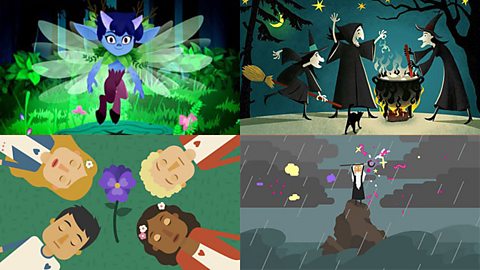
Now, write a sentence about each picture, using commas to show parenthesis. For example:
The fairy, who hovered above the ground, had a kind smile.
Remember to use a pair of commas to separate the parenthesis from the main clause within the sentence.
Play our fun English game Crystal Explorers! game
Use grammar, punctuation and spelling skills to explore jungles, caves and tombs on your mission.

More on Punctuation
Find out more by working through a topic
- count2 of 3

- count3 of 3