Overview of Havisham by Carol Ann Duffy
The poem Havisham by Carol Ann Duffy is told from the perspective of Miss Havisham from the novel Great Expectations by Charles Dickens - a jilted bride, who has never recovered from being stood up many years ago on her wedding day.
It is a bitter, sharp poem exploring:
- how love can turn so easily to hate
- how a rejected lover can become a dangerous figure
The poem deals with themes of love and betrayal and loss and grief.
Looking for some quick revision? Try an interactive quiz for National 5 English.
You can read Havisham by Carol Ann Duffy on the Scottish Poetry Library website.
Context
The poem Havisham comes from Duffy's collection Mean Time, published in 1993. It probably provided the inspiration for Duffy’s first themed collection of poetry The World’s Wife (1999), in which she considers the often neglected women behind some of the most iconic male figures from history, literature and legend.
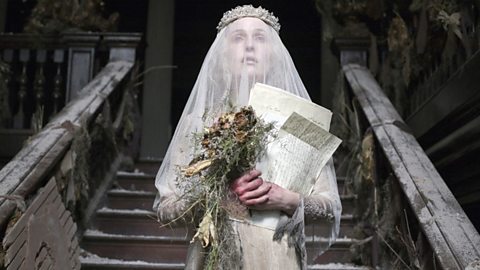
Who is Miss Havisham?
- The speaker of this dramatic monologue is the fictional Miss Havisham from Charles Dickens' Great Expectations.
- Jilted by her lover, Miss Havisham spends the rest of her life decaying in her wedding dress amid the remnants of her wedding breakfast, grooming her beautiful niece Estella to exact revenge on all men.
- The title of the poem, her unmarried surname, reveals her self- loathing and bitterness at being denied the A word or phrase which describes the main quality of someone or something. of Mrs and being forced to live the remainder of her life as a spinster.
Read more about the character Miss Havisham and her role in Great Expectations: Miss Havisham in Great Expectations.
Form and structure
With choppy, stilted phrasing, the poem Havisham is written in four unrhymed stanzas.
Havisham speaks in a dramatic monologue, picturing revenge on the man who abandoned her. The mention of death at the start and end of the poem show a lack of ability to move on – she comes full circle and arrives back where she started; thinking of his death.
The lack of rhyme and the presence of The use of run on sentences with no punctuation at the end of lines or across stanzas. help to create a more defined voice in the poem. However, while this can often produce a more natural, realistic speech pattern, in this case it has the opposite effect: Havisham’s voice is erratic, which emphasises the lack of order and structure to her thoughts.
Similarly, although at first glance the poem looks fairly regular, there is no fixed The number and type of rhythmic beats in a line of poetry.. This, and the occasional slightly off-kilter and The repetition of vowel sounds in a series of two or more words., help to reinforce this lack of logic and the erosion of the speaker’s psyche.
Stanza one
Havisham begins with a powerful A phrase that contains two words or ideas that seem to contradict each other, for example ‘bitter sweet’.An incomplete sentence that still makes sense without all the necessary information.:
Beloved sweetheart bastard.
This reveals, without ambiguity, the focus of the speaker’s hatred and emphasises the swear word. The The repetition of the same sounds or consonants in two more words nearby each other. of the Plosive sounds are made by suddenly releasing air that has been blocked by various parts of the mouth. The sounds /b/, /d/, /t/, /p/, /k/ and /g/ are all plosives. 'b' sounds creates the impression that the words are almost being spat out, helping to create the caustic, bitter tone that runs throughout the poem.
This is followed immediately by the frank admission that Havisham wishes for her ex's death every day. This entire stanza is a kind of curse, detailing the extent to which she wishes her former lover dead through the all-consuming nature of her hatred. She is literally stuck in time, paralysed as a ridiculous parody or imitation of a bride whose love has been rejected by her fiancé.
In giving a voice to Miss Havisham then, Duffy clearly exposes the terrible, corrosive effects of such an experience on the human psyche. She has prayed so earnestly for his death, with her eyes tightly shut and her hands clasped together, that her eyes have become "dark green pebbles" and the veins on the back of her hands protrude like "ropes".
Green, of course, is the colour of envy and jealousy and if the eyes are the windows to the soul, the pebble Imagery is where the writer uses words to paint picture to help the reader visualise the subject being described. Imagery often involves a comparison such as simile, metaphor or personification. suggests that hers is now cold, dead and hard.
The reference to strangling her lover is an An allusion is when you refer to a person, place, event or idea that other people will know. For example to a famous story or piece of literature. to Dickens’ novel, in which Estella’s natural mother strangled a rival with her unusually strong hands.
Video - What is allusion?
Havisham contains many allusions to Dickens' novel Great Expectations. Learn more about allusions in this short video.
What is allusion? How and why would you use it?
Allusion
Hinting at or making an indirect reference to a well-known person, place, event or idea.
A lot of the time, allusions refer to another piece of writing.
“When it came to spending money, he was a total Scrooge.”
Scrooge is a rich banker in Charles Dickens’ novel, A Christmas Carol.
He’s well known for being stingy with his money.
So, describing someone as a ‘total Scrooge’ alludes to the idea that they’re overly careful with their cash.
“She had so much homework, but the football tempted her from the garden - a forbidden fruit”
Can you figure out the allusion?
This is a reference to the forbidden fruit that Adam and Eve are tempted to eat in the Garden of Eden.
Here, the football is a very tempting distraction from homework.
You’ll find a lot of allusion that points to the Bible, or to legends and mythology.
Biblical allusion is also used by Norman MacCaig in his poem ‘Assisi’.
"A rush of tourists, clucking contentedly, fluttered after him as he scattered the grain of the Word.”
A group of tourists follow a priest who preaches the Gospel, but they all ignore a beggar who sits on the church steps.
“Grain of the Word” is an allusion to the Parable of the Sower, a story in which Jesus encourages the spreading of the word of God like you might scatter seeds.
Some seeds will grow into something great, but some land on infertile ground and don’t grow.
MacCaig’s allusion is deliberately ironic.
It implies that the true meaning of the gospel is lost on the tourists as they ignore the beggar.
Now you understand allusion, it can never be your Achilles Heel – your weakness.
Stanza two
Spinster. I stink and remember.
This stanza opens with the word "Spinster" spoken like a profanity or insult. It is deliberately isolated in a sentence on its own to emphasise Miss Havisham's own feelings of isolation in a society in which women were often defined by their marital status.
As the wedding dress decays on her year after year she is left only to "stink and remember" the pain inflicted on her by her lover’s rejection.
Nooooo at the wall; the dress / yellowing, trembling if I open the wardrobe
The "yellowing" dress imitates her emotional decay and, like the green mentioned earlier, Duffy exploits the negative associations of the colour with rot.
The description of the dress "trembling" could suggest that it has a life of its own, or that it is no longer clothing but part of Havisham herself. Is it, or she, trembling through age, or upset, or fear at the thought of being replaced with other clothing?
The When a word sounds like the word it is describing. For example, ‘buzz’ or ‘hiss’. "Nooooo" reveals the extent of the speaker’s anguish after she was jilted as she recalls viewing herself "full-length" in the "Something that has turned or twisted. mirror" and asking "who did this."
She no longer recognises the image that appears before her and the deliberate word choice of "slewed" shows how the world that she once knew and felt she belonged to is now similarly unfamiliar and strange.
This emphasises just how entirely out of place and alien she feels inhabiting her new persona as a spinster. In this stanza, the construction and order of the lines and words is deliberately jumbled and confused to emphasise the speaker’s irrationality and her muddled, tormented state of mind.
She presents herself as the victim - this was a wrong that was done to her and she is determined to exact revenge. The Presenting an idea in a way that is interesting or strange because of being very different from what you would expect. is that this quest and lust for vengeance is utterly self destructive and only increases her pain.
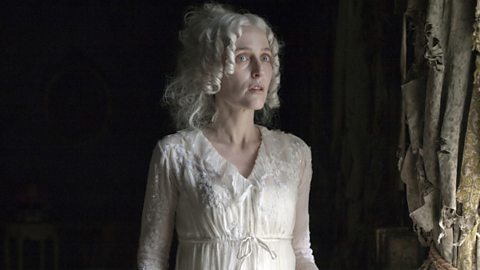
Stanza three
who did this / to me?”
Duffy uses The use of run on sentences with no punctuation at the end of lines or across stanzas. so this question carries on from stanza two into stanza three. This reinforces the continuation of her suffering.
Puce curses that are sounds not words.
Duffy chooses the colour puce, which has negative associations with disease and fever, to create A technique which suggests that one sense is experienced by another., when one sense, in this case sight, is used to describe another, the sounds of the speaker’s curses.
Video - What is synaesthesia?
Duffy uses synaesthesia when describing "puce curses". Find out more about this technique in this short revision video.
What is synaesthesia? How and why would you use it? Bitesize explains with examples from ‘Havisham’ by Carol Ann Duffy.
Synaesthesia
A technique that suggests that one sense is experienced by another.
Like this: “The boy’s friend gave him a cold look”
Here, the senses of sight and touch are connected.
Temperature is something we’d usually associate with touch, but using ‘cold’ to describe a look tells us the boy was being unfriendly - you can almost feel the chills!
Synaesthesia can be connected to other senses too.
“She spoke in honeyed tones”
Here, the pleasant, comforting sound of a voice is described using synaesthesia.
To the reader, it suggests something that feels soothing, and tastes sweet.
Synaesthesia is used in writing and poetry to stimulate the reader’s senses.
The experience can be enjoyable but it’s not always pleasant…
‘Havisham’, a poem by Carol Ann Duffy, describes the experience of a woman abandoned as a bride on her wedding day.
Decades later, still wearing her decaying wedding dress, she shouts at the wall:
“Puce curses that are sounds not words”
Puce is an unpleasant colour - the colour of old, dried blood.
Carol Ann Duffy links the unsightly colour with the harsh sound of Miss Havisham’s screams.
Together these build an uncomfortable experience for multiple senses that help us understand her grief, anger and pain.
Why not try synaesthesia in your writing, and paint a picture that’s a feast for all your senses.
Miss Havisham is so consumed by her hatred that she is unable to articulate her emotions through language. She is dehumanised when she is described as vocalising her bitter anger through "sounds not words", a link to the earlier "cawing Nooooo".
However, in an abrupt change in direction, a glimpse at the softer side of the speaker is revealed in the next two lines:
Some nights better, the lost body over me my fluent tongue in its mouth in its ear.
In contrast to her current struggle with language, in her dreams she recalls how her tongue used to be "fluent" when she could skilfully use it to seduce her lover. Even here though the strength of her hatred continues to permeate and sour all of her most pleasant memories.
Duffy deliberately chooses not to use the pronoun “his” for Havisham’s lover - instead she uses "the" and "its". This creates a sense of distance from him, while simultaneously depriving him of his humanity, and therefore makes it easier for her to continue to hate him. Reference to “the lost body” suggests an image of someone who is already dead.
The stanza concludes with the violent interruption of her dreams:
till I suddenly bite awake.
The use of the present tense in the verb "bite" reminds us that, despite the passing of years, her anger and bitterness have not abated and are just as raw today as when she was first jilted.
In addition, the choice of the word "bite" could also imply that she bites her tongue in her sleep, helping to explain her current inability to articulate herself or, even more sinisterly, that she fantasises about inflicting pain on her lover by biting him.
Stanza four
Love’s / hate behind a white veil
Again The use of run on sentences with no punctuation at the end of lines or across stanzas. is used at the end of stanza three with the word "Love's" running incongruously into "hate" in the fourth. In doing so, Duffy exposes just how inextricably linked these two seemingly opposing emotions are. There is something almost possessive, distinctive about the specific and enduring type of hate that is provoked through the betrayal of love.
The "white veil" is normally an image of romantic love, associated with the purity and virginity of a bride. Here it has become something that the speaker, and her true feelings, hide behind. Although she clearly identifies herself as the wronged, innocent party in this image, she cannot maintain it for any length of time as there is an almost immediate contrast in the next image of the "red balloon bursting". This violent Describing something by saying it is something else. While a simile compares things using 'like' or 'as', a metaphor creates a direct comparison represents the speaker’s heart and the rage and hatred that now consumes her.
The Plosive sounds are made by suddenly releasing air that has been blocked by various parts of the mouth. The sounds /b/, /d/, /t/, /p/, /k/ and /g/ are all plosives. 'b' in "balloon","bursting" and "bang" emphasises the suddenness and shock of this experience as her dreams were so abruptly and irrevocably shattered.
The isolation of the When a word sounds like the word it is describing. For example, ‘buzz’ or ‘hiss’. "Bang" in its own sentence also serves to awaken the speaker from her reverie and prompt her back to the miserable reality of her present existence.
Hate is the only emotion she is now able to feel. Without it she would be utterly numb and so in many ways it is only by preserving and nurturing her loathing and hatred that she has a purpose to her life.
As the stanza continues, Duffy subverts our usual happy associations of weddings into another violent image by describing Miss Havisham stabbing at the cake. As the cake lies there decaying, it reminds us that like Miss Havisham, it too has never fulfilled its purpose.
Just as the cake was never consumed, so too Miss Havisham's marriage remains unconsummated and, like her, the cake continues to stagnate and atrophy. The penultimate line of the final stanza is loaded with sinister, perhaps even necrophiliac undertones:
Give me a male corpse for a long slow honeymoon.
Again, she subverts our usual associations of the honeymoon with joy and happiness into something much more menacing.
The final line of the poem though is more poignant:
Don’t think it’s only the heart that b-b-b-breaks.
The last word is broken up not only to imitate the sound of the speaker finally breaking down in anguish, but to emphasise the extent of her mental and emotional disintegration.
This hatred and anger have consumed and destroyed every other aspect or facet of her personality so that she is now little more than an empty husk.
What are the themes in Havisham?
Love and betrayal
In giving Miss Havisham a voice outside of Dickens’ novel, the poet is able to crystallise perfectly how the single event of being jilted can completely shatter and destroy a human being, and erode any love or compassion that could once be felt.
The mood throughout is bitter and caustic as Duffy clearly conveys how love can quickly be replaced with hatred and violence. The wedding imagery, the cake, the dress and the honeymoon, are all used to reinforce how quickly experiences and events associated with joy can be soured and become toxic symbols to feed and nourish hatred instead of love.
Although furious in tone and content, it is clear that Havisham’s enduring love for the man who walked out on her is the root of her problems. The betrayal and hurt he has caused her has turned her into a hateful, violent figure. The theme of how love can turn so easily to hate and harm is common in Duffy’s work.
Loss and grief
Havisham is an undoubtedly angry poem, but at its heart there is a sadness prevailing. The loss and hurt Havisham feels is palpable and while she rages about revenge there is a sadness to the image of a woman unable to move on from the harm once done to her by a loved one.
Comparing Havisham with other Carol Ann Duffy poems
Carol Ann Duffy's poem Mrs Midas tells a similar story of a broken relationship, and although the damage done to the Midas’s relationship happens within the telling of the narrative, the betrayal and hurt caused by a loved one is similar. As well as the harm caused, the unbroken love between both sets of partners is still present, leaving us with the message that while love can be toxic, it can also remain even when it isn’t wanted anymore.
Medusa and Havisham share a sharp, vengeful tone and neither poem holds back from describing the anger filling the lives of both women. We see similar pictures of a broken relationship and the unmitigated desire for revenge existing within betrayed women.
Before You Were Mine has the speaker wistfully remembering her mother and trying to connect with the life she had as a younger woman, before the responsibilities of motherhood. In contrast to Havisham, this love doesn’t turn sour but nonetheless it is acknowledged that life experiences change the young, carefree woman portrayed in the poem.
Revise Havisham by Carol Ann Duffy
Revise Havisham and other poems by Carol Ann Duffy with interactive quizzes for National 5 English.
Quizzes - Carol Ann Duffy. quiz
Test your knowledge of the set texts by Carol Ann Duffy with interactive quizzes for National 5 English.

More on Carol Ann Duffy
Find out more by working through a topic
- count3 of 7
- count4 of 7
- count5 of 7

- count6 of 7