Overview of Medusa by Carol Ann Duffy
The poem Medusa by Carol Ann Duffy gives voice to the Greek mythological figure, Medusa. Medusa had the ability to turn people to stone with just one look at her face.
Medusa is both a terrifying and sympathetic reflection on the destructive potential of jealousy, anger, and the damage men can do to women.
The poem deal with themes of :
- trust and jealousy
- love and pain.
Looking for some quick revision? Try an interactive quiz for National 5 English.
You can read Medusa by Carol Ann Duffy on the Scottish Poetry Library website.
Context
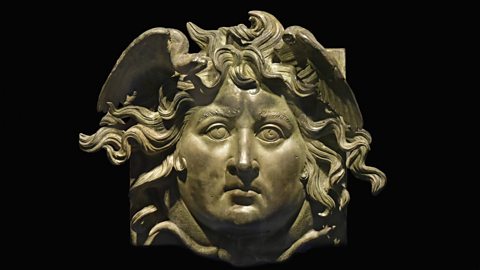
In Ancient Greek mythology, Medusa was one of three sisters called Gorgons.
In many versions of Medusa’s story, she was a beautiful woman who was cursed by the gods. Her hair was changed to venomous snakes and her stare could turn anyone who looked at her into stone.
In most versions of the story, Medusa was beheaded by the hero Perseus.
Watch: The Story of Perseus
Form and structure of Medusa
Carol Ann Duffy's poem Medusa is a narrative monologue, where Medusa addresses us, the reader, directly. The use of the dramatic monologue allows the reader to engage directly with the speaker’s emotion and unfiltered anger.
The poem has eight stanzas:
- Stanza one has five lines
- Stanzas two to seven have six lines each
- Stanza eight is one single dramatic line
There is also no A repeated pattern of rhymes, usually written with letters ABAB would mean lines 1 and 3 rhyme; and lines 2 and 4 rhyme also rhyme but differently. or The number and type of rhythmic beats in a line of poetry.. Combined, this gives the poem an informal, conversational tone which underscores the raw emotional content of Medusa’s speech. It also has the effect of keeping the reader in suspense as, unlike more formal rhyming verse, it’s unclear what pattern is coming next.
The list of creatures in stanzas 4-6, building in size and significance gives the effect of a A gradual build-up, increase in intensity before stanza 7’s direct appeal to her lover.
The clear command of the last line (“Look at me now”) stands alone and clear, a bold, direct challenge after the build-up of the previous few stanzas, while Medusa’s intention remains uncertain.
Stanzas 1-3
Stanza one
Medusa by Carol Ann Duffy begins with a list of three thoughts:
A suspicion, a doubt, a jealousy / grew in my mind
The use of Three parallel words, phrases or sentences. and The lack of conjunctions between phrases. leaves us wondering if these are separate thoughts or one complex, twisting feeling. Duffy uses the A word used to describe the ideas or feelings that a word might suggest. For example, a skull conjures up thoughts of fear, mortality and death. of “grew” to make the thoughts appear to take on a life of their own, bringing to mind the infamous snakes which make up Medusa’s hair.
This image is continued with the The repeated use of the ‘s’ sound in the beginning, middle or end of nearby words. of hissing sounds in:
hissed and spat on my scalp
This use of "hissed" and "spat" creates the image of the snakes being angry and ready to lash out.
Stanza two
Stanza two continues to describe the physical damage these negative thoughts have on Medusa’s body with the harsh A sound feature; the repetition of the same sounds (mainly consonants) usually at the beginning of words. ‘b’ sound in “bride’s breath” and the image of lungs as “grey bags”:
My bride’s breath soured, stank / in the grey bags of my lungs.
Medusa describes her low self-esteem as she loses her beauty and her humanity to jealousy.
foul mouthed now, foul tongued, / yellow fanged.
Duffy employs Three parallel words, phrases or sentences. again to emphasise how horrible she has become, and how she views herself. The imagery of "yellow fang[s]" directly compares her to the snakes on her head.
At the end of stanza two, when the monster has truly taken form, Duffy uses an A phrase that contains two words or ideas that seem to contradict each other, for example ‘bitter sweet’. as she describes “bullet tears” and we get a feeling of the fury and rage she feels as well as the heartbreak and hurt. However, before sympathy can build too much, Medusa turns her gaze to us with a mocking rhetorical challenge:
Are you terrified?
Video - Use of question and exclamation marks
Watch this short video clip to learn how writers, like Carol Ann Duffy, use question and exclamation marks for effect.
What are question and exclamation marks? How and why would you use them?
Question marks and exclamation marks
Punctuation marks that go at the end of a sentence, but they tell us more than a full stop does!
A question mark lets you know that the sentence is a question, and usually needs an answer.
Would you like a cup of tea?
Exclamation marks show excitement, shock or anger.
This tea is too hot!
Exclamation and question marks can also tell you how to read the sentence.
You could sound shocked, or aggressive!
Or maybe inquisitive?
You can also use question marks and exclamation marks together to ask an excited question or to show shock and disbelief.
Where on Earth have you been?! This can be shown as ?! or by using an interrobang: ‽
Tongue, Jackie Kay looks back nostalgically at the Scottish language:
“shut yer geggie or I’ll gie you the malkie!”
It might not be clear to people from outside Glasgow that this is a threat, but the exclamation mark gives us an idea, by showing that the sentence is to be said with some force.
"Oh where did all my words go – my old words, my lost words?”
At this point Kay uses a question mark to ask herself a question, giving us an insight into her feelings of uncertainty. The question draws attention to her sense of loss, as well as the speed of the change in her identity.
Do you get it now?
See, it’s easy!
Stanza three
Stanza three answers the previous question with the ominous statement:
Be terrified
Medusa speaks directly to us and we are him: the man who has caused her pain. This direct confrontation is uncomfortable and troubling. Duffy To place two or more ideas/images close together to create further meaning for an audience. it in the next line “It’s you I love” and, like “bullet tears”, we get an idea of Medusa’s contrasting emotions of love and hate.
Duffy goes on to describe her love interest as a:
perfect man, Greek God, my own
The use of another tricolon emphasises the idealised image of the handsome man she loves and an An allusion is when you refer to a person, place, event or idea that other people will know. For example to a famous story or piece of literature. to Greek statues not only describes the perfection of the male form (contrasting Medusa’s ugliness) but creates a menacing image of a man turned to stone.
She states that she knows:
you'll go, betray me, stray / from home
This emphasises that in her mind he will definitely leave her and be unfaithful. The rhyme of “my own” and “turned to stone” links the image of a Greek god with something made of stone – she would rather preserve him as he is as if a lifeless statue rather than let him live and move on.
We question whether she has learned from relationships in the past or if the thoughts from stanza one are pushing her loved ones away.
Stanzas 4-6
Stanzas four, five, and six of Medusa consist of a list of creatures which grow in terms of size and significance. Each animal becomes a paradox of beautiful life and then horrible, dead stone. As well as the creatures growing, Medusa herself grows more warped and powerful. Her actions grow from a “glance” to a “look” to a “stare”, as if experimenting with her growing power. This gives the poem a A gradual build-up, increase in intensity effect in this section.
Stanza four
Stanza four deals with:
- a happily A sound feature; the repetition of the same sounds (mainly consonants) usually at the beginning of words. “buzzing bee” which falls to a “dull grey pebble”
- a “singing bird” turning to “a handful of dusty gravel”
We are reminded each time of the beauty of life and the awful heaviness of a stony death.
Stanza five
As stanza five moves on to:
- “a ginger cat”
- “a snuffling pig”
We see that Duffy is increasing the stakes before she eventually looks upon herself. To ease some of this tension, black humour is employed when describing
a boulder rolled / in a heap of shit
Stanza six
Stanza six is when Medusa looks upon herself in a mirror and, with a touch of self-awareness, blames the horrid figure she sees on
Love gone bad
This three word line lays the blame not on her unfaithful lover, but on love itself, showing how far her jealousy has twisted her. The earlier black humour is gone and she describes herself with terrifying imagery, comparing herself to “a Gorgon” and “a dragon”. She speaks and her words are:
Fire spewed / from the mouth of a mountain
This brings to mind an awful vomit of rage and fury.
Stanza 7-8
Stanza seven
The tone of stanza seven grows frighteningly sharp as the build up of images and intensity finally reaches a peak, as Medusa addresses her lover:
And here you come / with a shield for a heart
This hints that he is guarded and possibly dishonest as well as the more obvious A word used to describe the ideas or feelings that a word might suggest. For example, a skull conjures up thoughts of fear, mortality and death. of needing some sort of protection from the visceral anger within Medusa. Her lover’s “sword for a tongue” again suggests the cruelty he is capable of and although he bears the equipment of an ancient Greek hero like Perseus, Medusa does not see him as a valiant figure and instead a threat. She has closed herself off to love and repeats a plural claim that he brings with him “girls” – a diminutive and belittling way of referring to other women.
Stanza seven closes with Medusa asking him in an ambiguous tone:
Wasn’t I beautiful / Wasn’t I fragrant and young?
She is perhaps questioning her lover as to why he would ever want to be unfaithful, or maybe highlighting through the past-tense phrasing how her jealousy has changed her into something entirely opposite these other women, and how nostalgic she now is for her former beauty. The questions are an example of A plea or argument designed to evoke an emotional response.: a plea to her lover, as well as the reader, to attempt to evoke sympathy or pity
Stanza eight
Stanza eight, with its four-word, single line structure, naturally stands out to us, emphasising the double entendre of:
Look at me now.
We are left wondering if Medusa is pleading for him to look at her in an attempt at reconciliation or understanding, or does this command reflect that her transformation to a monster is complete and her certainty that she wants to kill him with her stare? Nonetheless, the command is clear and direct, a dramatic end to the poem.
What are the themes in Medusa?
Trust and jealousy
The lack of trust Medusa has for men is evident throughout this poem. She allows her jealousy and fearful nature warp her humanity to the point she describes herself as “a Gorgon”, “a dragon”, and even a “mountain” spewing fire. She asks her lover “Are you terrified?” and immediately tells him ‘Be terrified’. She does not want to hear any answers or pleas – her mind is already made up:
I know you’ll go, betray me, stray / from home. / So better by far for me if you were stone.”
She would rather embrace her curse and turn the man she loves to stone than let him live and betray her.
Love and pain
Instead of painting love in the way we expect, Duffy instead focuses on the harmful potential love can bring out in some people. Medusa is so affected by the pain of a lost love, or perhaps simply the potential for love going wrong, that she becomes something inhuman and violent in order to keep people at arm’s length.
Her lover is described as having ‘a shield for a heart/and a sword for a tongue’, emphasising that his heart is armoured and not truly accessible to her, but that his words (possibly even loving ones) have the ability to severely wound her. It is this vulnerability she cannot accept, and so has, ironically hardened against the notion of love.
Comparing Medusa to other Carol Ann Duffy poems
Medusa and Mrs Midas share obvious similarities in the otherworldly powers based on classic mythology, but at its heart it is also a poem about a hurt woman and the emotional damage which can be done to one's partner in a relationship.
With its Gothic image of a spurned bride turned to spiteful cursing, Havisham marks the third poem which deals with emotionally fraught women and the effects a toxic relationship (or lack of relationship in this case!) can have on a person. All three of these speakers have been damaged and have resigned themselves to their fates.
In Before You Were Mine, the woman in the poem (the speaker’s mother), is seemingly happier in her youth and early days, so again there is that hint of life experience ultimately wearing women down. The title of this poem also alludes to the fact that the speaker is piecing the idea of her mother’s younger life together from passed down photographs and memories – so the woman in this poem, although seemingly a ‘real’ person is also a constructed character, like Medusa and Mrs Midas. She does not speak directly to the reader, like either of these characters. Although her myth is well known, Medusa has her own voice.
All of the poems in the set look back to the past and deal with change. For example, Medusa looks back to when she was “beautiful”, “young” and “fragrant”. This shares a sense of nostalgia and loss of innocence with Originally where moving to a new home means accepting the eating of worms or slugs, and In Mrs Tilscher's Class where the speaker leaves the security of Mrs Tilscher’s classroom for the outside world of rough boys and thunderstorms.
Revise Medusa by Carol Ann Duffy
Revise Medusa and other poems by Carol Ann Duffy with interactive quizzes and flashcards for National 5 English.
Quizzes - Carol Ann Duffy. quiz
Test your knowledge of the set texts by Carol Ann Duffy with interactive quizzes for National 5 English.

More on Carol Ann Duffy
Find out more by working through a topic
- count5 of 7

- count6 of 7

- count7 of 7
- count1 of 7