Overview of In Mrs Tilscher's Class by Carol Ann Duffy
In Mrs Tilscher's Class by Carol Ann Duffy explores a young child growing up within a nurturing primary school environment.
Mrs Tilscher, from the poem's title, is portrayed as a loving teacher who has a profound effect on her pupils.
The poem explores themes of childhood, change and growing up.
Looking for some quick revision? Try an interactive quiz for National 5 English.
You can read In Mrs Tilscher’s Class by Carol Ann Duffy on the Scottish Poetry Library website.
Context
In Mrs Tilscher's Class is drawn from Carol Ann Duffy's own experience and Mrs Tilscher was a real teacher.
The use of the The pronouns in English (I, you, he, she, it, we, they, me, him, her, us, and them) showing contrasts of person, gender, number, and case. "you" suggests Duffy is speaking to her younger self as she recalls her positive memories of school.
You also makes the recollection seem like a shared experience. This enables the reader to identify with Duffy, drawing them in to the poem and its universal theme of childhood and growing up.
Duffy uses different times of year to represent the stages in the child's journey towards adolescence.
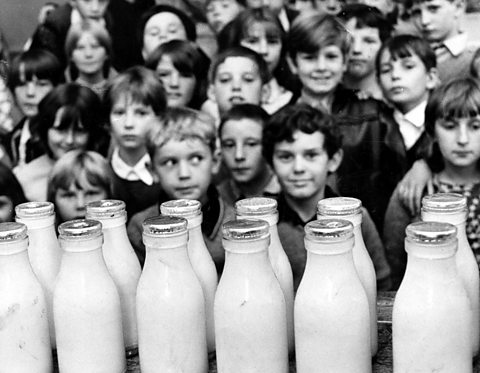
Duffy conjures a classroom from the past, by mentioning
- "chalk"
- a "skittle of milk"
The reference to Brady and Hindley, the ‘Moors Murderers’ serial killers, sets the poem in the 1960s, as they would have featured greatly in the news during this time. The fact that Brady and Hindley murdered children creates a sense of threat that contrasts with the safe world of the classroom.
The delight of Mrs Tilscher's Class seems to protect the children from the seedy and dangerous outside world, but it does not last forever. The children grow and move towards adolescence, where they experience new feelings and sensations, and ultimately leave Mrs Tilscher behind.
Form and structure of In Mrs Tilscher’s Class
In Mrs Tilscher's Class takes the form of four stanzas:
- Stanzas one and two each have an even eight lines. They describe the positive atmosphere of the primary school classroom.
- Stanzas three and four have seven lines each. This change perhaps reflects the destabilising nature of adolescence. They introduce the theme of change and growing up.
Stanza one
Stanza one introduces an idyllic primary classroom. The speaker is spellbound by her teacher who makes learning an adventure. It ends on a note of happiness with the laughing school bell, calling the lessons and the stanza to a close.
Stanza two
In stanza two, Duffy continues to portray the same wonderful environment of a classroom, comparing it to a sweetshop. However, she To place two or more ideas/images close together to create further meaning for an audience.
- the horrors of the external world (by including the names of Brady and Hindley)
- the almost magical descriptions of the classrooms
Structurally, while these names shock the reader, they have little impact on the rest of the verse, as they are enclosed within lines of positive description. But, like the "smudge" they leave behind, they do remind us that the innocence and joy of childhood is precarious thing.
Stanza three
Duffy introduces a turning point in stanza three. The time is Easter, when in the Christian calendar Christ rose again. It is a time of growth and new beginnings. And it is appositely at this point that the child speaker learns how she was born. It is interesting that this stanza takes place outside the classroom, as if this growth could not happen in the comforting bubble Mrs Tilscher created.
Stanza four
The final stanza describes the child's sexual awakening, as she experiences unfamiliar feelings and no longer finds the answers with Mrs Tilscher. Significantly, the poem ends with the speaker leaving the school gates, perhaps to embark on the next stage in her life.
Stanza one

In Mrs Tilscher’s Class opens with the The pronouns in English (I, you, he, she, it, we, they, me, him, her, us, and them) showing contrasts of person, gender, number, and case. "you". The poem is A description of a person’s life written by that person. and Carol Ann Duffy seems to be addressing herself and her own memories.
But the subject matter is universal and invites the reader to remember their own experience of primary school. The effect immediately involves the reader in this child's experience. We are going on a journey up the "Blue Nile" with the speaker who is fully engaged in Mrs Tilscher's lesson.
This poem is full of senses and we begin with the visual 'blue' of the river, followed by the sound of the teacher "chanting" the names
Tana. Ethiopia. Khartoum. Aswan.
The minor sentences here evoke the teacher dropping these foreign names into the young child's imagination so that they will follow her on the adventure of learning. Duffy conveys the sense of wonder and excitement of a young child. But this is a safe adventure, carried out in class with an atlas, very different from a real journey down river.
Then, still with Mrs Tilscher, the class has their milk - something all primary children were provided with for free at the time. Duffy describes the milk being in a "skittle". This suggests the shape of bottle but also suggests playing a game.
the chalky Pyramids rubbed into dust.
As the class move on, the lesson on Egypt is cleared from the board. The use of the passive here gives the action magical A word used to describe the ideas or feelings that a word might suggest. For example, a skull conjures up thoughts of fear, mortality and death.. We assume it is Mrs Tilscher who erases the wonder of pyramids that she just created in order to move onto the next lesson. The word "dust" conveys chalk dust but also implies that to the child they were real. This image is the first suggestion of the passing of time and of something ending and being lost.
A window opened with a long pole
The opening of the window with a pole provides a specific detail of school life that keeps the poem feeling real. Up until now the poem has all taken place in the classroom and the imagination. Here for the first time Duffy suggests the idea of the wider world outside.
The laugh of a bell swung by a running child.
The stanza ends with the bell for playtime, or the closing of the school day. Duffy Personification is when a writer gives human characteristics to something that isn’t human. the bell, projecting the child's laughter onto it, which creates a happy atmosphere. The energy in "swung" and "running" also work to establish an uplifting and carefree world, where children are free to grow and find themselves within a nurturing setting.
Stanza two
This stanza begins with an indisputable short sentence.
This was better than home.
The implication here is that perhaps the child’s life at home is uninspiring and does not have the "Enthralling books" that fill the classroom. "Enthralling" tells us the speaker is easily absorbed by literature.
The classroom glowed like a sweetshop
The use of the A simile is a word or phrase used to make a comparison for dramatic effect, using 'like' or 'as'. is very effective, as sweetshops are places full of colour and wonder for children; they offer temptation and delight. The comparison therefore suggests that the classroom is full of things to trigger the children's interest and imagination.

Minor sentences extend this idea:
Sugar paper. Coloured shapes.
Duffy creates a listing effect here as if she is documenting the surroundings. These are simple things, but they are enough to transport the child into a magical world, just a Mrs Tilscher listed places along the Nile in stanza one.
Video - Use of minor sentences
Watch this National 5 English revision video to learn about the effect of minor sentences, like "Sugar paper. Coloured shapes." in stanza two of In Mrs Tilscher's Class by Carol Ann Duffy.
What is a minor sentence? How and why would you use it? Bitesize explains with examples from ‘In Mrs Tilscher's Class’ by Carol Ann Duffy.
Minor sentences
An incomplete sentence that doesn’t have all the elements needed to make a full sentence, but still makes sense.
No pain, no gain!
We understand this sentence to mean: if you don’t work hard, you won’t make any progress, even though it doesn’t actually contain any verbs that tell us this, like 'work', or ‘progress'.
Minor sentences are often informal, but they can also create urgency, tension, or easily express emotion.
“I’ve booked us dinner tonight. 7pm sharp.”
“Good grief! Look at the prices on their menu!”
“Disappointing. Let’s go somewhere else then.”
Carol Ann Duffy’s poem, 'In Mrs Tilscher’s Class', explores the positive experience she had in a nurturing primary school:
"The classroom glowed like a sweet shop. Sugar paper. Coloured shapes.”
Sweet shops are places of wonder and temptation for children, and Duffy extends this idea by using minor sentences to nostalgically list snapshots of her memories. Being in Mrs Tilscher’s classroom was an experience of sensory overload, much the same experience you’d have as a child in a sweet shop.
Minor Sentences. Good job! The end. Wrap!
To place two or more ideas/images close together to create further meaning for an audience. with this positive and secure environment is the mention of a very different side of life. Ian Brady and Myra Hindley were serial killers who were active in the early 1960s. The reference here is particularly sinister as their victims were children. The ‘Moors Murderers' black and white images, which appeared in newspapers, contrast starkly with the colourful sweetshop classroom.
faded, like the faint, uneasy smudge of a mistake.
The power of this loving environment is such that these figures can almost be wiped away, reduced to a "smudge" on the page. The children in Mrs Tilscher's class cannot be harmed. And yet, she cannot erase evil completely. Its mark is still there on the pages that inform their lives.
But we quickly move on, as what concerns the child is the "good gold star", left almost as if a fairy had put it there by their name. Then another sensory line:
The scent of a pencil slowly, carefully, shaved.
The adverbs here prolong the line, mimicking the slow act of sharpening a pencil, a universal memory of childhood.
A xylophone's nonsense heard from another form.
The personification of sound once again closes this stanza. Xylophones are common in primary schools and "nonsense" implies that whoever is playing it is young and hasn’t mastered it yet. This is fine, however, as the experience sounds fun and appealing.
Stanza three

This stanza introduces the theme of change.
Over the Easter term, the inky tadpoles changed / from commas into exclamation marks.
It is the Easter term, a time of growth and regeneration. Duffy signals this with the mixed Describing something by saying it is something else. While a simile compares things using 'like' or 'as', a metaphor creates a direct comparison that links developing frogs to writing. The metaphor here is in keeping with the school setting, but also the move from the insignificant "comma" to the bolder (and taller) "exclamation" skillfully reflects the altered atmosphere within the playground. The exclamation mark also anticipates the shock the child feels when she is told how she was born. The tadpoles suggest sexual reproduction as well as development and growth.
The growing children are described through the frogs:
jumping and croaking away from the lunch queue
"Croaking" could imply their voices breaking.
Instead of gold stars and coloured paper we now have a "dunce" and a "rough boy" taking charge and causing havoc. The feeling is the child narrator is exposed. She is no longer in the protective classroom, but outside learning about the facts of life.
Her first reaction is anger: "You kicked him". The short sentence here evokes her disbelief and perhaps her fear of the unknown.
stared / at your parents, appalled, when you got back home.
The use of "appalled” Adding extra information using brackets (), commas , or dashes - -. places the word in the middle of the line, adding emphasis to her horror as her familiar and safe world disintegrates in front of her eyes.
Stanza four
By the final stanza, we have reached the summer. School, and this part of childhood is coming to an end.
That feverish July, the air tasted of electricity.
The weather is significantly hot. The word "feverish" conveys the flustered, agitated mood. The electricity metaphor extends this. It implies there is a new energy and excitement fuelling the children. But it also suggests the threat of lightning and storms, suggesting the difficult time of adolescence.
The laughing bell from stanza one has become a "tangible alarm", a state of stress and excitement that the child perceives in physical terms. "Alarm" also suggests a warning of what is ahead.
The child is now "always untidy, hot, fractious" and we can infer from this that they are experiencing the beginning of puberty.
Duffy uses Technique where the environment (usually the weather) reflects the emotions of the main character. to make this point clear. She describes this taking place under a "heavy sexy sky", which suggests that a storm is building. "Heavy" also suggests the burden of their new knowledge and emotions, while "sexy" refers to their sexual awakening.
This time, when the child goes to Mrs Tilscher for help and security it is no longer there:
Mrs Tilscher smiles,/ then turned away.
The line break is deliberate here to mimic the new division between teacher and pupil. Instead of a magical world, she is given her report. Mrs Tilscher's role has become matter of fact and ordinary.
The poem ends with the child symbolically running out of the school gates "impatient to be grown". The fear and alarm has translated into an urge to experience life, leaving Mrs Tilscher's classroom behind her.
the sky split open into a thunderstorm.
Duffy uses pathetic fallacy once again to close the poem. This illustrates the impact that growing up has on a child – it can be full of drama and strong emotions. There is also an implication that there is danger out there beyond Mrs Tilshcher's safe haven and that the child is racing into a world that, despite its excitement, will do little to protect her.
What are the themes in 'In Mrs Tilscher's Class'?
Childhood
Carol Ann Duffy conveys a childhood idyll in the first two stanzas. The classroom is a place of colour, safety, learning, delight. All elements of a happy childhood.
In the second two stanzas, the child is exposed to the outside world and the knowledge this brings.
Duffy mentions Brady and Hindley, the infamous Moors Murderers, but they are "faded" in the positive world Mrs Tilscher creates. This conveys how, in childhood, the horrors of the adult world often do not have an impact, as it is a time of innocence and make believe. It is also short-lived, as the second half of the poem confirms when the children begin to grow up.
Change and growing up
In Mrs Tilscher's Class charts the speaker moving from childhood to early adolescence. The secure, innocent world of Mrs Tilscher's class is interrupted by the outside world. A "rough boy" tells her how she was born and gives her knowledge she is not ready for.
The final stanza depicts a sexual awakening as Mrs Tilscher "turns away", leaving the child to explore her new feelings independently. She is growing up and cannot go back to her childhood of innocence and safety any more. She has to move forward, push the limits and handle the storm that looms on the horizon.
Comparing In Mrs Tilscher's Class to other Carol Ann Duffy poems
In Mrs Tilscher's Class would pair well with Carol Ann Duffy's poem Originally, as both explore childhoodand growing up
While In Mrs Tilscher's Class focuses on the joy of primary school that is closely followed by adolescence, Originally looks at the impact of physically moving country as a child and having to fit in in a new location, as well as moving from childhood into adulthood.
Alongside In Mrs Tilscher's Class and Originally, Duffy's poem Before You Were Mine deals with nostalgia and powerful memories.
You could also pair it with almost all of the other poems in terms of:
- language to conjure place
- the use of senses
- the portrayal of character
- contrast of happy memories with uncomfortable or upsetting change
Revise In Mrs Tilscher's Class by Carol Ann Duffy
Test your knowledge of In Mrs Tilscher's Class and other poems by Carol Ann Duffy with these interactive National 5 English quizzes.
Quizzes - Carol Ann Duffy. quiz
Test your knowledge of the set texts by Carol Ann Duffy with interactive quizzes for National 5 English.

More on Carol Ann Duffy
Find out more by working through a topic
- count4 of 7

- count5 of 7

- count6 of 7
- count7 of 7