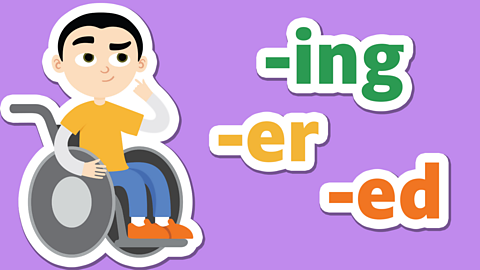
What is a suffix?
A suffix is a letter or group of letters that goes on the end of a word and changes its meaning.
Adding the suffix -ing to the end of a noun can change it into a verb.
For example:
garden + -ing → gardening
Adding the suffix -ed to a verb can form the past tense of that verb.
For example:
jump + -ed → jumped
Watch: Suffixes -ing and -ed
Watch this clip to learn more about the suffixes '-ing' and '-ed'.
Narrator: I've told you, fur doesn't tan even when you're in the garden.
A suffix is a letter, or group of letters, that go on the end of a word.
They change the word's meaning.
'ing' can change a noun into a verb, like gardening.
Make yourself useful.
Huh. There you go.
Oh, why do you have to destroy everything?
The suffix 'ed' puts things in the past tense.
Oh. Now you've destroyed them.
Ah! You know, suffixes sometimes change the original word's spelling, often doubling the last letter like trapped.
Ha! Gotcha!
When you are writing, the verbs you use show whether something has already happened, is happening now or will happen in the future.
Watch: Using suffixes to show tenses
Watch the following Teacher Talk with Ms. Williams to learn more about using suffixes to show past, present and future tense.
Learn about using suffixes to show past, present and future tense with Ms. Williams
[THEME MUSIC]
Hello, I am Ms Williams and today we're practising how to use the past, present and future tenses.
When we write or speak, we choose our words carefully to explain whether events have already happened, are currently happening or will happen in the future.
We use the past tense for events that already happened. For example, "I walked to the park."
If something is happening now or that happens regularly, we use the present tense. Such as "I am walking to the park".
If we are talking or writing about something that has not happened yet, we use the future tense. An example of this is, "I will walk to the park."
Walked, walking and walk.
Are they metaphors, pronouns or verbs?
That is right. They're verbs.
Words that describe an action, feeling or something that happens, an occurrence. So, it's verbs we need to keep our eye on, because they change depending on when something happened or will happen.
Let's take a closer look at verbs first. Here are four sentences:
He has a hat.
I am singing my favourite song.
She is 10 today.
They ran to the park.
I'd like you to count how many verbs you can find.
Spotted them all? Great.
There are five verbs in these sentences.
Two doing verbs: "ran" and "singing".
Three being verbs: "is", "am" and "has".
Next up, I'd like to transform the following two sentences from the past tense to the future.
Let's go.
I ran to school.
I wore jeans.
You need to transform these sentences into the future tense, the tense that tells us something will happen.
Ready? OK.
"I ran to school" in the future tense turns into "I will run to school".
And "I wore jeans" turns into "I will wear jeans".
Well done. Time to take it up a notch. Let's go.
Now we're going to explore the past continuous, present continuous and future continuous tenses.
Let's check out an example first.
We use the simple tenses to describe actions or habits that aren't happening in the present moment or won't change.
For example:
"I played football".
"I play football".
"I will play football".
Whereas in the present continuous, the sentences describe something happening in progress:
"I was playing football".
"I am playing football".
"I will be playing football".
The continuous form uses the form of the verb "to be".
Let's have a go together with another example.
Here we have our example sentence in the simple present tense:
I build bridges.
Press pause now and take your time to complete the table.
Ready for the answers? Excellent.
"I build bridges" in the simple past tense is "I built bridges"
In the future tense: "I will build bridges".
Now, let's transform these into the continuous tenses, where the sentence will now describe the action as it's happening:
"I build bridges" becomes "I am building bridges".
In the past continuous tense: "I was building bridges".
In future continuous: "I will be building bridges".
Well done.
You have been brilliant, you are brilliant and you will be brilliant!
Try complimenting yourself today and tomorrow in the past, present and future tenses. Go for it!
For more help, challenges and games on this subject visit BBC Bitesize.
Past tense

The past tense is used for things that have already happened.
Past tense verbs often end in -ed.
For example:
I walked to the shop.
However, not all past tenses are written like this as there are exceptions which need to be learned separately.
For example:
I bent down to pick up a penny.
The correct past tense of the verb to bend is 'bent' not 'bended'.
She swam three lengths in the swimming pool.
'Swam' is the correct past tense of the verb to swim, not 'swimmed'.
Present tense

The present tense is used when something is happening now or happens regularly.
Present tense verbs can end in -ing and when they do, they have 'am', 'is' or 'are' before them.
For example:
I am walking to the shop.
or
They are going to see their friends.
Spelling rules when forming tenses
There are some spelling rules to think about when you add the suffixes -ing and -ed to verbs.
1. For words ending in two consonants, just add the suffix to the root word. For example:
walk + -ed → walked
or
walk + -ing→ walking
2. For words that end in a short vowel sound followed by a consonant, you need to double the last letter then add the suffix. For example:
mop + -ed → mopped
or
mop + -ing → mopping
3. For words ending in a consonant followed by an ’e’, you need to drop the ‘e’ before you add the suffix. For example:
love + -ed → loved
or
love + -ing → loving
4. For words that end in a consonant and a ‘y’, change the ‘y’ to an ‘i’ and then add the suffix. For example:
cry + -ed → cried
For -ing, you keep the original ‘y’ in the root so that you don’t end up with a double ‘i’. For example:
cry + -ing → crying
Watch: Spelling rules
Learn these four important spelling rules for adding suffixes.
Learning the rules for adding suffixes can help you become better spellers.
So, here's a quick recap of the rules for adding the suffixes '-er', '-ing', '-ed', '-est', and '-y'.
Rule 1 is that for any word that ends in two consonants, you just add the suffix.
Words like fast and walk each end with two consonants, so for these words and all the others like them, the rule tells us: just add the suffix.
[FOOTSTEPS]
[ENGINE REVS]
Rule 2 helps us with words which end with a short vowel sound - ah, eh, ih, oh, uh — followed by a consonant, such as the word hop.
The rule for these types of words is that we double the last letter before we add the suffix.
So, if you have a rabbit called Hoppy, this rule helps you to remember that Hoppy is spelled with two Ps.
Rule 3 is for words that end in a consonant followed by an E, like the word hope.
The rule for this kind of word is that the E must be removed before the suffix is added.
Rule 4 reminds us that if the word you're working with ends in a consonant followed by a Y, then you change the Y to an I before you add the suffixes.
To avoid ending up with lots of double I's in our new words, it makes sense to have an exception to this rule, and to just keep the Y when adding -ing.
I've nothing against the odd double I myself, and when a root word ends in an I, like ski, taxi and safari, well, I just love seeing -ing just doing its thing.
♪ Doing its thing Ah, ah, ah, ah, doing its thing… ♪
Watch: Future tenses
Learn more about tenses, including the future tense, in this clip.
Learn about verb tenses.
Free biscuits? Oh, who will fall for that?
When we talk about things that haven't happened yet, we call it the future tense.
We often use the word will in front of a verb.
Looks like he will be sticky.
Seriously? You really do fall for everything.
When something is happening now, we use the present tense.
Now he is sticky.
Sentences that describe something that's already happened and use words like was are in the past tense.
He was sticky.
Every verb has a past, present and future tense form - licked, licking and will lick.
Uh, hey, no. Don't you even think about…
Oh, yuck.
Activity 1
Read each sentence below and decide whether it is written in the present or past tense.
1. Fahad jogged slowly through the park.
2. Florence is eating her cake quickly.
3. Alfie is drawing his picture very carefully.
4. Betsy kicked the ball into the back of the net.
5. Alyssa is looking at photographs and is dreaming of becoming a photographer.
6. Jaden reached for the full jug of water and his friend watched nervously.
You can check your answers using this answer sheet.
Activity 2
Look again at the four spelling rules above and try the activity below.
Change each of the verbs in the table below into the past tense by adding -ed and then the present tense by adding -ing.
The first one has been done for you as an example.
| Verb | Past tense | Present tense |
|---|---|---|
| crash | crashed | crashing |
| skip | ||
| move | ||
| try | ||
| kick | ||
| stop | ||
| wipe | ||
| worry |
You can check your answers using this answer sheet.
Activity 3

Time for more?
Find the present tense verbs in each of these sentences and then rewrite the sentences with the verbs in the past tense instead, using the suffix '-ed'.
For example:
Kerry is baking a cake.
Kerry baked a cake.
1. Maryam is kicking her football.
2. Isaac is playing his favourite game on his laptop.
3. I am listening to music.
4. My mum is dancing in the kitchen.
Challenge:
Now see whether you can change these present tense sentences into the past tense, thinking about the suffixes 'ing' and '-ed' and what they mean. You may have to change more than one word!
1. I am licking my ice cream quickly before it melts.
2. Zara is ignoring her little brother and watching TV instead.
You can check your answers using this answer sheet.
Play our fun English game Crystal Explorers! game
Use grammar, punctuation and spelling skills to explore jungles, caves and tombs on your mission.

More on Prefixes and suffixes
Find out more by working through a topic
- count4 of 5
- count5 of 5
- count1 of 5
- count2 of 5