Anglo-Saxon beliefs
In Roman Britain many people had been Christians. But the early Anglo-Saxons were not Christians, they were pagans.
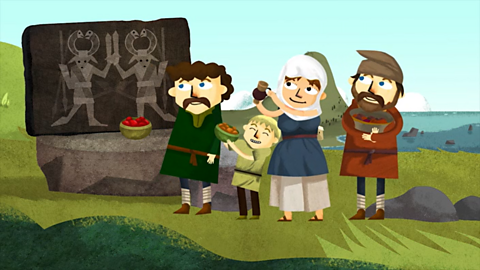
After the Romans left, Christianity continued in places where Anglo-Saxons did not settle, like Wales and the west. The Anglo-Saxons had their own gods, beliefs and superstitions.
Anglo-Saxons believed in lucky charms. They thought that rhymes, potions, stones and jewels would protect them from evil spirits or sickness.
Over time their beliefs changed and many Anglo-Saxons were converted to Christianity.
Which gods were there?
Look at the table below to see some of the most important gods and goddesses. They also gave their names to days of the week.
Woden had two pet wolves and a horse with eight legs. He was a German version of the Scandinavian god Odin.
| Tiw | god of war | Tuesday |
| Woden | king of the gods | Wednesday |
| Thunor | god of thunder | Thursday |
| Frige | goddess of love | Friday |
What do Anglo-Saxon graves tell us?
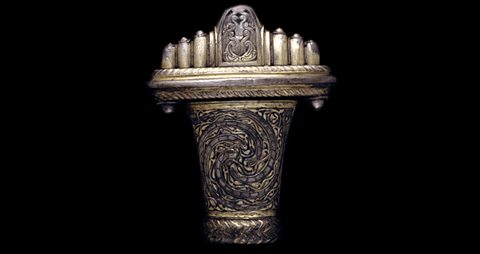
When Anglo-Saxons died, their bodies were often cremated or buried in a grave along with some belongings.
Men's graves included knives and spears. Women's graves included tools used for sewing and weaving. High status graves had swords and precious objects.
In 1939, an amazing discovery was made at Sutton Hoo in Suffolk. Archaeologists found traces of an Anglo-Saxon ship and many precious objects. This was the grave of a king, probably King Raedwald of East Anglia. He died around AD625.
Watch: Sutton Hoo artefacts
Find out what the artefacts found at Sutton Hoo tell us about Anglo-Saxon beliefs
The Sutton Hoo treasure. This is the finest hoard of Anglo-Saxon gold ever dug up in Britain. One of the great treasures of the British Museum. Just look at it! My legs go weak every time I see it because it’s in such excellent condition.
Much of the art that survives from the ‘Dark Ages’ has been battered by time but not the Sutton Hoo treasure. In the finest pieces here there’s hardly a gram of gold bent out of place or a garnet missing.
The Sutton Hoo treasure was dug up out of the ground in East Anglia, just a few weeks before the start of the Second World War in 1939 so it couldn’t be investigated properly until after the war was over and what a torture that must have been for the waiting archaeologists.
The treasure dates from around 620AD and comes from the grave of an important East Anglian king. The king was buried in a ship. His transport to the next world.
And all this was buried with him to serve him in the afterlife. These bits of sword here and helmets mark him out as a mighty warrior. You wouldn’t want to get on the wrong side of this man in heaven.
They find a lyre in his grave as well so the king could listen to his favourite music in the afterlife and that’s a recreation of it. He had to eat well so this fabulous cooking cauldron was buried with him. Look at all the intricate chaotic decoration around it.
Most important of all, the people who buried the king made sure that he’d look good in the next world by burying him with his best Anglo-Saxon ruler bling which is where this gold comes in and those magnificent garnets.
If you’ve ever seen finer jewellery than this, let me know where because I want to go there.How did they do it? These Anglo-Saxon wizards.
Why did the Anglo-Saxons convert to Christianity?
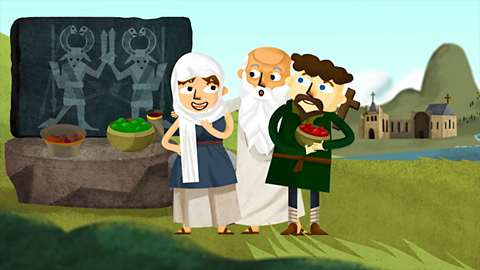
In AD595 Pope Gregory sent a mission to Britain led by St Augustine to convert the Anglo-Saxons to Christianity.
Augustine arrived in Kent and firstly converted the king there called Ethelbert.
More and more Anglo-Saxon kings and their people became Christians too. This is because they realised that by converting to one God, they could unite their people.
Watch: Pagan to Christian Anglo-Saxons
Find out how three important monks brought Christianity to the Anglo-Saxons living in Britain
Here are three super saints, Augustine, Columba and Aiden, who have more than just their itchy outfits in common.
These lads turned the pagans in Britain, who believed in many gods, into Christians who believed in just one.
Let’s start with Columba, a fearless saint. In 563, he sailed to Iona, and set up a monastery, and from here many people in Scotland converted to Christianity.
But if we look at the rest of Britain, things aren’t looking too great for the Christians: this lot are STILL pagan!
Next up was Augustine in 597. He was sent to England by the Pope. He converted a King, built Canterbury cathedral, and was very pleased with himself.
Unfortunately, he mainly just converted the King’s best mates to Christianity.
Most ordinary Anglo-Saxons thought he was a bit weird with his haircut and his itchy dress and they carried on believing in their old gods.
So much for Augustine.
Aidan to the rescue! He was determined to go out and convert the Anglo-Saxons.
He set up a monastery on Lindisfarne in 634 and from there did something amazing, something unheard of, something brilliant: he spoke to ordinary people.
This is what actually convinced the Anglo-Saxons to stop being pagan and give Christianity a try.
And there you have it, how these three saints and these three places helped Britain make the shift from many gods, to just one.
You can keep your rubbish robes to yourselves though lads!
What changed when the Anglo-Saxons converted to Christianity?
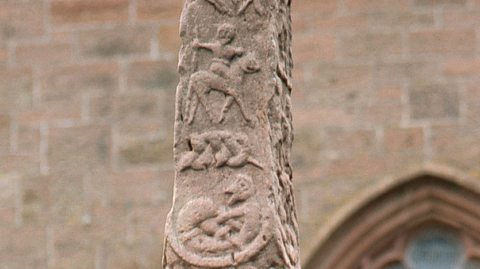
Pagan shrines were turned into churches, magic water became holy water, and various pagan gods were gradually turned in Christian saints.
Kings went into battle with priests, their armour and weaponry were carved with texts from the Bible which we know from the Staffordshire Hoard. With God on their side, they could not lose.
Why were monasteries important?
Monasteries were centres of learning. Monks and nuns spent their time there in prayer and study. They also copied out books by hand and decorated the pages in beautiful colours.
Monasteries were the only schools in Anglo-Saxon England. Boys lived there to train as monks and some girls became nuns.
Roman Christianity was strong in Europe, North Africa and Middle Eastern regions.
St Adrian was a famous abbot (head of a monastery) from North Africa, and was in charge of monasteries in Naples, Italy and the important St Augustine’s, Canterbury.
Who was Bede?
An English monk called Bede lived in the monastery at Jarrow in Northumbria. He went to live with monks in AD680, when he was just seven years old.
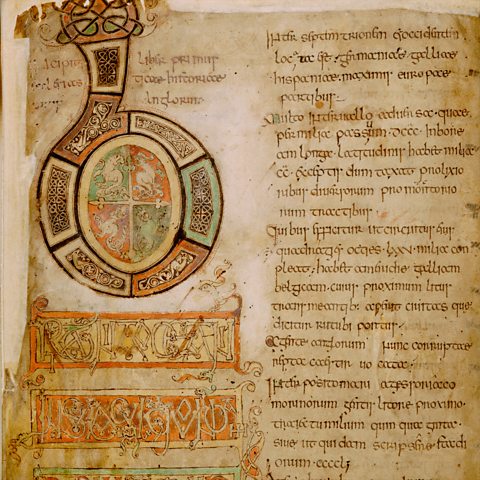
Bede wrote a book called 'A History of the English Church and People' in AD730. This was the story of the creation of a unified English peoples under one Church.
It was made into a book in the 9th century and starts with a decorated letter B (from 'Britain').
Who was St Cuthbert?
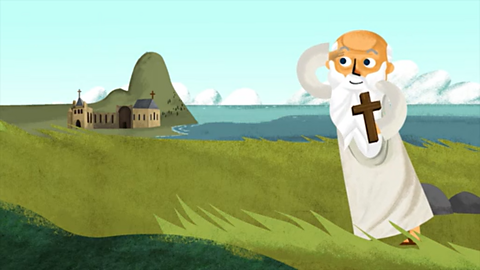
There was a famous monastery at Lindisfarne in Northumbria. One of the monks, St Cuthbert, left the monastery to seek a life of solitude on the tiny Farne Islands out to sea.
St Cuthbert performed miracles. When he died, he was buried in Durham Cathedral. Kings visited him there because they believed he was a source of power and faith.
Activity: Quiz – Anglo-Saxon beliefs
Race Across the Continents game - new update! game
Help this team of adventurers race their way to victory. Explore the globe in this exciting game update to discover new audio voiced by Ade Adepitan and fun animations. Challenge yourself with brand-new achievements and become a high-flyer!

More on Anglo-Saxons
Find out more by working through a topic
- count8 of 8
- count1 of 8
- count2 of 8