What was the Norman Conquest?
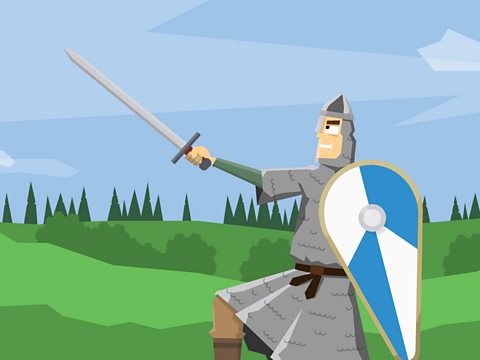
In 1066 there were two invasions of England, a Viking and a Norman invasion.
The Vikings were defeated but the Normans succeeded in conquering England, bringing to an end Anglo-Saxon England. This is known as the Norman Conquest.
Who were the Normans?
The Normans, or 'North-men', were originally Vikings who settled in northern France in AD900.
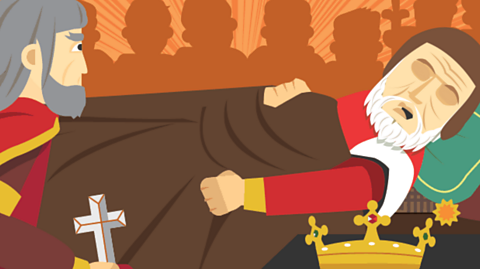
Edward 'the Confessor' was an important Anglo-Saxon king. He was later known as ‘the Confessor’ because he was so religious. He didn't have any children so left no heir.
After Edward's death, the Witan, the Anglo-Saxon council, chose Earl Harold of Wessex as the next king.
What was the Battle of Hastings?
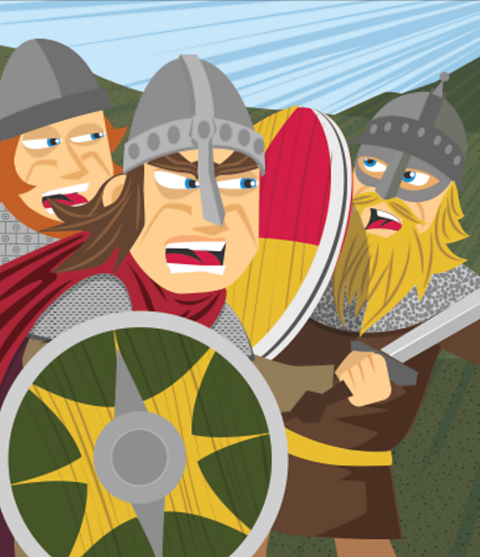
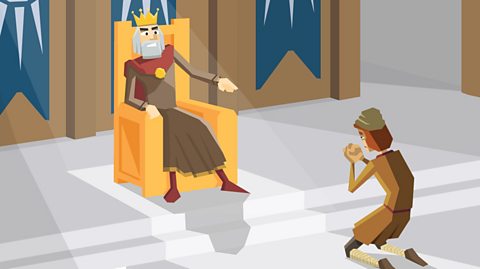
Duke William of Normandy was angry because he believed he was promised the throne. He ordered his army to invade England.
On October, 1066 the Duke William and King Harold's armies met on a ridge on the Downs. The Battle of Hastings began.
The English fought on foot, in shield-wall formation but the Normans had brought war-horses and archers with them. Harold was eventually killed and the English army fled. The Normans had won.
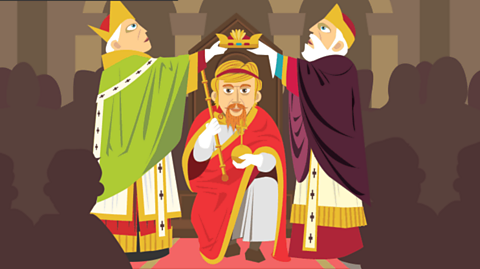
William became King of England on 25th December, 1066. Over the next twenty years the new king crushed rebellions, built castles and destroyed Anglo-Saxon churches and cathedrals.
How do we know what happened?
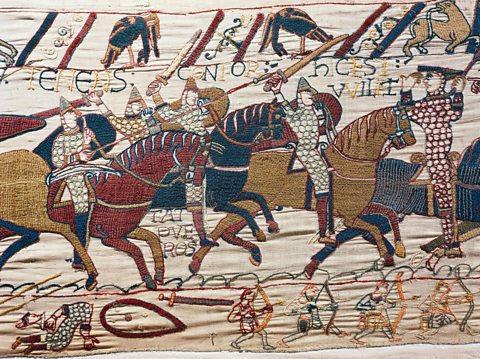
The Bayeux Tapestry is a long piece of embroidered cloth. It is almost 70 metres long!
It was made in England in 1075 by English women and tells the story of the Norman Conquest.
The story is told from the perspective of the Normans.
Watch: The Bayeux Tapestry
Narrator: 1066 is the best known is the best known date in English history. Harold, the last Anglo-Saxon King of the English, lost his eye to an arrow and his crown to William, Duke of Normandy, at the Battle of Hastings.
A great deal of what we know, or think we know about the event, is captured in the Bayeux Tapestry.
The first thing to say about the Bayeux Tapestry is that it’s not a tapestry at all. Technically, it’s an embroidery. A tapestry is woven on the loom.
An embroidery is stitched onto the fabric – in this case, linen.
The images in the Bayeux Tapestry are terribly familiar – all these men going like that, going overseas and meeting up with kings so when you actually come to the tapestry yourself and see it for real, it’s quite a surprise just what it looks like in terms of its proportions.
That’s only the half of it way down there. It’s displayed on a U-bend on the outside of it, here in its gallery.
It’s now accepted that the tapestry was made in England, which was top nation at tapestry making at the time. It was sewn by English craftspeople but probably designed by a Norman, and commissioned and paid for by William’s half-brother, Odo, Bishop of Bayeux.
In the main central band, there are depicted over 600 men, 200 horses, 50 dogs, and three women.
Anglo-Saxons are recognised by their moustaches. Normans by their hair, cropped aggressively short at the back.
The more you look at the tapestry, the more sophisticated it appears. To take a simple example, Harold is here shown eating a meal before sailing to France. He and his companions are on the first floor of a large house. But for economy of space in the tapestry, the upper floor is also the meal table.
Holding the roof on the right, there is a man who points the way down the stairs to Harold, who is now seen boarding his ship to Normandy.
Where necessary, scenes are separated by highly stylised trees. In the borders, drawings of fables and fantastic beasts comment on the action.
One or two scenes appear to be out of order, and have sometimes been dismissed as mistakes. But the ordering is no more an accident than is the use of flashback in a novel or a feature film.
Westminster Abbey, Edward the Confessor’s burial place, is shown before his funeral procession and two-layered deathbed scene. This is not because the designer forgot that you do not bury a king before he dies. Rather, it’s done in this way so that the man offering the crown to Harold in the next scene can point to Edward, bequeathing him the kingdom just before his death.
What everyone knows – or thinks they know – about the Battle of Hastings is that Harold was killed with an arrow in his eye. Is the tapestry the original source of that story?
Dr Majorie Chibnall: It’s the earliest known source of the story, but it’s a very plausible one. And although, sometimes, people have though that the arrow in the eye.
And although, sometimes, people have thought that the arrow in the eye was part of a restoration and wasn’t in the original, the stitch-holes at the back of the tapestry show clearly that it was in the original.
And as I said, it really is quite plausible, because so many arrows were flying around.
Narrator: Of course, further along, there’s another man falling down, obviously dead. That could be Harold.
Dr Majorie Chibnall: The most plausible explanation is that they’re both Harold, because these are two scenes shown as a cartoon, where you have to draw your figure several times, in order to show the change.
Activities
Activity 1: Norman Conquest Timeline
Activity 2: Quiz – Anglo-Saxon to Norman
Race Across the Continents game - new update! game
Help this team of adventurers race their way to victory. Explore the globe in this exciting game update to discover new audio voiced by Ade Adepitan and fun animations. Challenge yourself with brand-new achievements and become a high-flyer!

More on Anglo-Saxons
Find out more by working through a topic
- count1 of 8
- count2 of 8
- count3 of 8
- count4 of 8