What you need to know about winter
As a chill hangs in the air, and the first flutters of snow begin to fall, it's hard not to feel like winter's already here.
Whether it's a hot cup of cocoa, or a favourite festive flick, we all mark the beginning of winter in our own special way. For many, winter is a time to reflect on the year gone by, and set goals and aspirations for the year to come. For others, it marks a time of celebration, where spending time with friends and family can finally move to the top of the agenda. But for everyone, one question remains: when does it actually start?
Well, here at BBC Bitesize, we've taken a look at the history of winter: when it begins, when it ends, and what you can do to get yourself through it! So sit back, relax, and learn all you need to know about the snowiest season!

When does winter start in the UK?
There are a few different ways to define the beginning of winter here in the UK. For some, winter's arrived the moment they feel that first blast of cold wind. For others, it's marked by the end of Halloween, and the beginning of the festive period. Officially, however, there's two main definitions – the meteorological winter and the astronomical winter.
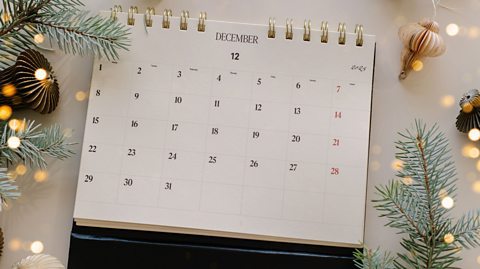
The meteorological winter begins 1 December 2025, as defined by the meteorological calendar – used by services like the Met Office and BBC Weather.
This is because meteorologists define seasons in three-month segments, with winter spanning December, January and February – the three coldest months in the Northern hemisphere.
The astronomical winter, by comparison, doesn't begin until the winter solstice, which doesn't come around until 21 December 2025. The astronomical winter also runs further into the new year, ending in March 2026.
What is the winter solstice and why is it celebrated?
The winter solstice marks the 'shortest day of the year', when the Earth's axis is tilted at its furthest point from the Sun.
The Earth orbits the sun at an angle, specifically 23.4 degrees on its axis (an imaginary line that runs through the Earth). During winter, the Northern Hemisphere (everything north of the equator) is tilted away from the Sun, resulting in fewer hours of daylight and longer nights.
The winter solstice is the moment this tilt hits its furthest extreme, placing the Sun at its lowest point in the sky. As such, the UK only sees seven hours, 49 minutes and 41 seconds of daylight – almost nine hours fewer than during the summer solstice.
It's not all doom and gloom though, as reaching our darkest day means that brighter ones are coming. For this reason, the winter solstice was seen as an important festival for many cultures, with some traditions going back thousands of years.
Our ancestors knew it as Yule, a festival which celebrated the rebirth and return of the Sun, from which many of our festive traditions – including Christmas trees – were taken.
The solstice is still celebrated today, with many people gathering at Stonehenge to take in the low hanging Sun.

When is the winter solstice 2025?
In 2025, the winter solstice will fall on 21 December, marking the official beginning of winter for the astronomical calendar.
This is the case most years, but a slight misalignment between the Earth's rotations and the Gregorian calendar means there can be some variance. As such, on occasion, the solstice will fall on 22 December, as it will in 2027!
If you're after the exact moment of the solstice, this will occur at 3:03pm GMT in the UK – when the Northern hemisphere is at its furthest tilt away from the Sun.
When does winter end in the UK?
Like its bleak beginning, winter's end will vary based on which definition you choose – the astronomical end or the meteorological end.
For meteorologists, winter officially comes to a close on 28 February 2026. The meteorological calendar splits the year into four seasons, each spanning a period of three months:
- Spring – March, April, May
- Summer – June, July, August
- Autumn – September, October, November
- Winter – December, January, February
As such, the beginning and ending of each season stays the same from year to year, with the exception of leap years, when winter gains an extra day.
On the astronomical calendar, winter doesn't finish up until 20 March 2026, as defined by the tilt of Earth's rotational axis in relation to its orbit of the Sun.
How can I stay entertained over the winter?
With nights growing darker, and the air beginning to cool, winter can leave some people at a loss for something to do – but BBC Bitesize is here to help!
If it's festive fun you're after, why not try the winter re-skins of our popular games, or this Christmas quiz, which puts your knowledge of the festive season to the test?
Tired of the same old talking points while stuck at home? Find you and your loved ones' first Christmas number one here, or check out this quiz, to find your perfect telly for tinsel time.
And if you're looking to get some learning in, to prove yourself as an all-star student, take a look at our Winter holiday activity packs, carefully curated to help you make the most of the winter break!
This article was written in November 2025.