|
 |
 |
|
|
|
|
|
|||||||||||||||||||||||||||||||||||||||||||||||||||||||||||||||||||||||||||||||||||||||||||||||||||||||||||||||||||||||||||||||||||||||||||||||||||||||||||||||||||||||||||||||||||||||||||||
|
|
|
You are in: Business | |||||||||||||||||||||||||||||||||||||||||||||||||||||||||||||||||||||||||||||||||||||||||||||||||||||||||||||||||||||||||||||||||||||||||||||||||||||||||||||||||||||||||||||||||||||||||||||||
|
|
|
Sunday, 15 September, 2002, 13:25 GMT 14:25 UK
Lessons learned on 'Black Wednesday'

Policy-makers still bear the scars from that day - when speculators sold the pound, detaching it from its link to the deutschmark.
In the event, the strategy DID give us low inflation, but not a stable economy. The fact that Britain had to follow German interest rates, combined with the fact that Germany needed tighter monetary policy than Britain at the time, meant the ERM prolonged an already painful recession in the UK. And leaving the ERM did not seem to hurt us. Was it really a disaster? At the time, it seemed that after Black Wednesday, Britain was sailing into the unknown. How low would the pound go? Would inflation erupt as a lower pound forced import prices to rise? Would people ever have confidence in economic policy again?
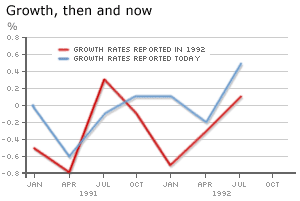
In the event, things turned out rather well. The pound fell, but then rose again. (It is now high - above its target value in the ERM). Inflation has stayed surprisingly benign since we left. And as for economic policy, Britain's way of doing things is now respected worldwide - 10 years is obviously a long time in economics. Deliberate recession So what lessons might we draw about the whole experience? Was it really the disaster it is now thought to be? Was there anything to be said for it? Well, first it is worth pointing out that statisticians now tell us our economy was growing significantly faster in the ERM than the published figures suggested at the time. After the statistics were revised and corrected, average growth was about 0.3% faster than the statistics said in late 1992. That is a considerable difference. The economy over these two years had 2% more growth in it than we had thought.
It also has to be said that much of the recession we endured - the 1991 recession - was actually not a result of the ERM, but of the painful hangover from the Lawson boom. The recession was a deliberate, and perhaps justified, outcome, designed to get inflation down to developed world levels. It worked, and who knows, the ERM may have helped set a low-inflation foundation for the subsequent decade of relative success. Conflicting needs But all this being said, the ERM did prolong the British slump, as it prevented UK rates from being cut to the levels justified by the UK economy. It was a nasty taste of a one-size-fits-all interest rate policy, as it was actually a German interest rate policy, set for Germany by the Bundesbank, which was the anchor currency of the whole system.
That tells us that the ERM may have worked better, if the interest rates had been set not by Germany for Germany, but by Europe for Europe (as they are in the euro). At the time of the September 1992 crisis, most of Europe - including Britain, France, Italy and to some extent Spain - wanted lower rates. But it was the Bundesbank who effectively decided what rates were. Nevertheless, even if rates had been set on a pan-European basis, the ERM would undoubtedly have had some problems at some stage. There are times when the economic policy needs of one country, conflict with the needs of the other countries. What does it mean for the euro? For what it is worth, the mainstream view today is that fixing exchange rates as we did in the ERM is bound to fail, what with huge cross-border flows of currencies. Any strain in the system caused by conflicting policy needs will be exploited by speculators, who will destroy the currency parities.
In effect, that means for most large mid-sized countries (such as Britain, Argentina, Turkey, France or Brazil) there is a simple choice - a freely floating currency, or a shared currency like the euro. Personally, I don't think the ERM experience tells us very much about how successful the euro will be. The euro has benefits in terms of convenience and transaction costs that the ERM never had; and the euro can't be ripped asunder by currency speculation. But the euro can involve totally inappropriate economic policies being imposed on countries. It is no wonder that while pro-and anti-euro campaigners agree the ERM was a mistake, they do not agree on which route we should now follow. |
|
See also:

28 Jun 02 | Business
30 Apr 01 | Euro-glossary
12 Sep 02 | Business
Top Business stories now:
Links to more Business stories are at the foot of the page.
|
|||||||||||||||||||||||||||||||||||||||||||||||||||||||||||||||||||||||||||||||||||||||||||||||||||||||||||||||||||||||||||||||||||||||||||||||||||||||||||||||||||||||||||||||||||||||||||||
|
 |
|
 E-mail this story to a friend E-mail this story to a friend |
 |
|
|
Links to more Business stories |
|
|
|
||
 |
||||
 |
|
Back to top
|
||
|
----------------------------------------------------------------------------------
To BBC Sport>> | To BBC Weather>> | To BBC World Service>> ---------------------------------------------------------------------------------- © MMIII | News Sources | Privacy |
~RS~a~RS~International~RS~q~RS~~RS~z~RS~42~RS~)


 Britain's way of doing things is now respected worldwide - 10 years is obviously a long time in economics