Taking an interest in your child's favourite toys is an excellent opportunity to chat with them.
Some children prefer solitary play, and following their lead can open up a chance for language development, even if they’re not always ready for you to join in.
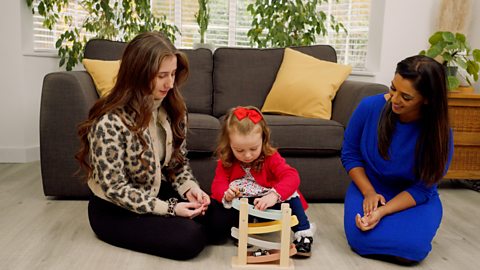
Watch the video below for tips from highly specialist speech and language therapist Neha Makwana on how to join in, when the moment is right, and add words to your child’s play.
When your child is playing with their favourite toys, it's a great opportunity to chat with them if they don't usually involve you in their play. There are still a few things you can try and do that can help their speech and language development. However your child is playing, follow their lead to suggest what you can talk to them about.
Keep your language simple using 1 or 2 words like, ‘fast train’ to narrate what they are doing. These sorts of short phrases are useful because they show that you are interested in their favourite toy and what they are doing with it, but you aren't taking control of their play.
There it is!
Extending and adding language to the way children choose to play is a great way to build their language skills. If your child has a special interest or an intense interest, like playing with animals, then you can expand on the words they use when playing. If they say horse, you can respond with…
Big horse!
A good rule is to add one more word to their word. This will help them link words together and further develop their language. If your child gives clues that they really want to play with their toy alone, then step back. It can be hard, but taking their lead also means knowing when they need a break.
What colour is the ball?
Red and black.
It's red and black!
Using your child's favourite toys to introduce them to language whilst they play can keep it interesting for them, and following their lead rather than yours means that they're more likely to stay interested and pick up on the words and how you're using them.
Ah ha! Well done.
If you are concerned about your child’s language and communication development, then discuss any issues with your health visitor
We spoke to speech and language therapist Alys Mathers for some additional advice…
What is solitary play?
It’s simply playing alone!
Lots of children enjoy playing alone at least some of the time. Children who are two years old or younger only have the capacity to focus on one task at a time, meaning if they’re enjoying playing by themselves, they won’t necessarily be focussing on others nearby.
It’s unlikely to be because they dislike potential playmates.
As children get older and can shift attention they may still sometimes enjoy solitary play. Other children and adults can be unpredictable, and playing can feel more comforting if it’s the same way every time.
Should I join in with my child’s play?
Being involved with your child’s interests is important, and it’s good to keep an eye out for any signs that your little one wants a play partner.
They may want you to join in but don’t know how to ask. In this case, being nearby, available and sitting at their level is a good idea so they can still use non-verbal cues to get your attention.
If they’re not moving themselves or their toys away from you, it could be an invitation to play. Try copying what they’re doing with the toys, even if it’s not how you’d ‘normally’ play with that toy. This helps to show you’re here as a playmate and understand what they're trying to do.
When should I take a step back and let my child play independently?
If you see signs that they’re getting frustrated with you joining in, possibly even pushing you or the toys away, they’re communicating that they need a bit of time on their own. You don’t need to leave the space entirely, they might just want you to play separately in the room.
They might be worried you’ll try to change their play or take their toys. You could try having your own set of the same toys, for example some bricks which you stack when they are stacking theirs. If you keep your joining in short, only two or three minutes at a time, it can keep you involved without being overwhelming.
Understanding your child in this way, when they can’t directly tell you, isn’t easy.
Watch how they play and try not to take control when you join in. Given space, they'll reveal useful clues about their likes and dislikes.