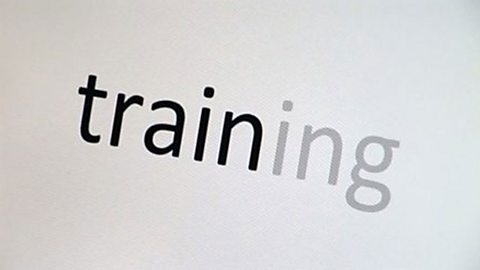
Female in dusky pink top: Prefix is the piece that you add onto a word at the beginning of a word and the suffix is the bit that you add on at the end.
Female in suit: So you see here a thank you letter from a client, where it says, "Thank you for the wonderful entertainment at the event," so you have two suffixes in this sentence, which is, ful is a suffix to the word wonder and ment is a suffix to the word entertain.
If you know about suffixes it helps you learn how to spell.
Male in suit: There's a council leaflet aimed at raising the awareness of abuse and vulnerable adults and in this leaflet, as an example, we use the word, unexplained.
Un, unexplained.
We use the word, unwanted, un, unwanted.
Prefixes really change the focus of a word, from for example, legal to illegal or safe to unsafe.
Prefixes like 'un' or 'pre' in front of a word, or suffixes at the end like 'ing', change the word's meaning.
Quick tips for tutors
Prefixes and suffixes includes:
- Recognising prefixes and suffixes
- Recognising the root word
- How adding a prefix changes the meaning of a word
- How adding a suffix changes a word into an adjective, noun or adverb, or affects the tense of a verb
- Spelling rules for adding prefixes and suffixes
Downloadable Factsheets
Entry 3 - What is a prefix?
An explanation of prefix and common prefixes with their meanings.
Entry 3 - Prefixes and suffixes
Understanding how to find the root of a word and adding prefixes and suffixes to a root word.
Level 1 - What is a suffix?
An explanation of suffix and common suffixes with their meanings.
Downloadable Worksheets
Entry 3 - Using prefixes
Exercise in using prefixes.

Entry 3 - Using suffixes
Exercise in using suffixes.
Level 1 - Taking away the suffix to find the root word
Exercise in finding the root word by removing the suffix.
Level 1 - Taking away the prefix to find the root word
Exercise in finding the root word by removing the prefix.
Level 1 - Choosing suffixes for root words
Exercise in choosing suffixes for root words.