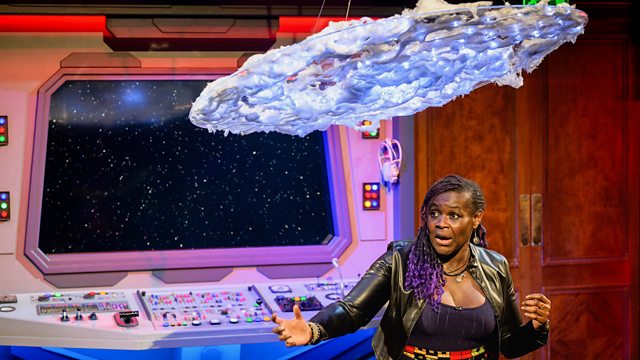
To the Stars and Beyond
Dame Dr Maggie Aderin-Pocock, with the help of the world’s most powerful telescope, ventures through the Milky Way and into the universe beyond, on the hunt for alien worlds.
In her final lecture, Maggie takes her audience beyond our solar system, deep into the Milky Way galaxy, and yet further out into the universe, where the chances of finding life out there, somewhere, seem greater than ever before.
On Christmas Day 2021, the most powerful space telescope ever created, the James Webb Space Telescope, was launched. Maggie played her own part, helping to build one of the key instruments on board, and now the JWST is sending back the most extraordinary images and is one of our key tools in the hunt for alien life. With the help of British astronaut Tim Peake, Maggie and the audience grasp the scale of JWST’s huge mirror and demonstrate the challenges of launching it into space. Tim recalls his own experiences of travelling into space ten years ago and reveals the impact on his perspective about what might be out there beyond Earth.
Tim Peake went to the International Space Station, but on our journey to hunt for life, we’re going to need to go much further than that. The next nearest star in our galaxy, Proxima Centauri, is 4.24 light years away. To get a handle on this staggering distance, Maggie calculates the speed of light and the distance of a light year using a simple microwave. She then explores what kind of spacecraft we might need to cover these kinds of distances, such as Breakthrough Starshot, which envisages using a 'solar sail' powered by a huge laser. The alternative might be an Alcubierre drive, a theoretical ship that could warp space-time to travel faster than the speed of light. As we reach further stars on our journey, Maggie introduces ESA's revolutionary Gaia spacecraft, designed to map the stars in our galaxy, which confirmed that our Milky Way has hundreds of billions of stars. Imagine if all of these stars had planets, just like our sun has!
When Carl Sagan gave his lectures in 1977, we didn't know of any planets outside our own solar system. Now we are aware of over 6,000 of these 'exoplanets' and counting. Through a series of demos, Maggie shows how astronomers use instruments like the James Webb Telescope to find and study exoplanets with techniques such as the transit method - used to detect a planet and determine its size and orbit - and spectroscopy - employed to find out whether a planet has an atmosphere and what that might be made of. Finally, spectroscopy can also be used to detect 'biosignatures' - any signs of life. We meet Cambridge professor Nikku Madhusudhan, whose team have used the JWST to uncover signs of life on exoplanet K2-18b, a planet 124 light years away, with a similar temperature to Earth. They have detected the chemical fingerprints of sulphur-containing gasses, which on Earth are only produced by living things...
As Maggie and Tim examine just how common extraterrestrial life might be, she unpacks Frank Drake’s 1961 equation, designed to calculate how many detectable extraterrestrial societies exist in our galaxy. How do the numbers change now that we know exoplanets are so common and that our galaxy has so many more stars than we thought? And then what about galaxies beyond our own? Where we once thought there were around 100 billion galaxies in our universe, Hubble's 'deep field' images have revealed at least two trillion!
Will we ever find definitive evidence of extraterrestrial life? Or even experience our own alien encounter? If we did detect an alien civilisation, what do we think it might look like, and what would we say to it? These are some of the many questions future scientists and astronomers will be grappling with, and we invite our audience of young people to contribute to that discussion. It’s up to future generations to take up the baton – to infinity and beyond.
This is the 200th anniversary year of the Christmas Lectures. They are the most prestigious event in the Royal Institution calendar, dating from 1825 when Michael Faraday founded the series for children. They have become the world’s longest-running science television series and promise to inspire children and adults alike each year, through explosive demonstrations and interactive experiments with the live theatre audience.
On TV

More episodes
Next
You are at the last episode
Now it's time to launch your own space mission
Discover the teams that bring space science to life with The Open University.