Study to research effects of singing on Parkinson's

 Britten Pears Arts
People with Parkinson's are being asked to help with a study exploring if singing can improve facial mobility and expression capability.
The study is a partnership between the University of Suffolk's Institute of Health and Wellbeing, the University of Essex, East Suffolk and North East Essex NHS Foundation Trust and Britten Pears Arts.
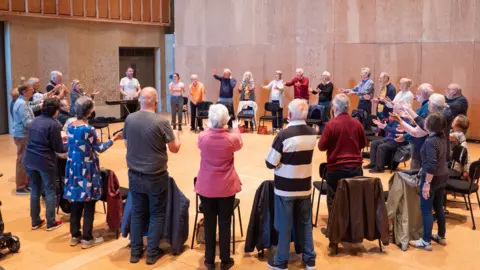
Participants will take part in weekly singing sessions at Britten Pears Arts' East Suffolk Skylarks group and be compared with a control group.
Dr Abigail Webb from the University of Suffolk said no study to date had evaluated the efficacy of singing as a rehabilitative tool to improve facial mobility.
Parkinson's is a condition where part of the brain becomes progressively damaged over many years, according to the NHS.
A reduction or loss in facial movements and expressions effects 92% of people living with Parkinson's.
Researchers believe that the exaggerated facial movements required in singing could help improve muscle strength and enhance circulation in a fun, non-clinical way.
The study is looking for 20 people with Parkinson's to take part in the weekly two-hour Skylarks programme that begins on 8 January over 12 weeks.
A further 20 people also living with Parkinson's are being sought for the control group, who will not sing, and instead have their facial expressions and movements measured and compared with the singing group.
 Martin Giles/BBC
"Many local and national incentives demonstrate the impact of singing on the physical and psychological wellbeing of people living with Parkinson's, but no study to date has evaluated them for their efficacy as a rehabilitative tool to improve facial mobility," Dr Webb said.
"By delivering a fun, non-clinical intervention that can help address the symptoms of facial hypomimia, we will measure whether facial exercises in these sessions influence facial mobility and self-confidence."
Dr Sebastian Korb, from the University of Essex's Department of Psychology, added the project was an "initial step in the quest to better understand the role of mobility in emotion".
Follow Suffolk news on BBC Sounds, Facebook, Instagram and X.