Trade war in no-one's interest, says PM in face of Trump threats

 Reuters
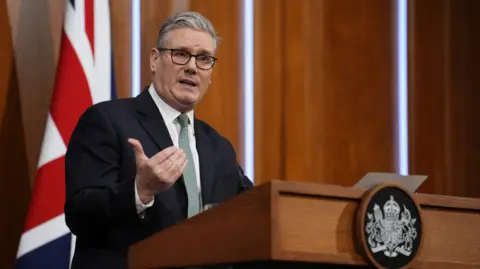
Prime Minister Sir Keir Starmer has said a trade war is in "no-one's interest" after Donald Trump threatened to impose a 10% tax on imports from the UK and other countries who oppose his plans to take control of Greenland.
Making a speech from Downing Street, Sir Keir said the "right approach" was "through calm discussion" and that the use of tariffs against allies was "not the right way to resolve differences".
He reiterated his belief that decisions about the island should rest with the people of Greenland and Denmark.
Principle "cannot be set aside", he said, but he vowed to take a "pragmatic" approach, emphasising both the economic and military importance of the UK-US relationship.
He said he did not believe Trump was genuinely considering military action against Greenland.
While seeking to diffuse tensions, the prime minister stressed that the situation was "very serious" and said it was a "moment for the whole country to pull together".
He welcomed the support offered by Conservative leader Kemi Badenoch in regards to Greenland and potential tariffs.
Trump's threat had, he said. been "very badly received" in the UK but warned against "performative" or "grandstanding" actions.
"It may make politicians feel good, but it does nothing for working people whose jobs, livelihoods and security rely on the relationships we build across the world."
Sir Keir defended his decision to pursue a close relationship with Trump, arguing that it had help deliver "hundreds of billions of pounds" of investment in the UK.
During his speech and the subsequent question session, he also made repeated references to US-UK co-operation on defence, nuclear capability and intelligence.
Asked if he would consider imposing retaliatory tariffs on the US, the prime minister replied: "We have not got to that stage, my focus is making sure we don't get to that stage."
European leaders are expected to raise the future of Greenland with Trump this week when he travels to Davos for the World Economic Forum gathering.
French President Emmanuel Macron has hinted he wants to impose counter-tariffs saying the EU should deploy its "trade bazooka", but Italian Prime Minister Georgia Meloni has expressed concerns about the mutual cost of a trade war.
The prime minister is not currently due to attend Davos but it remains an option as the week progresses.
Over the weekend, a small French military contingent travelled to Greenland as part of a so-called reconnaissance mission. The deployment also involved Germany, Sweden, Norway, Finland, the Netherlands and the UK.
Asked if Trump had incorrectly interpreted the visit as a hostile act towards the US, Sir Keir said: "This is one of the things I discussed with President Trump yesterday.
"Those forces were clearly there to assess and work on the risk from the Russians - there is real clarity, I hope, about that."
He added that Europe needed "to step up and do more on its own defence and security".
The US president has partly justified his interest in controlling Greenland by arguing that Denmark had not done enough to protect the area from Russian threats.
Located between North America and the Arctic, Greenland is a useful base for early warning systems for missile attacks as well as monitoring vessels in the region.
It is also a potential source of rare earth minerals as well as oil and gas, all of which could become more accessible as global warming leads to the melting of the ice sheet that covers the island.
Trump has said "complete and total purchase" of the Danish territory is essential for US and global security.
"If we don't take Greenland, Russia or China will take Greenland," he has warned.
On Saturday, he said he would place a 10% levy on goods exported to the US from the UK, Denmark, Norway, Sweden, France, Germany, the Netherlands and Finland.
The tax would come into force from 1 February, rising to 25% on 1 June.
If Trump does follow through on his threat to impose tariffs it could be damaging to the UK economy, whose biggest overseas customer, in terms of individual countries, is the US.
Economists have estimated the new tariffs could take 0.5% off the UK's GDP.
The threat of tensions hit stock markets in Europe on Monday morning, with carmakers and luxury good firms seeing some of the biggest falls.
Over the weekend, Badenoch said she agreed with the prime minister on the sovereignty of Greenland adding that tariff threats are "a terrible idea".
Scotland's First Minister John Swinney has also condemned the threat of tariffs saying they should "not be a bargaining chip in place of reasonable dialogue between partners".
The leader of the Liberal Democrats Sir Ed Davey said he was "a bit disappointed", saying that the prime minister had taken "retaliatory tariffs off the table".
He said "no-one wants a trade war" but "as our European neighbours and others are doing, they're keeping this threat on the table to show that we're not going to be bullied by Donald Trump - the way to beat a bully is to show that you're serious and will stand up."
Reform UK leader Nigel Farage said: "This is not how you treat your best friends", adding that he would be "having some words" with members of Trump's team when he travels to Davos this week.
He said he that Brexit meant the UK were "free to negotiate directly" with the US.
Lord Mandelson, former British ambassador to the US, told Matt Chorley on BBC Radio 5 Live that the US president "expects direct language" adding: "He will not be surprised if people talk directly back, but respectfully, not through a megaphone, not by shouting at him from the other side of the street."
"That's not what Starmer does, and he's absolutely right not to do so. I think that there are other European leaders, frankly, who could do worse than take their cue from our own prime minister."

Sign up for our Politics Essential newsletter to keep up with the inner workings of Westminster and beyond.