How three pigs will help transform 500 acre royal hunting ground

 Jonathan Perugia for Nattergal
A historical former royal hunting ground is being transformed into a nature paradise – with the help of three pigs.
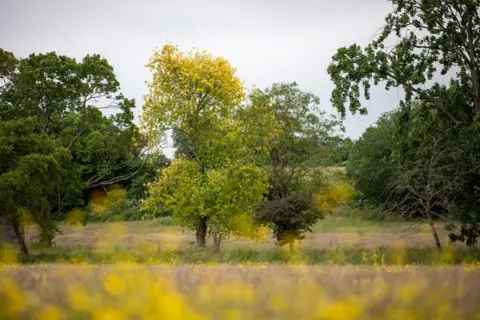
Harold's Park Wildland is a 509-acre nature reserve in Waltham Abbey, in Essex, but it has proved unsuccessful as arable farmland and as a Christmas tree plantation.
But owner Nattergal is on a mission to use "soft engineering" - a natural process to manage environmental challenges - to improve biodiversity.
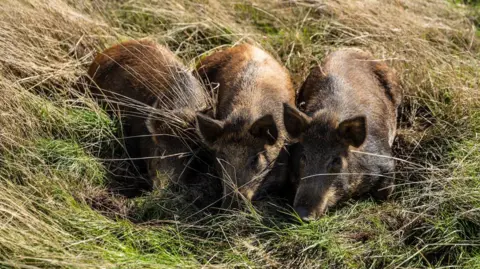
And that's where three Iron Age pigs, and later cattle and ponies, will help revitalise this site.
 Jonathan Perugia for Nattergal
The wildland was once a royal hunting ground of the last Saxon king Harold Godwinson in 1066, and has also housed a 96-horse stables.
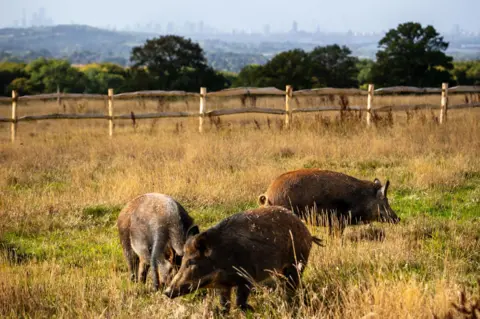
But now the ancient woodland is being revitalised with the pigs - half wild boar, half Tamworth - which are turning over the soil.
The introduction in the future of cattle and ponies should also help restore natural processes in the landscape and also help manage the deer population.
Conifer plantations on the estate are being cleared, allowing native saplings space to grow.
Ponds will be put in during the winter and steps will be taken to slow the flow of water off the land, and to reduce flooding beyond the estate.
 Jonathan Perugia for Nattergal
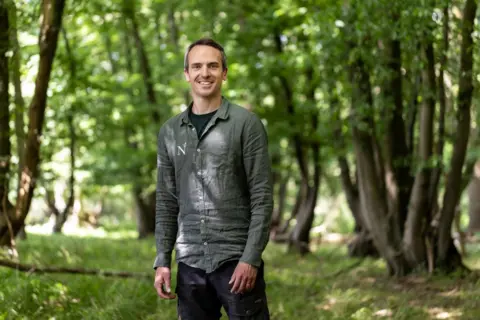
Machinery has been used to cut a huge muddy track to open up the woods and create what Harold's Park site manager Tom Moat describes as an "artery of wildlife through the woodland".
"This won't be mud for long; the grass will come and then the flowers behind it," he said.
Mr Moat said "nothing is working as it should" in the landscape, which has lost beavers and bison, herds of wild boar and big herbivores.
Deer are not behaving naturally as a result.
"We are replacing that, and as a re-wilding company, we're trying to do that as light touch as we can and letting nature do the rest," he said.
Mr Moat said it would be "exciting" to see how the landscape evolved, with land which is currently fields softening into scrubland and wood pasture.
This will be beneficial for a host of wildlife and rare species, including nightingales.
Nattergal hopes to open up the nature reserve for children from urban areas, on educational trips.
 Jonathan Perugia for Nattergal
Dr Simon Lyster, chairman of the Essex Local Nature Partnership, agrees that the likes of nightingales and turtle doves could come to the site.
The reserve could ease the pressure on other outdoor spaces that suffer from high numbers of tourists, Dr Lyster explained.
"The soft engineering is very important and has been very successful elsewhere," Dr Lyster said.
"It creates space for wild plants, protects the scrub areas, which is very good for nightingales.
"At Hatfield Forest [in Essex], 20 years ago that got 100,000 local visitors per year, and now they get 600,000.
"And now there's a problem with visitor pressure. Harold's Park will help alleviate pressure from the places that are getting too much."
Dr Lyster expects quick results.
"It's quite extraordinary how quickly nature recovers," he added.
Harold's Park was identified as a high priority area in Essex's Local Nature Recovery Strategy, published earlier this year.
Essex County Council's Conservative cabinet member for the environment, Peter Schwier, visited last year.
"It will be an opportunity for anyone interested in nature and re-wilding to benefit from learning a lot about it," he said.
"It's going to be a great day out, completely different to the average of what goes on at the moment."
Follow Essex news on BBC Sounds, Facebook, Instagram and X.