Bronze Age treasure donated to village museum

 David Stuckey
A village museum has expressed its delight at acquiring a hoard of Bronze Age items that have been declared treasure.
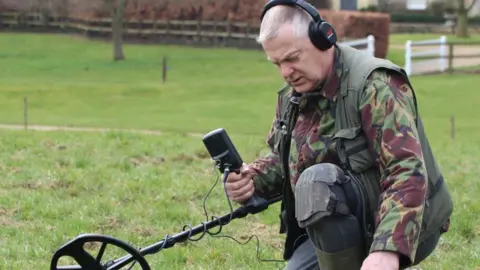
The stash of copper-alloy debris, dating back more than 2,000 years, was found by metal detectorist David Stuckey, from Stevenage, in a field in Guilden Morden, Cambridgeshire, in December 2019.
It was described by an expert as the equivalent of "a modern-day recycling bin".
The hoard was declared treasure earlier this year and has now been donated to Ashwell Museum in Hertfordshire, where it will eventually go on display.
Mr Stuckey, 69, had been detecting on the land where he found the hoard for about seven years.
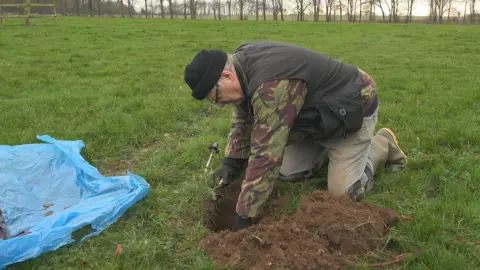
"About a foot down I suddenly saw fragments of green-coloured metal coming out of the hole. I picked up the pieces and could see that they were bronze fragments of 'something'," he said.
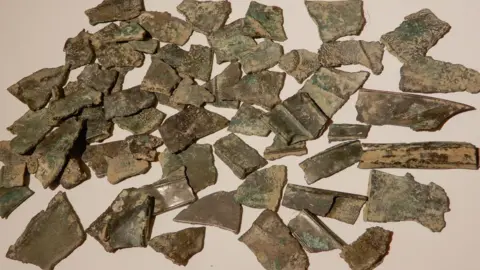
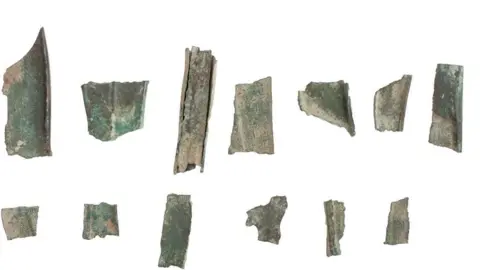
The 66 fragments date from the late Bronze Age — between 1050BC and 800BC - and include chapes, which are pieces of metal used to protect the sharp end of a bladed item such as a sword.
 David Stuckey
 Oxfordshire Museums Service
Cambridgeshire County Council's finds liaison officer, Helen Fowler, said earlier this year that the hoard was most likely to have been deposited in one go to be melted down later, once there was enough metal to make the process worthwhile.
"The hoard is like our blue recycling bins here [in parts of Cambridgeshire]," she said.
Earlier this year it was declared treasure by a coroner under the stipulations of the Treasure Act 1996 (Designation Order 2002).
 David Stuckey
It has now been donated to Ashwell Museum, just over the border in Hertfordshire, by the landowner and Mr Stuckey.
The museum's co-curator, Peter Greener, said: "We're so pleased, as we don't have many Bronze Age items.
"It will be quite hard to display as it is bits of scrap, but we are planning a new display of local archaeology and finds from detectorists so it will go out, as it's interesting."
He said they would try to find out more about the hoard and it would be available for people to see and for researchers to use.
Mr Greener also said the stash of debris might be named the "Odsey Hoard" at the request of the landowner.
Mr Stuckey said he would "look forward to visiting the museum sometime soon" and seeing his finds on display.
Follow Cambridgeshire news on BBC Sounds, Facebook, Instagram and X.