Thousands of invasive crayfish trapped in river

 Belper Angling Club
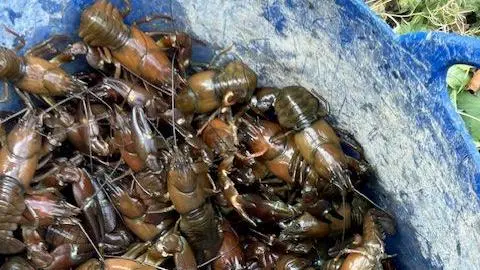
Thousands of invasive crayfish have been humanely killed after being found in a river.
Belper and District Angling Club was given a licence to trap 3,000 American signal crayfish in the River Derwent in August.
The crayfish are an invasive, larger species that threaten the native white-clawed crayfish.
The captured crayfish were handed over to the Environment Agency, which killed them by freezing.
Government regulations on crayfish trapping say people must not trap or remove native and non-native crayfish in England without written permission from the Environment Agency.

Belper Angling Club treasurer John Nelson said: "The river bed must have been walking with them.
"It is something like the grey squirrel. It took out the native red squirrel and this is happening here with the American crayfish and it's killing our ordinary crayfish."
He added these animals were also a threat to fish stocks in the area.
"It's not the fish [themselves] that they damage. They eat all the spawn," said Mr Nelson.
"When the fish spawn, they will go on to spawning beds and eat all the spawn, so we don't get any breeding fish at the moment."
 David Sainsbury
Matt Gable, who is an area incident manager for the Environment Agency, said the American signal crayfish was originally bred in captivity in this country for food but it escaped into watercourses.
He said: "They can upset the whole eco-system if they are allowed to spread completely out of control.
"We do have quite a strong population of native crayfish within the East Midlands, so that's why there is a lot of focus on making sure they're protected."
The level of the River Derwent is low, which has left a mud flat near to Belper Gardens where these animals have been spotted.
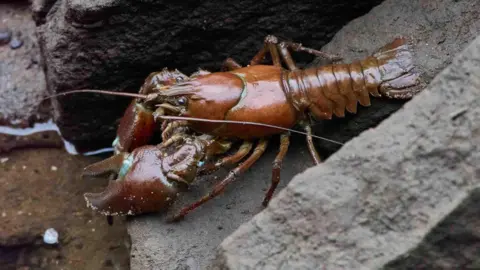
Wildlife photographer David Sainsbury, from Belper, has posted photos of the crayfish on social media.
"I have never seen one in my life that close, when I saw one last week," he said.
"It was almost as if a kid had dropped a toy Action Man [into the mud] and it was crawling its way out."
He added some people who had seen them had mistaken them for small lobsters.
Follow BBC Derby on Facebook, on X, or on Instagram. Send your story ideas to [email protected] or via WhatsApp on 0808 100 2210.