Tailoring academy aims to revive 'dying' skills

 Aisha Iqbal/BBC
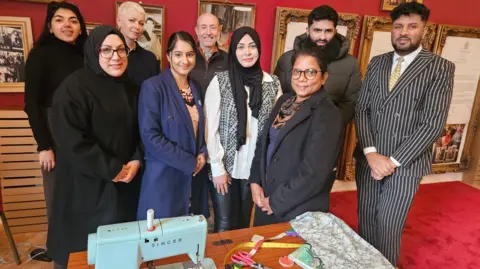
When Lisa Coolen walked into the Westgate Ballroom in Bradford to sign up for a new tailoring academy she was immediately transported back to her childhood.
"I wore only what my grandmother made until I was twelve," she says.
"I'd never bought anything from a shop. She made dresses, skirts, blouses, everything. I still have most of them."
But Lisa, who works in logistics, has never sewn anything herself before, so, when she heard local tailor Imran Khan was planning a community-led tailoring school, she was excited.
"It's something I wanted to learn from a young age, but I never got the opportunity," she says.
"These are heritage skills that are dying out. And I wanted to do something [my grandmother] would be proud of."
 Getty Images
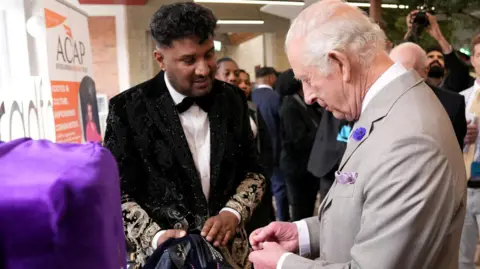
The space Lisa and others stepped into will soon become the home of the IK School of Fine Tailoring, which is due to launch in January.
For now, Imran is running a series of informal gatherings designed to meet potential students and shape the course around their needs.
"This has always been my dream," he says.
"I wanted to create something for young people, older people, anyone who wants to learn a skill and do something meaningful with their time."
Rather than a fixed programme, the academy will be built around the people who attend. "Weekends, evenings, whatever works," Imran says. "It's a community project, and the community will shape it."
 Aisha Iqbal/BBC
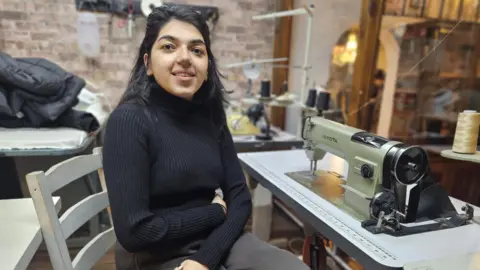
Downstairs, in the busy tailoring shop where his team works, Imran demonstrates some of the industrial sewing machines currently in use.
The teaching itself will take place upstairs, but the emphasis will be on practical skills from the start. "We want people learning by doing," he says.
The interest so far has been broad.
Zaidan Khan, 21, first tried sewing after watching a YouTube tutorial on how to make a shalwar kameez, a traditional South Asian outfit.
"I just followed along and made one," he says. "That's what got me interested."
The Academy, he says, could help him take that curiosity further, whether as a career or a creative outlet.
Others are drawn by the rarity of the opportunity.
Noor Haider, who describes sewing as a long-standing passion, says opportunities like this are hard to find locally.
"There isn't much like this in Bradford," she says.
"So when it came up, I thought I should go for it. I'm looking forward to getting creative and learning a new skill."
 Aisha Iqbal/BBC
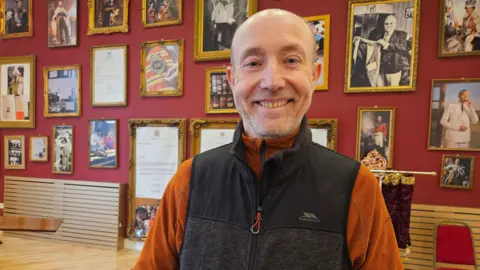
For Paul Lambsdown, who has recently retired after a career in cybersecurity, the appeal is more practical.
"You should never stop learning," he says. "I'm retired now and I want to do something productive with my time.
"I am quite short and I want to be able to alter my own clothes, shorten trousers, sleeves. It's a basic skill we've forgotten."
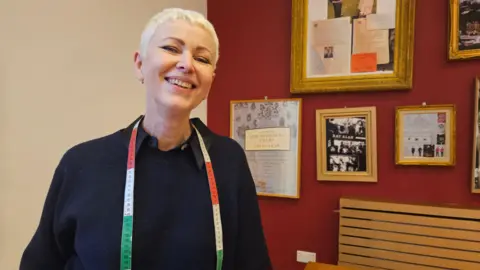
Teaching the course will be professionals like Zana Kacanovic, a designer and pattern cutter who began studying sewing technologies as a teenager in Lithuania before completing a fashion degree in London.
"We are losing sewing skills," she says. "It's creative, practical, and satisfying, starting with nothing and ending with something you've made yourself."
 Aisha Iqbal/BBC
The creation of the Bradford academy comes at a time when traditional tailoring is increasingly considered under threat.
The Heritage Crafts Association, which monitors endangered skills through its Red List, has highlighted the decline in bespoke tailoring, citing a lack of training opportunities and an ageing workforce.
However programmes like the BBC's Great British Sewing Bee have also been credited with boosting public interest in textile crafts and contributing to a resurgence in interest in sewing and other handmade skills in a modern context.
Once unused, the ballroom has been completely reimagined by Imran as an events and learning space, decorated in traditional English style with a distinctly regal feel.
For those involved, the project's ambitions extend beyond craft.
Safora Uddin, who helped develop the academy, works in drug and alcohol treatment, and sees tailoring as a powerful tool for connection and recovery.
"When people come out of trauma, they want to learn something new," she says.
"It gives them purpose and confidence. This isn't just about sewing, it's about belonging."
Much of the work so far has been driven by Imran himself, from restoring the building to sourcing and repairing machines.
"It's been a labour of love," he says.
For Lisa, though, the reason she is there remains deeply personal.
"I think I'll try to make one of those panel dresses my grandmother used to sew. Just to remind me of her."
Listen to highlights from West Yorkshire on BBC Sounds, catch up with the latest episode of Look North.