UK expert helps police 'manage tensions' at US protests

 Keele University
An expert in public order policing from Staffordshire has been advising authorities in the United States on how to manage protests and large gatherings.
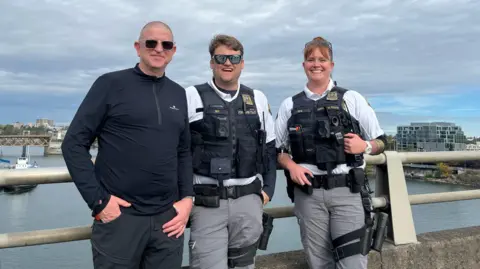
Professor Clifford Stott, from Keele University's School of Psychology, has been helping guide the response of police in Portland, the largest city in the state of Oregon.
His work has included helping them develop a model for policing protests linked to immigration enforcement operations.
It follows ongoing protests in the city in response to Immigration and Customs Enforcement (ICE) operations in the area.
"One of the most important things to recognise is the city has become a site of national contestation and the frontline of the disputes that are emerging between the Federal administration and local governance in the country," professor Stott said.
"Our work occupies a delicate middle ground that both protesters and police tend to value because it helps protect fundamental rights, supports non-violent behaviour, and strengthens local policing legitimacy."
While observing a peaceful demonstration in Portland in October, he was exposed to tear gas deployed by federal agents, along with the surrounding demonstrators.
"With the protests that have taken place, it has presented an opportunity to really test the research-led policing model that we have been working on," he said.
The Portland Police Bureau began rethinking its crowd management strategies after social justice protests in 2020 escalated into months of civil unrest.
Officers used force on protesters more than 6,000 times but ultimately paid out huge sums in injury claims and lawsuits.
"We're now in a position where at recent protests, the local police force has not acted in amplificatory ways, and it has been able to manage the tensions outside the ICE facility in a way that has not seen those confrontations escalate as they did in 2020," professor Stott said.
"The policing model has played a powerful role in helping to deescalate tensions and avoid the spread of confrontation beyond a very isolated area in the city itself."
The work had been "incredibly rewarding," he added.
Follow BBC Stoke & Staffordshire on BBC Sounds, Facebook, X and Instagram.