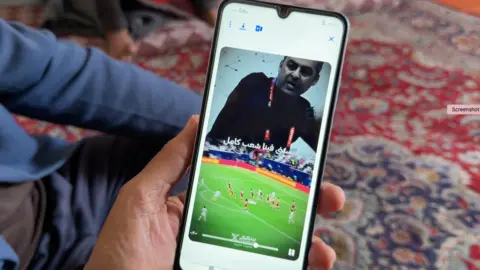
'There is no other joy' say Gazans, as Palestine readies for pivotal football match

 BBC
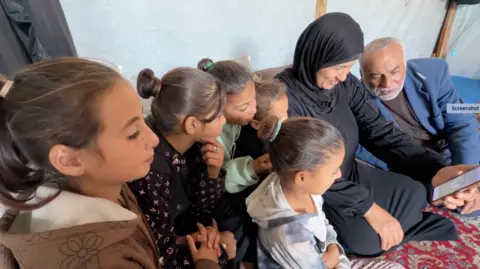
BBCAs a winter storm batters the Gaza Strip, Huda Abu Jazar, has been preparing her tent for floods while in Qatar, her son Ehab gets ready for one of the biggest football matches Palestine has ever played.
The head coach of the national team - who comes from Rafah in the south of Gaza - has told sports journalists that he dedicates his side's qualification in the quarterfinals of the Fifa Arab Cup to his mother.
"From the womb of suffering, success is born," Mrs Abu Jazar says of the Palestinian footballers' recent achievements. "They feel for us, and they know what has happened to us, and they are doing the impossible to bring joy to the Palestinian people."
After two years of devastating war, Gazans have crammed into coffee shops since the start of the month to watch their side play. Palestine dramatically beat Asian champions, Qatar, 1-0 in the opening game of the tournament, memorably prompting Ehab Abu Jazar to break into a run along the touchline, jumping in the air and hugging his players.
They then came back from 2-0 down to draw their second match against Tunisia.
On Sunday, a goalless draw put Palestine through to the quarterfinals of the Arab Cup for the first time. They play Saudi Arabia in Qatar on Thursday.
Ehab Abu Jazar has been out of Gaza during the devastating two-year-war triggered by the deadly Hamas-led assault on southern Israel in October 2023.
When he calls his mother, he says that she offers him tips, rather than dwelling on her own difficult living conditions.
"She talks to me about nothing but the team. She wants the focus to remain solely on the tournament," the 45-year-old manager told AFP news agency. "My mother asks me about the players, who will play as starters and who will be absent, about the tactics, the morale of the players and the circumstances surrounding them."
Most of the Palestine team have never been to Gaza - they come from the occupied West Bank, East Jerusalem and the diaspora, or are Palestinian citizens of Israel.
For many Palestinians they are a symbol of national unity. And Israel's war on Hamas has been felt deeply by all.
Many prominent Palestinian players have been killed in Israeli attacks in Gaza.
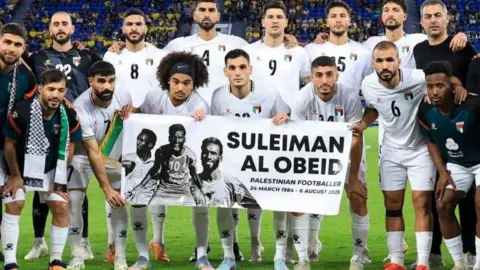
In September, the Palestine national team paid tribute to a former captain, Suleiman al-Obeid, before their friendly match against Malaysia.
Obeid, who was known as the Pelé of Palestine, was a father-of-five. An Israeli strike had destroyed his family's home in Shati refugee camp in Gaza City, and they had been displaced multiple times by bombings and evacuation orders.
Tarrad al-Obeid told the BBC that, even though his brother had saved a good sum of money playing football before the war, he had been left with nothing to buy food.
"We had to move seven times. Even if you had a mountain of money, it would get finished by doing all this!" he said.
"He used to go to the aid centres and then stopped. Then he went again and was telling me that bullets had grazed near his head and that quadcopters were firing at aid seekers," Suleiman's wife, Doaa, said. "He would keep repeating that he didn't want to go and I would tell him not to and that we would be ok."
Ultimately, Tarrad al-Obeid said that "it was need" that drove him and Suleiman with a group of others to one of the US and Israeli-backed Gaza Humanitarian Foundation (GHF) aid sites in early August.
"We were taking cover behind a sand barrier," he recalled. "Suddenly a quadcopter came and directly filmed Suleiman. Then, it turned around and got prepared to fire and directly hit him. Suleiman died immediately together with four or five others."
The Israel Defense Forces (IDF) told the BBC that, after an initial review, it found no record of casualties from Israeli fire at aid distribution points on the day that Suleiman al-Obeid was killed. At the time, GHF did not respond to a request for comment.
The GHF began operations in Gaza from May until November, ceasing after the ceasefire came into effect. There were regular reports of Israeli forces killing people at its sites. The IDF typically said its troops fired warning shots but denied targeting civilians.
 Palestinian Football Association
The IDF has razed most buildings in Rafah and the house of the coach and those of his mother and brother have been destroyed.
"Every match and every tournament is an opportunity to prove ourselves, and through the Arab Cup, we are sending a message to the world that we are a people who love life," Ehab Abu Jazar said in a news conference at the weekend.
"What the players offer on the field is an expression of the spirit and determination of our people."
The wet weather in Gaza may make it even harder for Palestinians to watch the upcoming Arab Cup match. Many have been using mobile phones to follow the Arab Cup, but the internet often cuts out.
Huda Abu Jazar is huddled down with Ehab's brother and her grandchildren in a tent in a camp in al-Mawasi on Gaza's southern coast.
"We're suffering like any Palestinian family suffers in the Gaza Strip. There are shortages of everything. We lack water, we cook over fire, there's no electricity," she says.
"It's cold and our tents get flooded."
"There is no other joy than football," she goes on.
"The national team made people happy, including the displaced people in tents. It achieved great accomplishments and made all Palestinians proud. God willing, they will be successful in the next match. May God honour my son!"