'Elephant walk' by helicopters tests readiness

 Jamie Niblock/BBC
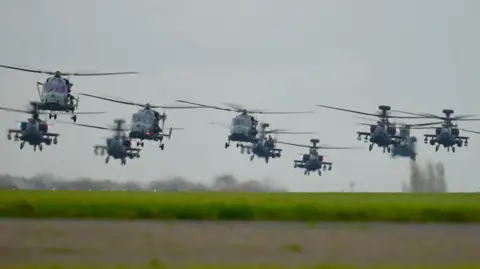
An "elephant walk" by a formation of 25 helicopters showed their readiness for Nato combat operations, the Army said.
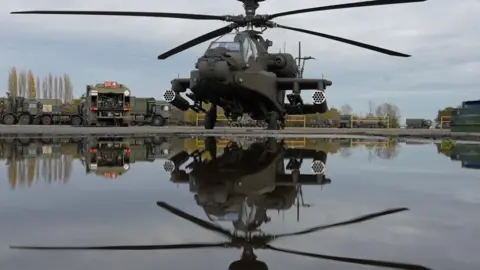
Apache, Chinook, Gazelle and Wildcat helicopters lifted off at Wattisham Flying Station in Suffolk to mark the start of exercise Pinion Titan.
They then performed the low-altitude, nose-to-tail manoeuvre, said by the Army to demonstrate strength, readiness and teamwork.
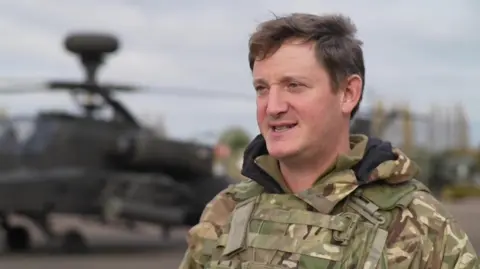
Brig Nick English, commander of the 1st Aviation Brigade based at Wattisham, said it "tests every single aspect" of its operations.
 Jamie Niblock/BBC
"We get every single aircraft and you walk them down the runway, nose to tail, like a set of elephants," he said.
"But the amount of precision, engineering, teamwork and everything required to get everything out all at the same time is huge."
Up to 50 helicopters, 1,000 vehicles and 2,000 soldiers from the British army, the RAF and the French army were in Wattisham for the 10-day exercise.
"You just have to look at conditions in eastern Europe and at any point we could be asked to head over," Brig English added.
 Jamie Niblock/BBC
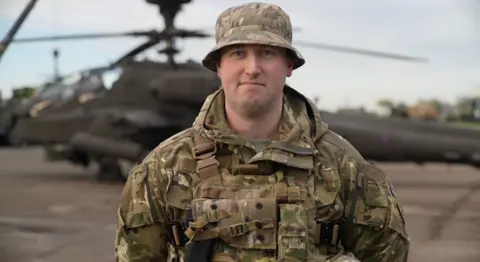
Mark, a captain who flies Apaches who did not want to give his surname, said while it could be a "challenging" role, it was "good fun".
"By all coming together in a large demonstration with lots of aircraft, lots of moving pieces, lots of nationalities like the French, it tests everything," he said.
"It tests the gatehouse, the passes, the logistics, the fuel, the food as well as the piloting and the aircrew making sure all the coordination works."
 Jamie Niblock/BBC
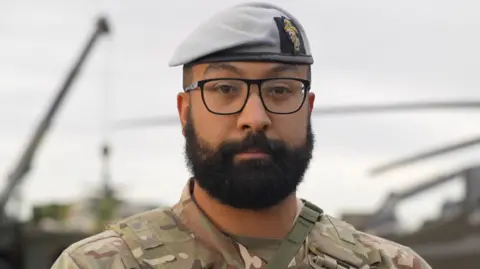
Capt Blake, from 7 Aviation Support Battalion REME, who did not give his first name, was coordinating 50 technicians who ensure the aircraft are safe.
"Without out us the aircraft can't fly," he said.
"They've got a strict programme to make sure that we can continue to look after their airworthiness, the safety of the people operating it, working around it and the public."
 Jamie Niblock/BBC
Follow Suffolk news on BBC Sounds, Facebook, Instagram and X.