Indian dinners made easy
Whether you’re short on time, money or motivation, chef Sanjana Modha has advice for cooking delicious Indian dishes with little effort…
Cooking Indian food is often seen as a labour of love, with layers of spices and hours of slow cooking. But it’s totally possible to deliver all the taste with far less time and effort, says food content creator Sanjana Modha, who’s gained an army of fans through her social media-friendly recipes.
“While restaurant-style Indian cooking is time consuming, most home-style Indian dishes can be quick – for example stir-fry or sauté-based dishes,” explains Modha.
“As someone whose job it is to cook all day, the food I want to eat tends to be on the quick and simple side. Not overly spiced but still boasting big, bold flavours,” says Modha.
Here’s her advice on creating Indian dinners without breaking a sweat…
Use a spice tin
If you’re new to cooking Indian food, don’t feel that you need to invest in every spice associated with the cuisine, says Modha. “Choose a handful of recipes you love the flavour of. You don’t need to stock your cupboard with loads of different spices you won’t use. Notice which spices your favourite-tasting dishes call for and just keep those in your cupboard or in a spice tin.
“A good place to begin would be to stock your cupboard with the all-rounder spices that are used in most dishes: Chilli powder, turmeric, cumin, coriander seeds, mustard seeds.”
Related stories
- The secret to easy Indian breads you can make in minutes
- The five spices you should never be without
- It’s officially the season of the ‘king of fruits’ – here’s how to use it
If you do want to branch out, consider if you’re particularly drawn to the dishes of a specific Indian region.
“Each region of India has dishes that call for certain spices and combinations of spices. While this is a short overview and is by no means exhaustive, you can expect Garam Masala, dried mango powder (amchur) and dried fenugreek leaves (kasoori methi) to be prevalent in the dishes of North India.
“Coconut, tamarind and curry leaves are popular in South Indian cooking. Panch Phoron (a mix of five spices - fennel seeds, nigella seeds, fenugreek seeds, mustard seeds and cumin seeds) are used in dishes like Jalfrezi from Eastern India.
“And, in Western India, cumin, sesame, mustard and asafoetida (hing) feature heavily.”
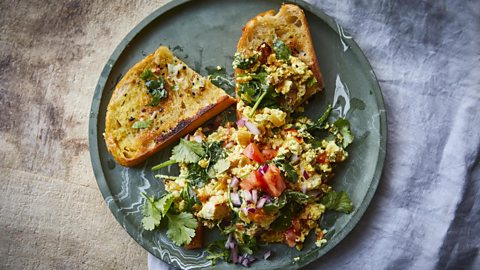
Modha’s spinach and ricotta bhurji, includes just three spices: cumin seeds, ground turmeric and garam masala and is bursting with flavour, highlighting that sometimes less is more.
Spinach and ricotta bhurji with garlic naan toast
“This feels much less complicated than making a full curry and naan. I always have sliced bread at home and giving it naan vibes is easy with the simple nigella seed-infused garlic butter. You can also make this with frozen spinach which keeps costs down.”
Cook once, eat multiple times
We’re a nation of batch cookers and Modha suggests including the extras that make Indian food so special.
“I like to prepare fresh Indian chutneys in bulk and freeze them for later.
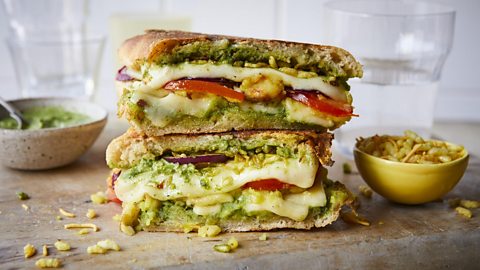
“These are different to the sticky, syrupy chutneys like mango chutney as they are usually a blend of fresh ingredients that do not require cooking. For example, my recipe for garlic bread Bombay sandwiches (pictured above), a play on the classic Mumbai Sandwich, calls for vibrant green coriander and mint chutney, which is incredibly versatile as a sandwich spread, topping for chaat or dip. You can even mix it with yoghurt for a quick and easy raita-style sauce to enjoy with rice.
“Other chutneys I like to freeze include tamarind (imli) chutney and red chilli chutney.”
These chutneys will all add flavour to your dishes
Tailor to your tastes and budget
There’s nothing wrong with adding your own twists to recipes – whether that’s to make things quicker, cheaper or to merge your favourite cuisines, the latter is something Modha frequently does.
“My style of cooking is very much a mirror image of my mixed background. As a first-generation British Indian with an East African family background, as well as a love for global cuisines, the food I want to eat draws upon a kaleidoscope of flavours.
“I don’t believe the concept of fusion food is something to be seen as a thoughtless fudging up of ingredients, since all the meals we eat today are historically a product of cultures coming together.
“Authenticity is entirely subjective and where the most exciting innovations happen. I like to think of the meals I cook as authentic to myself, which is exactly the way I want to be nourished.”
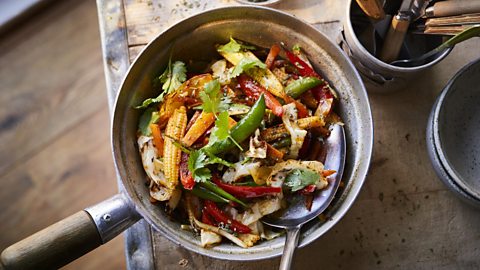
One of Modha’s favourite – and quick – evening meals is a stir-fry veg jalfrezi.
“It’s Inspired by the Hakka community of East India. This dish is a fusion of Indian and Chinese cooking techniques and flavours. It’s also very quick to cook and great for using up scraps of veg you have in the fridge.
Stir-fry veg jalfrezi
“Make sure your wok is smoking hot before adding the veggies and then cook them quickly to retain their crunch. It goes perfectly with rice.”
Reduce soaking time
Beans and lentils are often a key component of vegetarian Indian dishes and they can require a long soak. So, if you’re short on time, choose varieties that require little to no soaking time.“Soaking makes lentils more digestible and removes excess starch from rice so I never skip this step, however you can choose ones such as red lentils, which I just leave to soak for 20 minutes or so.”
If you’re making a dal and the recipe does include a lentil that requires a long soak turn to a pressure cooker as this will cut down the time considerably, says Modha.
Modha’s lemon pepper tarka dal uses red lentils to make for a quick-turnaround evening meal. Talking about how it pairs with the citrus fruit she explains: “The lemon zest in the tarka (final spice tempering) isn’t traditional but gives the dal an incredibly unique freshness.”
Lemon pepper tarka dal
“Add a very small pinch of bicarbonate of soda. This helps to break the lentils down quickly for speedy cooking.”
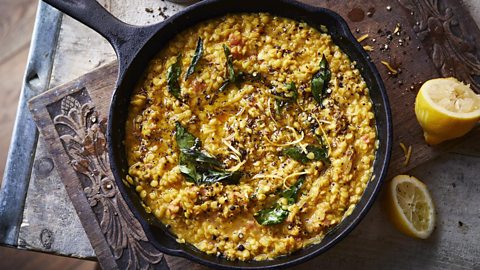
With different influences, these dals all taste delicious and different
Don’t over complicate things
Your average dinner doesn’t have to involve multiple dishes with many ingredients, save that for special occasions. “There’s nothing quite like a simple dal and rice after a long day. Just a handful of spices and a little blob of ghee brings instant comfort to lentils. This is the nostalgic food I revisit every week for a taste of home. I like to think of it as central heating for the soul,” says Modha.
Another easy example is Modha’s potato and edamame curry. “This is the kind of curry my mum would prepare for my brother and I after school and we would devour it with buttered roti.
“It’s very lightly spiced compared to Indian restaurant curries and that’s the beauty of it. The edamame adds a little kick of protein to this vegetarian dish.
Potato and edamame curry
“Frozen edamame are widely available in supermarkets and cook in the same amount of time that it takes for the potatoes to soften.”
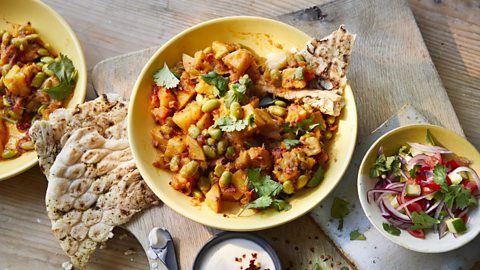
These recipes all include breads or pancakes
Originally published May 2024