When you think of Christmas – what comes to mind?
Gifts under the tree, tinsel, turkey and lights everywhere, perhaps? As Kermit the Frog so wonderfully put it in The Muppets Christmas Carol, ‘Tis the season to be jolly and joyous’.
But through the years, there have been glimpses of a more, altogether disturbing set of Christmas traditions – eerie and spooky characters who bring presents and punishment in equal measure.

But if you're thinking of The Grinch or Scrooge - think again. Those two Christmas villains came to their senses and joined in with the festivities, unlike these seasonal scoundrels.
BBC Bitesize explores the darker side of Christmas – and we very much hope we’re on the nice list this year.
Krampus
The concept of the naughty and nice list is now well-established. Make it onto the nice list (after, of course, Santa has checked it twice) and you’re in for presents on Christmas Day.
Naughty list? Well it’s a lump of coal for you.
But in some countries in Central Europe, there are greater consequences.
The origins of Krampus are said to have begun in the 16th and 17th Centuries – an Something that has human characteristics goat-like figure who accompanies Saint Nicholas on visits to children in early December ahead of the Feast of St Nicholas on 6 December.
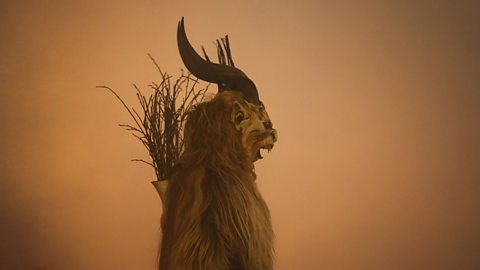
While jolly old Saint Nick gives small gifts to children who’ve behaved well throughout the year, Krampus is tasked with dealing with the mischievous ones. They might have their hair pulled out, be beaten with tree branches or in extreme cases, be taken away by Krampus for his own personal feast.
The night this all takes place is known as Krampusnacht and is still celebrated today in some Alpine communities – where the horned beast frightens children into last minute behaving.
Belsnickel
Another companion of Saint Nicholas, prominent in German folklore and among the Pennsylvanian Dutch in the United States, is Belsnickel.
Unlike Krampus, Belsnickel is believed to be human, depicted as a dishevelled, ragged man in furs. He also visits children before Christmas to test their behaviour ahead of the big day.
Children are rewarded with sweets and cakes while the naughty ones are once again punished with a stick.
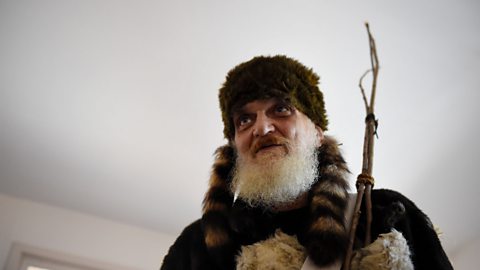
But Belsnickel has been known to deliberately manipulate the naughty and nice list – in a sort of Christmas entrapment. He throws treats onto the floor to see if any children rush to grab them – punishing any child who is greedy enough to give into temptation.
Belsnickel is probably best known for being portrayed by Rainn Wilson’s Dwight Schrute in an episode of the US version of The Office – but Schrute’s line of ‘impish or admirable’ was classic Dwight, rather than sticking to Belsnickel’s lore.
Mari Lwyd
Closer to home, the 19th Century Welsh festive tradition of Mari Lwyd is still carried out today.
Mari Lwyd – which is said to mean either Grey Mare or Grey Mary – sees a horse’s skull mounted on a pole, draped in a white sheet and decorated with lights, baubles, streamers and holly.
More traditionally a South Wales custom, Mari is paraded around local villages between Christmas and Twelfth Night, or sometimes later into January, visiting houses to sing or take part in pwnco – a back and forth of rude rhymes between the visitors and home owners.
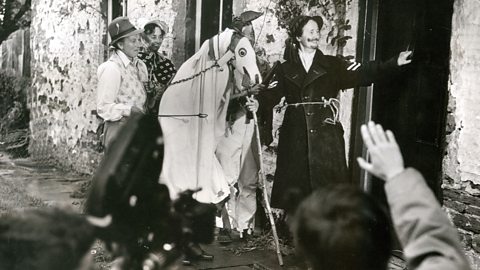
If the household are willing to let Mari in, they’re said to have good luck for the year – but it’s not always an easy invitation to say yes to. Mari is deliberately mischievous – often trying to steal things, chase people or snap her jaw menacingly at people.
Gryla, the Yule Lads and the Yule Cat
Heading further north, and in Iceland – there’s a whole family bringing a darker side to Christmas.
The legend of Gryla heads back to medieval times. As the story goes, Gryla is a fearsome giantess who lives in the mountains. She rarely descends, unless it’s Christmas – but she’s not a welcome visitor.
Gryla heads into villages to snatch up naughty children to feast upon, taking them back into the mountains to cook in her cauldron.
And she’s not alone. Gryla has 13 sons – known as the Yule Lads. Original folklore suggested they were much darker in tone than their name suggests, and that they too had a taste for eating children. Modern versions of their tale sees them as cheeky pranksters. A different one visits each evening in the run up to Christmas, leaving presents for the good children and rotten potatoes for the naughty ones – along with a healthy dose of pranks.
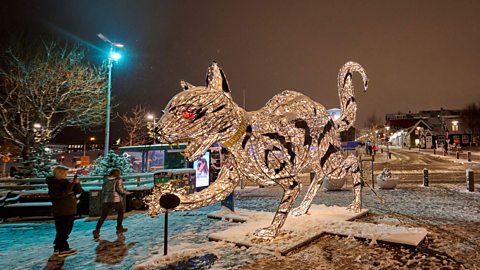
There’s also the family pet – whose vibe is much more aligned to the matriarch. The Yule Cat prowls the countryside, seeking out any children who did not receive new clothes for Christmas.
In line with keeping it in the family, the Yule Cat also eats these children. The targeting of children without new clothes is thought to be a 19th Century tradition linked to the country’s wool production. So not just a Christmas tradition, but also a lesson in a strong work ethic too.
This article was published in December 2025

Test your TV knowledge with the ultimate Christmas adverts quiz
How well do you know your big budget, memorable Christmas adverts from through the years?

What Christmas is like in space with Tim Peake
To mark the tenth anniversary of his space mission, Tim tells us about the Christmas Day he spent 250 miles above the Earth