In recent years, scientists have explored how Christmas affects our bodies and minds. Studies have shown that singing carols can relieve stress, and on the opposite end, they've found that Christmas Eve can be a peak time for heart attacks.
BBC Bitesize had a look at the science behind that Christmas feeling. Bryan Haddock, a medical physicist at Copenhagen hospital, embarked on a classic Christmas movie plotline to find the Christmas spirit. But instead of leaving the big city and going on a holiday to a small town, he used brain imaging techniques to conduct a neuroscientific study.

Bryan Haddock was looking to see how people responded in different ways to Christmas images.
His team ran fMRI (Functional Magnetic Resonance Imaging) scans on a group of 20 people. As well as this, the group was asked questions about their experience of Christmas after the scans were taken. They were asked to fill out a questionnaire about their Christmas traditions, feelings associated with Christmas, how long they had lived in Denmark and ethnicity.
In this study they were looking to see if there was a Christmas spirit network in the brain.

Mr Haddock concluded that “there is a Christmas spirit network in the human brain comprising several cortical areas."
He says: "This network had a significantly higher activation in people who celebrate Christmas with positive associations, as opposed to people who have no Christmas traditions and neutral associations.”
The scans showed that the brain was reacting to the Christmas images. However, the study did not conclude whether this was cause or effect - ie, whether this area lights up because you like Christmas, or you like Christmas because this area lights up.
Bryan says: “The answer is that it could be either or both. We are catching the brain responding to the Christmas stimulus and the brain is fast. Several steps and subprocesses are being caught at once so it is possible one of the activated areas is recognising while another is creating a response.”
He also suggests that “although merry and intriguing, these findings should be interpreted with caution.”


So how did they find the Christmas spirit network?
“In fMRI, you run a sequence of images and see if there is any stimulus in different parts of the brain.”
“The person lays in the scanner and we took a measurement every three seconds to monitor changes in blood oxygenation in the brain."
“We ran a sequence where we presented everyday images but then alternated it to a series of Christmas theme images, then back to regular images and repeated this cycle six times.”
“All the time, we were taking the same measurement looking to see which parts are changing in time with the images changing within that cycle.”
“We looked at fluctuations and we saw reactions (to the pictures being changed) in their visual cortex.”
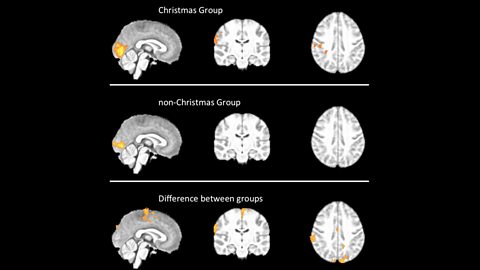 Image source, BMJ
Bryan found that the part of the brain that lit up is also the part that is active when we have emotions shared with others, which is in the primary motor cortex and pre-motor cortex.
This part of the brain is also important for controlling body movement. Happy memories and pleasant behaviours are likely to activate the area.
However, Bryan acknowledges there are limits to the study and that his colleagues in neuroscience might suggest that just because we can localise emotions in the brain, it doesn’t contribute much to how we understand them.
Unfortunately this experiment can’t provide definitive conclusions about the emotional impact of Christmas on the brain.
However, he says, “it’s not that far fetched to suggest a connection between these areas, and why we feel warm or happy when they light up.”
So does Christmas make Mr Haddock’s brain light up?

“I still have knee-jerk responses to Christmas stimuli. The first time I hear certain songs or when I go get the tree, I’m definitely getting some positive reactions.”
“I find it interesting to reflect on how we react at different stages of life. As a teenager I started to miss the excitement I felt when I was younger. Some of the things that really triggered me as a kid, the first time I saw a gingerbread, or practicing the Christmas play - all those things didn’t excite me so much when I was a teenager. But now I have kids of my own and I have a different kind of excitement to experience it again with them.”
This article was published in December 2019, and updated in December 2025
Singin’ in the Rain: From Hollywood to the round stage
The famous musical Singin' in the Rain makes its round theatre debut in Manchester
Where do Advent calendars originate from?
We delve into the history of Advent calendars and find out where they really come from!

The trailblazing female World War II spy you might not have heard of
The story of Noor Inayat Khan features in a new exhibition called Spies, Lies and Deception, at IWM North