However you celebrate Christmas, the chances are your traditional festive meal has an air of familiarity to it.
For many of us, it’s a roast turkey with all the trimmings, including those dreaded sprouts – or perhaps you and your family pull crackers alongside an annual nut roast.
But just as we have our traditions, around the world there are many variations to what we would think of as a Christmas dinner. BBC Bitesize takes a look at some of the unique national festive dishes being served up each year.

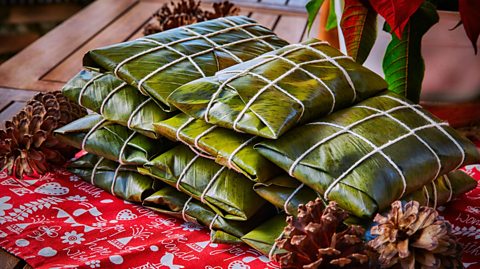
Venezuela - Deck the Hallacas
In Venezuela, Christmas sees one of the country’s national dishes served up each year. Families prepare hallacas, a traditional meal that dates from 15th and 16th Century colonial times.
Enslaved people in the country prepared them originally by taking leftovers from meals that they had prepared and wrapping them in banana leaves to cook over fire.
In modern times, they’re made from corn dough, stuffed with a pork, beef or chicken stew, as well as raisins, capers, olives and other ingredients. They’re then wrapped in banana leaves before being boiled or steamed.
As making hallacas can be quite a lengthy process, it becomes a family Christmas tradition, with everyone working together to prepare them. Hallacas are also given out as gifts, with friends and neighbours exchanging their variations on the dish.
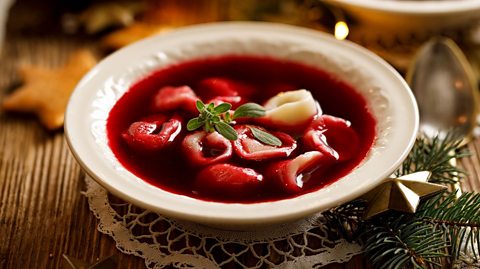
Poland - a ruby red bowl of festive goodness
Our next food plays an important festive role in Poland, but as part of celebrations on the day before Christmas. It is barszcz wigilijny, or Christmas Eve borscht.
As in many other European countries, Christmas Eve is a big day in Poland. When the first star is spotted in the sky, families begin their feast of (at least) 12 dishes symbolising the 12 months of the year, the 12 apostles and abstinence (so no meat). It is also custom for many to set an extra place at the table incase of an unexpected guest. Dishes such as filled dumplings (pierogi), Christmas carp, sauerkraut or cabbage rolls and then fruit or cake desserts are all shared. But it all begins with the breaking of the Christmas wafers (opłatek) and then a serving of barszcz.
Borscht or Barszcz traces it’s origins back to ancient times when a tart or sour-tasting soup would have been made from any available ingredients. Originally popular across Eastern Europe, different versions are now important traditional dishes in many cultures.
The Barszcz wigilijny contains beetroot simmered in vegetable stock with vinegar and garlic, before it’s strained to create the red, clear broth. Traditionally on Christmas Eve, small dumplings filled with mushroom called uszka (little ears) are added to float in the soup.
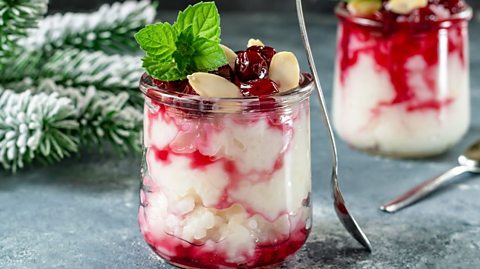
Denmark - Christmas Eve dessert that hides a prize
The Danes also eat their main celebratory meal on December 24, a day when Julemanden or Father Christmas brings presents and the family gather for a slap-up meal. The main course may centre around roast pork or duck with vegetables followed by the nation’s favourite festive dessert containing a hidden prize.
Risalamande is a rich, cold rice pudding with added whipped cream, served with a hot cherry sauce. But it’s also become a traditional Christmas Eve game. Buried deep within one serving, is hidden a single whole almond. If you’re lucky enough to find it, you must keep quiet until everyone else around the table has finished eating theirs. Quite a task after a full meal, but then you’ll win a small prize.
For centuries in Denmark, people would eat sweetened oat porridge at Christmas, often to fill themselves up before eating the meat course. But during the late 19th Century, upper class houses and restaurants began serving sweetened rice porridge and then cream, making it even more luxurious and celebratory.
Risalamande is also possibly inspired by the French tradition of baking a bean in a cake to represent the baby Jesus forEpiphany is celebrated 12 days after Christmas, on 6 January, and commemorates the visit of the wise men to the infant Jesus but instead, Danes hide an almond.

Portugal - rocking around the Christmas Sea Monster
Around the world for many, there’s nothing like a festive dessert. In the UK, that might be a mince pie or a piece of Christmas pudding. But in Portugal, it might be a lampreia de ovos, a particularly unique traditional sweet themed after a bloodsucking eel called the lamprey.
This not-so-festive sounding treat dates back to the 15th Century and is thought to have been created by nuns. In convents, they used egg whites to help keep their habits free of wrinkles, but found they had a surplus of yolks. Combined with an influx of sugar to Portugal, the nuns made rich, yellow, sweet desserts that looked like very thin strings of pasta.
Effigies of lampreys were placed on top of the egg strands – the fish has been beloved in Portugal for centuries. Lamprey remains a popular choice to this day, particularly in areas close to the Rio Minho (Minho River) in the north of the country and Rio Tejo more centrally - while you will often see lampreia de ovos for sale in highly decorated boxes in Portuguese bakeries in the run up to Christmas.

South Africa - a comfort food with a traditional festive twist
For South Africans in December the weather is usually warm, averaging 26 degrees celsius. So over the Christmas holiday, families will often gather for carols, trips to the beach or a traditional braais (barbecue).
Christmas dinner might be a mix of European-inspired roast meats, seafood and rice salads. And for dessert, the nation’s favourite comfort food the malva pudding is often given an added festive sparkle.
The malva pudding dates back to the 17th Century when Dutch colonisors settled in Cape Town. Wanting a taste of home, they added plentiful local apricots and at Christmas, some Malvasia wine to their baked golden sponge. The name is also thought to relate to the spongy texture, as in Afrikaans malvalekker means marshmallow.
Not as heavy as our sticky toffee pudding in the UK, the malva sponge is made of eggs, flour, sugar, apricot jam and then baked. Straight out of the oven, it’s soaked in a creamy vanilla sauce, giving it a similar caramelised, gooey consistency.
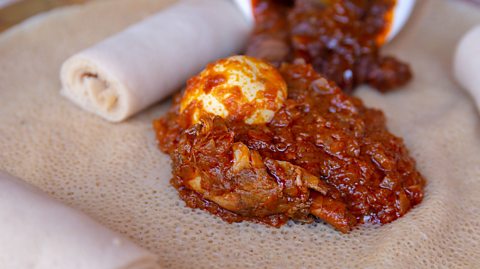
Ethiopia - dreaming of a Doro Wat Christmas
In Ethiopia, Christmas isn't celebrated in December. The East African country's largest Christian denomination is the Orthodox church - meaning their festivities, known as Ganna, take place on 7 January each year.
The main meal eaten on Ganna is Doro Wat – the national dish of Ethiopia. It is a spicy chicken stew, typically served with injera – a type of fermented flatbread with a pancake-like texture.
The meal is often eaten from one communal bowl. It’s customary to wrap some of the fiery hot stew in the injera and then to put a piece directly in someone else’s mouth – feeding your friends and family in this way is a huge sign of love and respect in Ethiopia.
This practice is known as gursha – which means mouthful. It’s considered an honour and once someone has been given a gursha, it’s then their turn to return the favour.
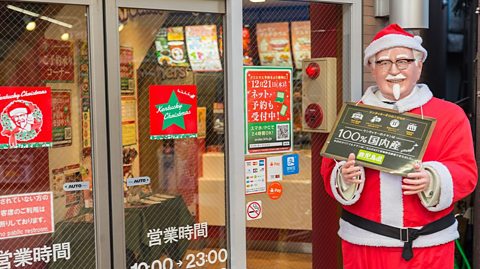
Which country has a Kentucky Fried Christmas?
While turkey is a traditional main course for some Christmas meals, chicken is less common. Especially when it’s been deep fried.
But that’s exactly what happens in Japan each year where more than 3.5 million people head to KFC for a festive dinner.
It all started back in 1970, shortly after the first branch of the fast food chain opened in the country. The manager, Takeshi Okawara, was inspired by a dream one night to sell a party barrel of chicken on Christmas Day.
He said the idea must have come to him after overhearing some foreigners in his store talking about missing turkey and other traditional Christmas things while in Japan – only around 1% of people in Japan celebrate Christmas as it isn’t an official holiday in the country.
The restaurant’s head office loved the idea and took it national in 1974. To this day, many families in Japan mark Christmas Day with a party barrel or a premium whole chicken. Customers are encouraged to order their meals weeks in advance, with many of the stores seeing huge queues on Christmas Day itself.
This article was published in December 2021 and updated in December 2025.

Test your TV knowledge with the ultimate Christmas adverts quiz
How well do you know your big budget, memorable Christmas adverts from through the years?

What Christmas is like in space with Tim Peake
To mark the tenth anniversary of his space mission, Tim tells us about the Christmas Day he spent 250 miles above the Earth