Planet line-ups, major meteor showers and a super wolf moon - there are lots of treats in store for us in the night sky throughout 2026. So wrap up warm, find a dark, safe spot to watch from… and look up.
Here are some of the incredible celestial happenings that you’ll want to add to your diary.
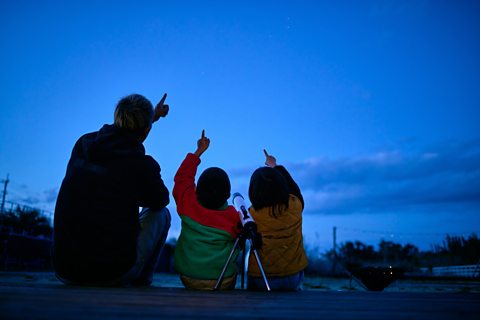
Alignment of 6 planets
A planet parade might sound like a dressing-up opportunity but it’s actually the term used to describe a number of planets all being visible in the night sky at the same time. It will be time to watch one such “parade” just after sunset on 28 February 2026 when six of the planets in our solar system will line up.
Four of them - Jupiter, Saturn, Venus and Mercury - will be visible to the naked eye. You’ll need binoculars or a small telescope to spot Uranus and Neptune.
The end of the year will see another alignment, this time with Mars, Jupiter, Uranus, Saturn and Neptune visible around 10pm each evening. The planet parade is expected to be particularly stunning on 25-26 December.
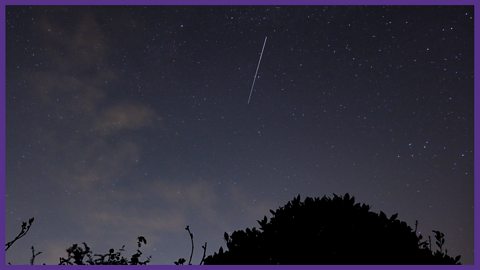
The International Space Station is also visible in the night skies
Supermoons
There will be three supermoons in the UK in 2026 - when it looks far bigger and brighter than usual. This is caused by the moon being at its closest point to Earth, rather than it actually growing larger, and it appears at its most dramatic at sunset when it is low on the horizon.
The first supermoon will take place on the evening of 3 January, when it will be alongside Jupiter. It’s traditionally known as the “wolf moon” as winter is the season when wolves howl the loudest.
Next comes the “beaver” or “frost” moon, and it’s a long wait - all the way to 25 November. Finally, on 23 December 2026, the moon will be at its closest all year. Known as the “cold moon”, it will be visible alongside Jupiter and Saturn.
Meteor showers
Is there something you really want to happen in 2026? Well, there are many meteor showers coming up so get ready to wish upon a “shooting star”. It starts with a biggie - the Quarantids, which peak right at the beginning of the year on January 3-4. It is one of the strongest meteor showers, with up to 120 per hour on a clear night.
In the summer will be the Perseids, one of the better known meteor showers made of debris from the comet Swift-Tuttle that breaks up as the Earth slams into it on its turn around the sun. As well as around 50 to 100 meteors per hour, they also feature fireballs that explode for longer and tend to be brighter than a meteor.
As there will be a new moon around the Perseids’ peak, the sky will be darker and better for spotting the shower. Look out for them from 12am to 5.30am from 17 July to 24 August - the peak will be around 13 August.
To get the best views, find a dark spot away from lights on a clear night and give yourself 15 minutes for your eyes to adjust. There’s no need to use binoculars or a telescope and in fact these limit how much of the sky you can see.
Venus and Jupiter will be visible together
Venus and Jupiter will appear to be just a finger’s distance apart on the evenings of 8-9 June - with Mercury also visible nearby.
You can read about the planets in our solar system in this Bitesize guide.
Total solar eclipse
Sadly you’ll have to travel to appreciate one of the most breathtaking celestial events of 2026 - a total solar eclipse. On 12 August 2026, the moon will block the view of the sun from Earth, causing the sky to go dark.
If you happen to be in Greenland, Iceland, Portugal or northern Spain at the time, then you will need to protect your eyes with a special solar viewer while looking at the eclipse, except for the brief time when the sun is entirely covered by the moon.
Meanwhile, scientists will be studying the outer part of the sun’s atmosphere, called the “corona”, which is usually too faint to make out.
Lunar eclipse
On 3 March, it will be the Earth’s turn to pass in front of the sun, casting the moon in shadow. People in the UK will miss out on witnessing 2026’s total lunar eclipse with their own eyes as it will only be visible in parts of North America, Asia and Australia. However, we will get to experience a partial lunar eclipse on 28 August.
Unlike a solar eclipse, you don’t have to shield your eyes when looking at them - they never get brighter than a full moon, which we look at all the time. Because of the way the Earth’s shadow makes the moon appear reddish, they are often also known as “blood moons”.
More powerful Northern Lights
These colourful waves of light are expected to be particularly strong in 2026 due to an increase in the solar storms that cause them. In the Northern Hemisphere, there are often more powerful auroras, as they are also called, thought to be due to the tilt of the Earth.
Around the Spring Equinox on 20 March would be a good time to look out for them.
Check the viewing potential where you live at BBC Weather.
Learn more about the Northern Lights, what they are and when to see them
This article was published in December 2025

Bitesize Parenting
Fun activities, real-life stories, wellbeing support and loads of helpful advice - we're here for you and your child.

How to turn a walk in the park into a colourful craft activity
Parents can make a walk in the countryside or the park into a fun art, craft and leisure activity for their children

Seven ways to get your kids outdoors
Getting your teens out of the house and into nature can boost their health and wellbeing. Tips on how to do it from parents who are outdoors enthusiasts.

How to catch a meteor shower
You might think spotting a shooting star is pure luck, but there is a way to predict when a meteor shower might hit.
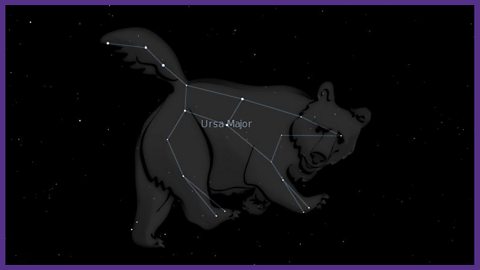
How to spot constellations and asterisms
Bitesize Parents' Toolkit
Free family days out and events to enjoy this winter
Here are some great ideas for things to do wherever you live in England, Scotland, Wales or Northern Ireland - and they're all free