The festive season may be packed with traditions, but Christmas is also an occasion that changes with the times.
It could be down to world events, advances in technology, or simply popular additions to the celebrations that never went away. BBC Bitesize looks at how Christmas has evolved over the past 200 years.

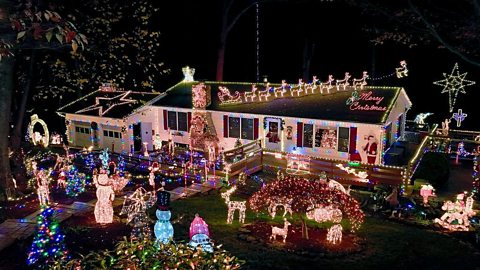
Christmas decorations: From kissing boughs to electric wonderlands
By the 1820s, Christmas was poised to become more like the holiday we know today. In less than 20 years, Queen Victoria would be on the throne, and customs such as Christmas cards and crackers would become more commonplace.
However, the 1820s weren't a festive-free zone. In the Georgian era, kissing boughs were a popular way to make homes look more special for 25 December.
These were a pair of hoops, crossed to make a spherical shape, then decorated with items such as holly, ivy, paper roses and fruit. If a gentleman picked a berry from the bough, he could ask to kiss a lady on the cheek. The tradition of kissing beneath the mistletoe also originated in Georgian times.
By the 1920s, the Christmas tree was a firm December favourite. Its popularity soared after Queen Victoria, Prince Albert and their children featured in a magazine illustration in 1848 enjoying the decorated tree imported from the Prince’s German homeland, although they had been around in wealthy homes since the beginning of the 19th Century.
The first artificial tree was set to hit the market in 1930. It was also around the 1920s that mass-produced advent calendars - with opening doors - became available.
Today, electric lights are more plentiful and complex, but trees, mistletoe and advent calendars are all traditions which have firmly stuck.
Christmas presents: How wooden toys have made a comeback

Kids have dreamed about gifts in the run up to Christmas for centuries, although not all would wake up to toys on 25 December. For many, fruit was the typical treat.
Historian Debby Brown notes that in the 1820s, if a child did receive toys, it wasn’t in huge quantities. She told Bitesize: “A child would not expect to have more than one, or a very few, items as presents.”
Dolls’ houses, or model rooms for dolls, were popular in this era. At the time, they had an educational purpose, preparing girls for a life running a household.
As horses were a major form of transport, toys often included hobby horses and toy horse and carts. Move forward 100 years, and these were replaced by tin and clockwork trains, aeroplanes and cars.
By the 1920s, cartoon heroes such as Felix the Cat, and newspaper comic strip favourites Pip, Squeak and Wilfred had their own annuals and other merchandise, including lead figurines. In the immediate aftermath of World War One, toys with a military theme remained popular.
In the 2020s, technology may have marched even further, but similarities remain. Bicycles are still up there, with one estimate suggesting UK sales will pass £1bn by 2023.
Some companies are also cutting down on single-use plastic and boosting sustainability. There has been a revival in wooden toys - take a bow, 1820s - and it’s now possible to buy teddy bears made from recycled water bottles and modelling clay that uses plant-based colours and compostable glitter.
Christmas food: Why do we have turkey at Christmas?
If you were wealthy in the 1820s, Christmas was a good chance to prove this by hosting a dinner full of fresh produce. Beef was the dish most likely served at Christmas dinner, followed by a portion of plum pudding.
Food historian Dr Annie Gray wrote in her book At Christmas We Feast: “It wasn’t unique to Christmas, but served, along with plum pudding, at any celebration which needed a bit of patriotic yen.
"Beef was symbolic of Britishness.”
One hundred years later, goose and turkey were among the affordable meats served up in working class households on 25 December. The only issue was roasting such large birds at home. Poultry was tricky to cook on an open fire and, right up until the 1960s, some bakeries would open on Christmas morning to allow people to roast their festive birds in their ovens.
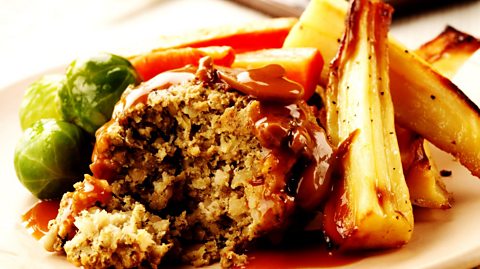
Today, turkey remains popular but vegetarian and vegan options are many and varied (although it’s worth bearing in mind that The Vegetarian Society dates back to 1847, so a meat-free Christmas dinner is not a completely new concept).
BBC Food has a selection of vegan main meal recipes to choose from, and also some vegetarian options.
This article was first published in December 2021 and updated in December 2025.
What Christmas is like in space with Tim Peake
To mark the tenth anniversary of his space mission, Tim tells us about the Christmas Day he spent 250 miles above the Earth


Test your TV knowledge with the ultimate Christmas adverts quiz
How well do you know your big budget, memorable Christmas adverts from through the years?
