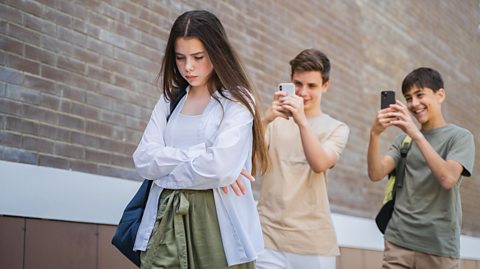
EastEnders viewers are going through a tough watch right now.
The character Joel Marshall, a secondary school student, has become more influenced by misogynistic content - showing prejudice against women - which he sees online. It's a storyline that will have a negative impact on other residents of Albert Square.
But it’s not just Joel who is falling for the misogyny posted on social media. Sixty-nine per cent of boys between the age of 11 and 14 have been served content that’s negative about women and girls, without having searched for it. That's according to Professor Harriet Over, a psychologist at York University, speaking as part of the new BBC Three documentary EastEnders Investigates: The Manosphere. It explores the real-life issues behind the story, where young teenagers are being exposed to this online hate, even if they haven’t sought it out in the first place.
So why is this happening? BBC Bitesize Other Side of the Story took a look at the stats behind the disturbing messages, and the experts working to stop them.
Why is there so much misogyny online?
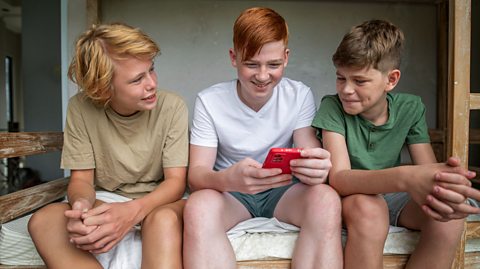
As part of the documentary, Prof Over - who studies online misogyny - spoke to EastEnders cast member Diane Parish (Denise Fox) about the extremists who try to spread the idea that men are superior to women.
Prof Over said: “A lot of [their talk] is creating this idea that women are the villains, that anything boys are experiencing in their life that might be difficult can be blamed on women. I think often they’re targeting boys at an extremely vulnerable stage, just when they’re about to start dating or want to start dating for the first time.”
How are teenage boys seeing misogyny online?
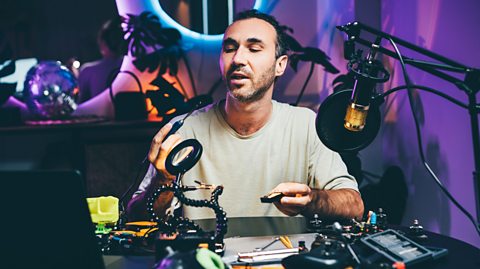
Author Laura Bates is a campaigner for gender equality. She spoke to the BBC’s Amol Rajan on his podcast Radical about the ongoing fight to make the online world a safer place.
Laura explained how new studies show that aggressive attitudes towards women are coming from the youngest people questioned. It’s the first time this has happened, and one of the reasons given is that children accessing social media sites are being served extreme content by algorithms.
An algorithm is a computer program operated by the company that owns the app or website you are using. It uses information about the posts you most engage with, watch, like and share to then suggest more of the same or similar content to you. A feed is personal and everyone's is different - all based on the information the algorithm takes.
This can create something called a filter bubble, where we only see posts connected to our interests, from people we share opinions with, and not from those we may disagree with. This can restrict your view of the world, where you are not taking other viewpoints into account. Fake news can go viral in a filter bubble, as people share it.
Prof Over also mentioned the thinking - which has yet to be confirmed - that content about gaming, fitness or self-help, along with other examples, are ‘gateways’ introducing an audience to increasingly extreme content. The misogyny spread online is an example of disinformation and it's always worth checking the facts behind the claims being made in them.
Laura added: “If you are a teenage boy today and you set up a TikTok account, you tell it you’re a teenage boy and it is, on average, less than half an hour before a piece of severely misogynistic content is served into your feed.”
TikTok has responded by saying they don’t allow misogyny on their platform and through their own initiative, they find 93% of the content that is then removed for breaking rules on spreading hate. They also said the report Laura used: “does not reflect how real people experience TikTok.”
What is the YouTube algorithm?
Laura said that YouTube is a primary news source for many children.
The video-sharing platform has more than two billion daily users and 70% of what people watch isn’t what they searched for - it is content that has been recommended to them.
Laura added: “YouTube accounts for 37% of all global download traffic. If you put those two stats together, 70% of 37%, about a quarter of all global download traffic is accounted for by that one algorithm… people [are] watching just what that algorithm has told them to watch.”
You can influence what you see on your feed by following accounts that have a different viewpoint to yours, even if you may disagree with them. Engage with posts from reputable organisations and experts that give a wider view of the world. Talk to people offline too - having a conversation or good-natured debate with different people from different viewpoints is another way of experiencing different opinions.
If you do find content that makes misogynistic claims, there are things you can do to check the story out. Think critically about what somebody is saying and approach the story as a journalist would.
BBC Bitesize's World of Wellbeing podcast took a closer look at toxic masculinity - and how boys and young men can feel a need to be 'tough' and 'in control' in a negative way. Listen to it here.
This article was published in October 2025

Not sure if the news you’re seeing on social media is true or false? Can you always tell if the things you see online are real or fake? Learn how to get the other side of the story with our quizzes, videos and explainers.
The monthly AI or Real quiz: September 2025
Can you tell the real images from the ones created using AI in this month’s special edition quiz?
Super Bowl half-time show: Headliner rumours and Bad Bunny backlash
Adele and Taylor Swift were rumoured - but it's not them