Where will you be spending Christmas this year? Whether you celebrate the festivities or not, the holiday is often a great time to catch up with family and friends.
But for those of us that are working, or away from home, it can often take a bit more planning and preparation to make it feel special.
As Tim Peake celebrates the tenth anniversary of his space mission, BBC Bitesize asked him about that Christmas Day in 2015, he spent 250 miles above the Earth.

Christmas Day in space
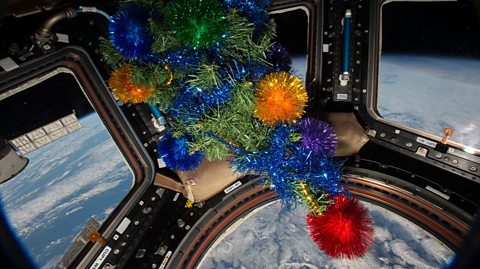 Image source, NASA
“There was no such thing as a day off in space, there was always something to be done, but it is what they would call a day off," Tim explains. "We had a few decorations up, some Christmas stockings and a tiny Christmas tree, little Christmas hats that we wore when we had dinner.”
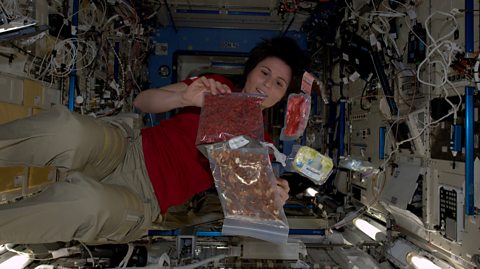
“Most of the food is normally pretty bland standard NASA food, but we're allowed to take 10% of our own food within the allowance," says Tim. "One of the Christmas treats I took up was whiskey fudge. It wasn't alcoholic but it was lovely.”
Tim’s actual Christmas meal had been designed by children as part of a create a menu for an astronaut competition, the winning ideas were then made by the children and chef Heston Blumental; “I had beef truffle stew, which was amazing. I was lucky because it was made by Heston.”
Marking the festive period with the crew also helped them connect back to Earth; “When you thought about how many people around the planet would be celebrating Christmas in their own way, with their own traditions and cultures, it was amazing to be orbiting the planet, looking down… It was a very special day.”
Tim's children could see the space station on Christmas Eve
Every now and again, the International Space Station or ISS passes over the UK, visible to the naked eye; “It was very fortuitous… that Christmas Eve we had one of the best space station passes over the UK - incredibly clear weather, very bright and at around 6pm. So it was prime time when so many kids were outside watching us go over.”
Tim believes a few festive fibs might have been told that night; “there were quite a few parents telling their children that might just have been Santa Claus in the sleigh going over.”
Pre-Christmas mission planning
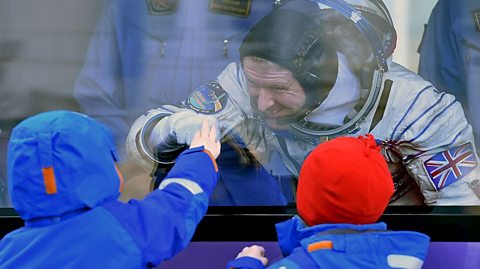
Tim and his fellow astronauts were kept in quarantine, away from family and friends for ten days before the launch, to ensure they were fit and healthy. The final stage of a long and busy training schedule.
So Tim had to do all his Christmas shopping in the summer, including for his two sons aged four and six at the time; “My wife, she came to the launch with our children in Kazakhstan, and then was flying to Scotland for Christmas, which is where her family lived. I bought some presents and left them there so they would be a surprise for them."
But Tim’s wife, Rebecca, was even more organised; “She had made this most wonderful calendar… that [she had arranged to be] launched into space about eight months earlier in order to go up on a cargo vehicle.” Tim explains that from his first day in space, December 15, “leading up to Christmas Eve, there were notes written from friends and family… It was all written on the old, very light, airmail paper that you could fly up into space. So that was just wonderful and very thoughtful for her to have arranged that.”
How to become an astronaut
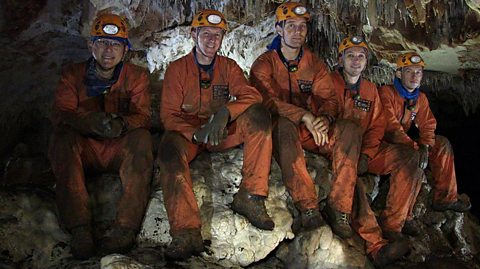 Image source, ESA
“It was a long journey between being selected and actually sitting on top of a rocket knowing that you're heading to space,” Tim explains. He was told he’d passed the selection process, but there was no guarantee of going in to space at that point. So when Tim was assigned to a mission, it became very real, “there was actually a seat with your name on it.”
That marked the start of two and a half years of intensive training that took Tim up to the moment of launch; “We did get involved in some crazy things during our training.” The objective was to give them all the skills that they needed to be able to work in a very high pressured environment, that also involved accepting some risk; “Because we ultimately had to go and sit on a rocket, fly to space and do a spacewalk, and that's incredibly high risk.”
One training exercise involved spending a week living down in a cave, in Sardinia; ”We were put under a lot of pressure: limited food, limited sleep, cold, wet and uncomfortable. The whole point was for you to get to know yourself, but also for you to get to know your colleagues and to learn about the Soft skills are usually self-taught and self-developed. They can include: communication, teamwork, problem solving, taking initiative that are so important.”
Astronauts need soft skills too…
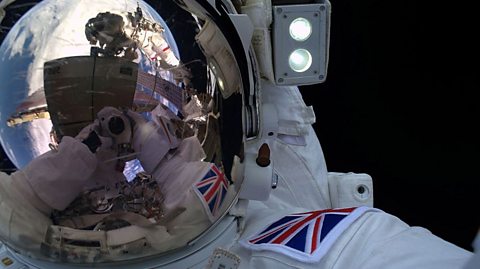 Image source, ESA
“We talked a lot about soft skills in space because, and this is what I talk a lot to kids about as well - school and academics are great. That will definitely help you get ahead in life. But… the academics is probably just the stuff that… gets you the interview,” Tim explained.
“What gets you the job is how you perform in the interview, and it's all about you as a person. Your character, your personality, your ability to communicate with people, to work in a team.
And this is the kind of stuff that you learn as a child, whether it's in Guides or Scouts or doing music and drama class or whatever it is outside the classroom.”
“For us as astronauts, we had to take that one step further”, Tim said. “So going into a cave, or we spent 12 days underwater on a simulated mission to an asteroid… we were pushing ourselves out of our comfort zone. We were learning about risk, about ourselves, and developing those soft skills.”
10 years since Tim blasted off into space
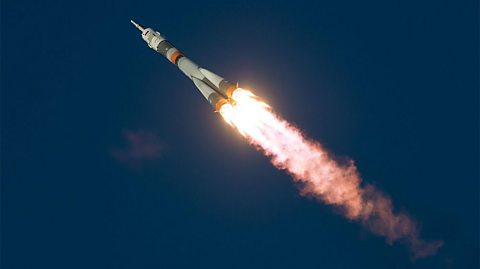
To mark ten years since Tim began his six month space mission, he is hosting a live lesson at the Science Museum in London, which teachers and schools can sign up for.
It is important to Tim to keep sharing his experiences and love of STEM stands for science, technology, engineering and mathematics with young people; ”Science and technology are going to provide us with so many solutions to the problems that we face today. We need really bright young minds to get excited and interested in the world around them in science and tech. More so now than ever because my children are growing up, as all children are today, surrounded by technology.”
“Introducing young people to science, to technology, to engineering, and showing them how it controls our everyday life and how it can be used for the benefit of so many people is really, really important. And that's something we tried to do with my mission, we reached 2 million school children during that six month mission to space.”
Tim Peake live lesson: Celebrating 10 years since blast off, Monday 15 December 2015 @10.20-11.05
Schools across the UK are invited to celebrate the 10th anniversary of Tim Peake’s mission to the International Space Station by joining in a lesson with Tim. Broadcast live from the Science Museum, it will feature a mass paper rocket launch to mark the exact moment at 11.03 that Tim blasted off into space a decade ago.
This article was published in December 2025
The International Space Station at Christmas and how to look out for it
You can see the ISS with the naked eye! Here's what happens on the ISS at Xmas and how you can see it.

Astronaut Tim Peake's five favourite space films
For International Space Week 2025 Tim picks his fave films about space
Hot sauce and over 200 food options: What do astronauts really eat in space?
From christmas dinner to birthday cake, BBC Bitesize takes a look at the tasty treats astronauts have whilst they are floating around in space