For many people, opening an Advent calendar marks the start of the festive period, with the countdown to Christmas officially starting once you devour the tasty treat behind door number one.
An estimated 16 million Advent calendars are sold each year in the UK, but where did Advent calendars originate from, and what is the history of Advent? Lets open the door and discover the secrets behind Advent calendars.

What is an Advent calendar?
Advent calendars usually come in the form of a box, often made from cardboard, with a plastic inner – although you can now get eco-friendly calendars. Traditional calendars have 24 doors, ending on Christmas Eve, whilst some modern calendars will have 25 doors, with the last door opened on Christmas Day. Inside the doors you typically find chocolate, but some have festive pictures. Brands have recently cottoned onto the popularity of Advent calendars and some now contain all manner of things, from luxury goods like perfume, to flavoured tea, Lego figures and hand-dyed yarn.
What is Advent?
The Advent season is celebrated by many Christians around the world and is a four week period leading up to the birth in the Bible of Jesus Christ. The word 'Advent' comes from the Latin 'adventus' which means a 'coming' or 'arrival'. Traditionally, some Christians will light a candle on an Advent wreath for four weeks starting from the closest Sunday to 30 November. Each candle that is lit has a theme to help encourage prayer and reflection, the themes include hope, peace, joy and love. However, some Christian denominations have different themes, and some don't celebrate Advent at all.

Where do Advent calendars originate from?
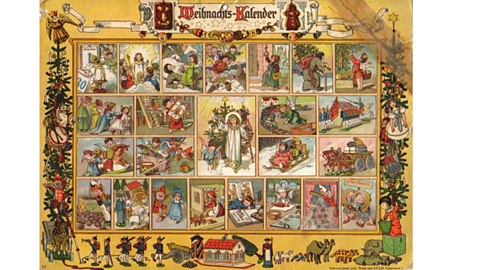
Like many of our modern Christmas traditions such as Christmas trees and Christmas markets, Advent calendars are thought to originate from Germany. Back in the 19th century German Lutherans celebrated the Advent period by marking chalk lines on doors, which were rubbed out each day. They also lit candles to count down the days until 24 December.
The German Christmas Museum states that there was evidence of a type of Advent calendar in a children’s book by Elise Averdieck dated 1851, but it was in 1908 that a German printer called Gerhard Lang created what is thought to be the first commercial Advent calendar. It was made from paper or card, with playful tear-off designs of paper images for children to stick on a backdrop.
These calendars were popular in Germany until the outbreak of World War 2, when paper and cardboard rationing, along with a Nazi ban on picture calendars, forced Lang's business to close; the Nazis instead produced a propaganda filled pamphlet to mark the festive period.
After the war finished, another German publisher called Richard Sellmer successfully applied for a license from the American occupation authority to start printing calendars. Sellmer initially printed fifty thousand calendars, which became popular with American servicemen in Germany. Sellmer went on to make international versions of his Advent calenders, which featured American traditions in the design such as Santa standing near a fireplace. In 1953, US President Dwight D. Eisenhower and his family were pictured in Newsweek with a Sellmer calendar, and the German tradition soon took off in America.
When did chocolate Advent calendars originate?
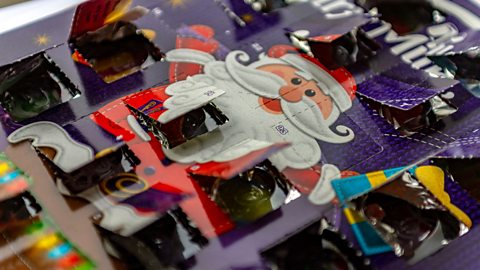
The first chocolate Advent calendars are thought to have been produced in the 1950s, but it wasn't until 1971 that chocolate giant Cadbury joined the Christmas-party and made their own calendars.
Cadbury produced chocolate Advent calendars intermittently for the next 32 years until 1993, when they put their Christmas countdowns into continuous production, making Advent calendars each year since. Chocolate and Advent calendars are now synonymous with each other and its hard to imagine a time when the two things didn't co-exist!
This article was published in December 2025.
The bumper Christmas telly quiz
Festive TV treats are a big part of Christmas each year, but how much do you know about the seasonal specials?

Christmas stress: What festive classic could you do without?
BBC Bitesize asked young people what they found most stressful about Christmas. Do you agree with them?

Trivia to impress your loved ones at the Christmas table
Level up your Christmas table chat with four impressive festive facts.